
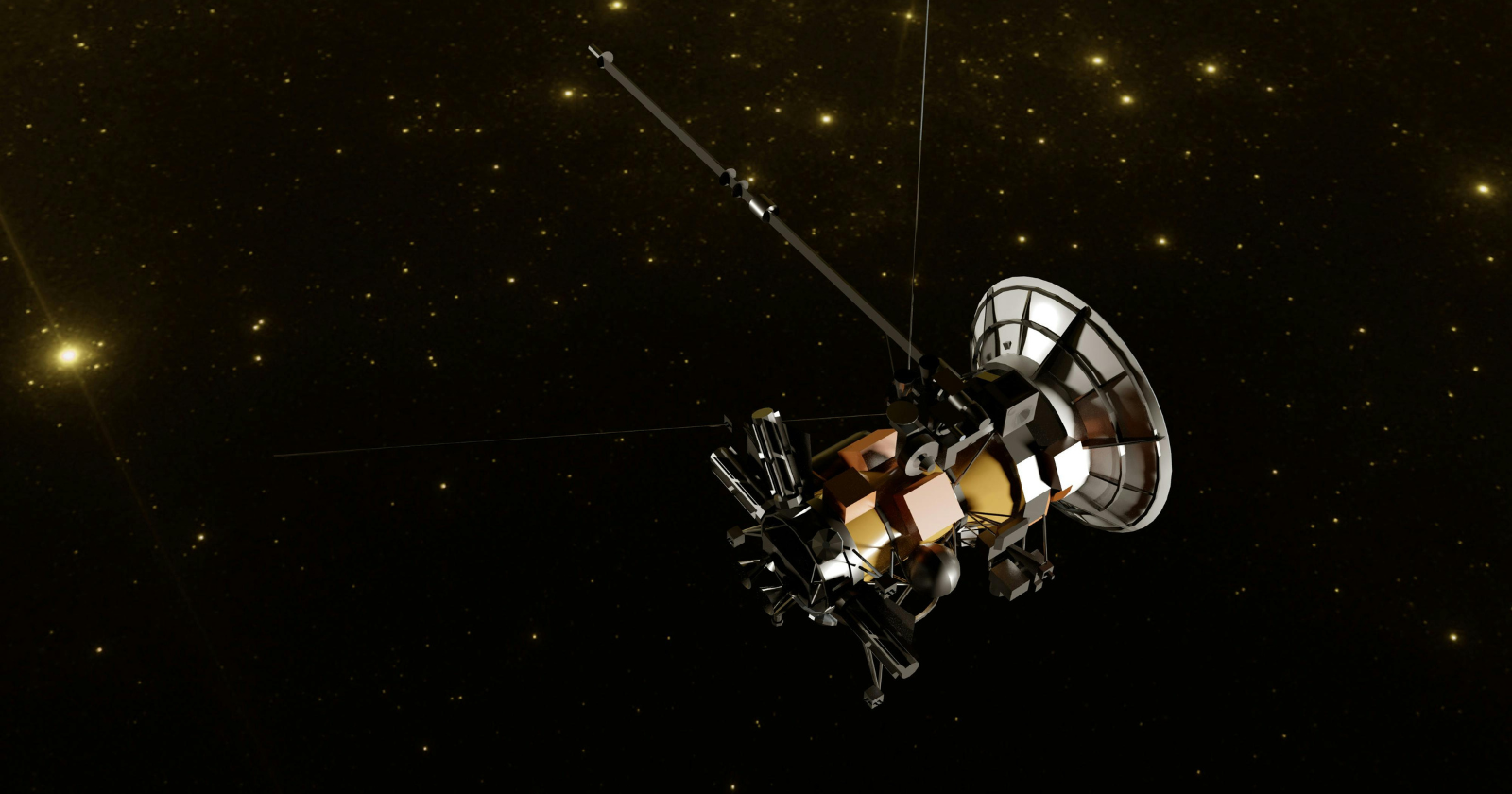
Bolted to the side of Pioneer 10 is a gold-anodised aluminium plaque, about 152 by 229 millimetres, engraved with the figures of a man and a woman and a set of symbols meant to mark where and when the spacecraft came from. The craft that carries it has been silent for more than two decades. It is still moving, coasting outward beyond the planets on a path that points in the general direction of the star Aldebaran, in Taurus.
The message was not NASA’s idea, or even Carl Sagan’s. As the Smithsonian National Air and Space Museum recounts, the science writer Eric Burgess suggested during the mission’s planning that Pioneer should carry a greeting to any civilisation that found it. Sagan took up the idea, designed the plaque with Frank Drake, and had the human figures drawn by Linda Salzman Sagan. Its best-known feature is not the figures but the diagram beside them: a radial pattern showing the Sun’s position relative to fourteen pulsars, each line marked in binary with that pulsar’s frequency. The idea was that any finder able to identify those pulsars could triangulate the Sun’s location, and read the frequencies as a rough timestamp, since pulsars slow at known rates. It is a map home, and also a clock.
How the spacecraft went quiet
Pioneer 10 launched on 2 March 1972 and became the first spacecraft to cross the main asteroid belt and the first to fly past Jupiter, which it reached in December 1973. Its routine science mission ended on 31 March 1997. After that, NASA kept tracking its weakening signal as a test of deep-space communication.
The power was the limit. Pioneer 10 ran on radioisotope thermoelectric generators, which produce less electricity as their plutonium decays. According to NASA’s account, the last telemetry came back on 27 April 2002, and the final faint signal, carrying no data, was detected on 23 January 2003. A contact attempt on 7 February 2003 found nothing, and a last try in March 2006 also failed. The spacecraft did not break or crash. Its RTGs had likely fallen below the power needed to keep the transmitter operating.
The Aldebaran figure, and what it actually means
The line repeated in most accounts is that Pioneer 10 is heading for Aldebaran and will take about two million years to get there. NASA uses the same framing, putting Aldebaran at roughly 68 light-years away and the trip at more than two million years.
Two qualifications matter. The first is that the two-million-year figure assumes Aldebaran stays put. It does not. The number is calculated as if the star had zero velocity relative to the spacecraft, which is a convenient simplification rather than a prediction. Over two million years both the star and Pioneer 10 will have moved, so the figure describes the crossing time to Aldebaran’s current position, not a genuine rendezvous.
The second is that “heading for” overstates the aim. Pioneer 10 is drifting in the broad direction of Aldebaran, not on course to reach it. Nothing is steering. The plaque and the trajectory have become a single object now, a labelled probe on a fixed coast, and the star is a marker on the horizon rather than a destination.
Why the message is more durable than the machine
The spacecraft itself may not remain recognisable forever. Across millions of years of travel, micrometeoroid impacts and cosmic-ray erosion will slowly wear at the structure. The plaque was mounted on the antenna support struts partly to shield it from interstellar dust, and gold-anodised aluminium was chosen with durability in mind, but durability here is relative, and no one can say with confidence how legible it would be to a finder in the far future.
The more honest point is about audience. The plaque was never likely to be read by anyone. The nearest stars are light-years apart, the space between them is mostly empty, and the chance of any object the size of a car being intercepted is vanishingly small. Sagan understood this. The plaque worked at least as well as a message to the people who made it, a statement in 1972 that a species capable of building the probe was also capable of imagining who might one day find it.
Where it is now
Pioneer 10 is no longer the most distant human-made object. Voyager 1 passed it on 17 February 1998, at a distance of about 69 astronomical units, and has remained farther out since. Pioneer 10 continues outward regardless, unpowered and untracked, likely somewhere around 140 astronomical units from the Sun by now depending on how the estimate is framed, and receding by roughly 2.5 astronomical units a year. Without a signal, that position is inferred from its trajectory rather than measured.
There is nothing left to wait for from it, no next contact and no milestone NASA is tracking. What remains is a quiet piece of bookkeeping: a 1972 spacecraft, its last word logged in January 2003, still carrying a map of where it came from on a path that points, for now, at a red star in Taurus.
