
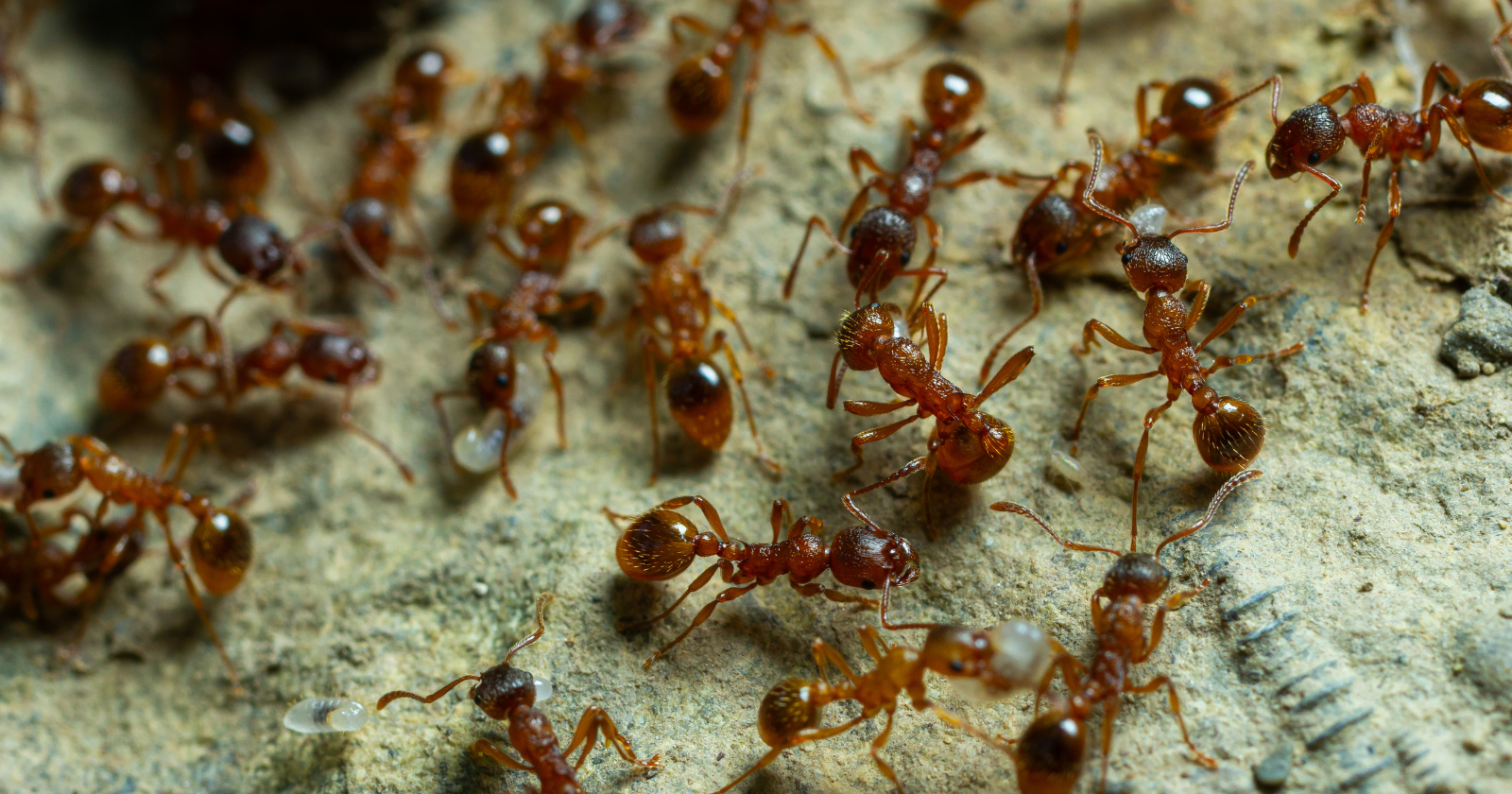
The 2022 paper that established the modern estimate of how many ants are alive on Earth was published in the Proceedings of the National Academy of Sciences by Patrick Schultheiss, Sabine Nooten and colleagues. The work was conducted at the University of Hong Kong, with the two lead authors now based at the University of Würzburg in Germany. According to the team’s analysis of 489 separate studies of ant abundance across every continent and major biome, the population at any given moment is approximately 20 quadrillion individuals, written 2 × 10¹⁶. That works out to roughly 2.5 million ants for every human on Earth. The figure is a conservative estimate; the authors note in the paper that subterranean ants and ants in northern Asia and central Africa are inadequately sampled and that the true number is likely higher.
The number, large as it is, comes with a smaller and more contested figure for total biomass. The popular claim, repeated for decades in science journalism and natural-history writing, is that all the ants on Earth together weigh roughly as much as all the humans. The 2022 paper updates this claim, and the update goes in one direction.
How much the ants actually weigh
The Schultheiss group’s estimate of total ant biomass is 12 megatons of dry carbon, written 12 Mt C. Earlier estimates, from papers in 2009 and 2014, had given figures as high as 70 to 100 megatons of carbon. These higher numbers were the source of the famous “ants weigh as much as humans” comparison. According to a 2022 commentary in PNAS by Tom Fayle and Petr Klimes, which appeared alongside the Schultheiss paper as part of the peer-reviewed response to the new estimate, the more rigorous 2022 count puts global ant biomass at about one-fifth that of humans. The earlier comparison, in other words, was based on biomass figures that the new methodology has corrected downward by a factor of five to eight.
Even at the new figure, the ants are still doing extraordinarily well by any biological measure. According to a piece co-written by the study’s authors and published via The Conversation, the 12-megaton figure exceeds the combined biomass of all wild birds and all wild mammals on Earth put together. Wild bird biomass is estimated at about 2 megatons of carbon; wild mammal biomass at about 7 megatons. The ants alone outweigh both groups combined by a margin of roughly a third. To put the figures in their full biospheric context, the 2018 PNAS census of global biomass by Yinon Bar-On, Rob Phillips and Ron Milo found that plants account for around 450 gigatons of carbon (mostly wild terrestrial plants), bacteria for around 70 gigatons, and all animals combined for only about 2 gigatons. Humans and livestock together now outweigh all wild mammals combined by more than an order of magnitude, but the planet’s biomass overall remains dominated, by a wide margin, by wild plants and bacteria.
How the count was done
The methodology is worth describing, because the count of 20 quadrillion ants is the kind of figure that sounds invented and is in fact carefully derived. The Schultheiss team integrated data from two standard ant-sampling techniques used by ant ecologists around the world. The first is leaf-litter sampling, in which a measured area of leaf litter is collected, sifted, and all the ants in it are counted. The second is pitfall trapping, in which small cups are buried flush with the ground for a measured period of time and the ants that fall in are counted. Each method has limitations; pitfall trapping measures activity density rather than absolute abundance, and leaf-litter sampling misses arboreal and subterranean ants. The team combined the two methods, corrected for what neither could detect, and extrapolated by biome to a global figure.
The figure they reached, approximately 20 × 10¹⁵ ants, is described in the paper as conservative. The combined biomass estimate of 12 megatons of dry carbon corresponds to roughly 24 megatons if other bodily elements besides carbon are included. The team also found that ant density varies enormously by biome. Tropical moist forests and tropical savannahs carry the highest ant densities. Polar regions essentially carry none. The ants are extreme generalists across the rest of the planet’s land surfaces.
Why this matters beyond the headline number
The “20 quadrillion” figure has a practical use beyond being a piece of natural-history trivia. It establishes a baseline against which future surveys can measure changes in global insect abundance. The wider literature on insect decline, much of which has focused on European and North American populations of flying insects, has not previously had a robust global baseline for one of the most ecologically important insect groups. The Schultheiss paper provides that baseline, with explicit confidence intervals, for ants specifically. According to Mongabay’s account of the research, the authors regard the establishment of a comparable benchmark as one of the paper’s most useful contributions to future climate and biodiversity research.
Ants do disproportionate ecological work for their biomass. The biologist E.O. Wilson, whose career was largely devoted to ants and who died in 2021, famously called insects and other invertebrates “the little things that run the world.” Ants are the principal agents of seed dispersal for thousands of plant species, aerate soils on a scale that rivals earthworms, and recycle organic matter in tropical forests on a faster timescale than fungi alone could manage. The 12-megaton figure understates their ecological footprint, because ant impact on ecosystems is not strictly proportional to their mass.
The honest version of the famous fact is therefore that ants are extraordinarily numerous and extraordinarily important, that they outweigh every wild vertebrate group on land combined, and that they are best described as the dominant terrestrial animal life on Earth by abundance. The specific claim that they weigh as much as humans, however, is no longer the best estimate. The current best figure puts them at roughly a fifth of the human biomass, even before livestock are factored in. The number that has replaced it, 2.5 million ants for every person, is doing the same rhetorical work in a different and more defensible way.
