
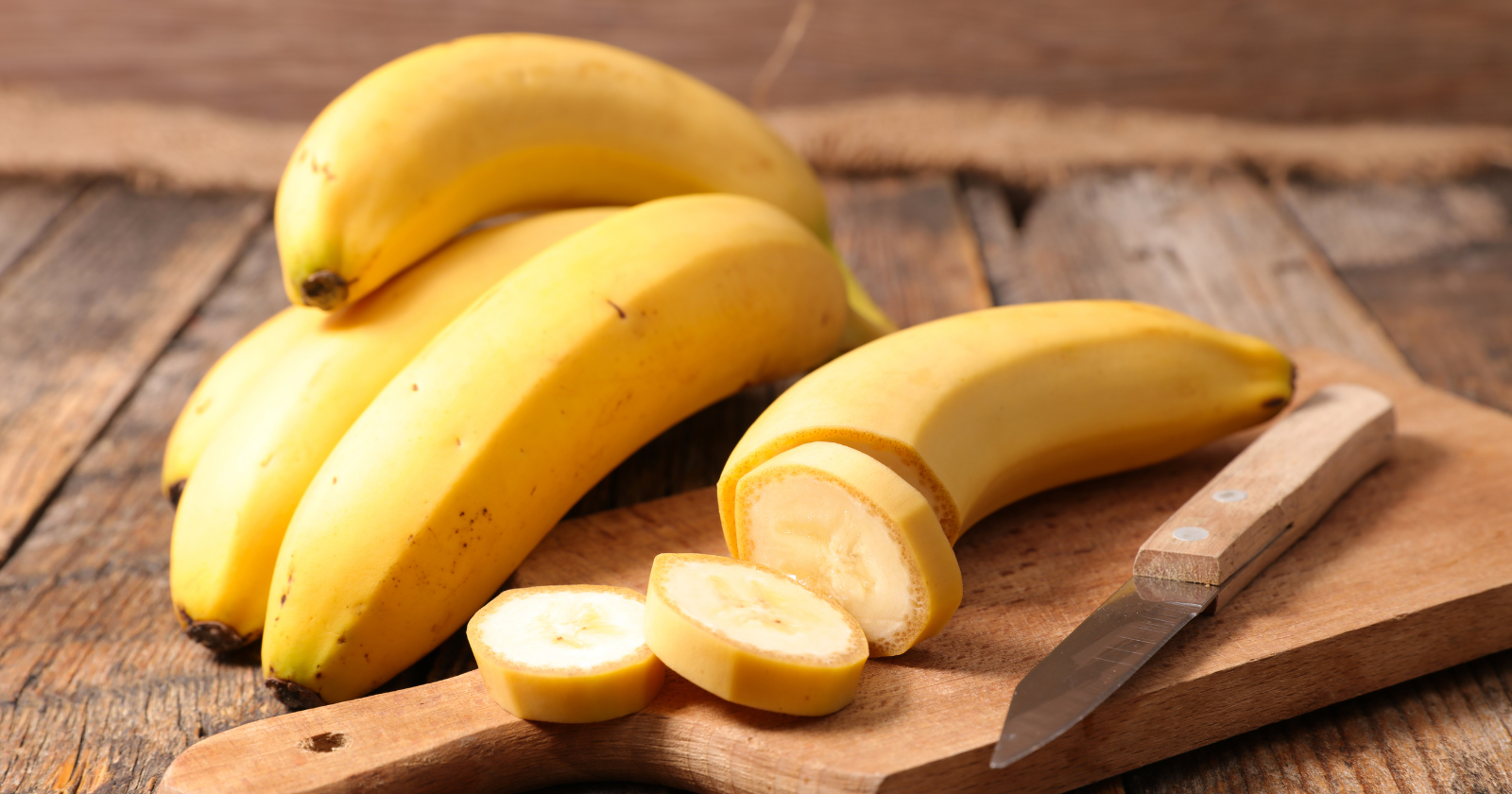
Bananas are slightly radioactive.
They are one of the most potassium-rich common foods, with about 0.5 grams of potassium in a typical 150-gram fruit, and 0.0117 percent of all naturally occurring potassium on Earth is the isotope potassium-40, which is radioactive. A medium banana therefore contains roughly 15 becquerels of radioactivity, meaning about 15 atoms decay every second somewhere inside it. The radiation dose delivered to a human who eats the banana is small but consistent enough to have become a popular unit of measurement in radiation safety education, called the banana equivalent dose, or BED. One BED is conventionally given as 0.1 microsieverts. A chest CT scan delivers roughly 70,000 BED. The metaphor is durable enough that nuclear-safety educators reach for it constantly. It is also more complicated than the simplified version suggests.
Where the unit came from
The banana equivalent dose was proposed in 1995 by Gary Mansfield, a scientist at Lawrence Livermore National Laboratory, in a post to the RadSafe mailing list, an online forum for radiation safety professionals. According to Versant Medical Physics and Radiation Safety’s account of the unit’s origin, Mansfield wrote that he had found the BED “very useful in attempting to explain infinitesimal doses (and corresponding infinitesimal risks) to members of the public.” The idea spread quickly through health-physics teaching and popular science journalism, and it has been a fixture of public communication about radiation ever since, including in news coverage of the Fukushima and Three Mile Island accidents.
The underlying physics is straightforward. Potassium-40 has a half-life of 1.25 billion years, decaying so slowly that a given atom is overwhelmingly likely to outlast the lifetime of any individual organism. About 89 percent of K-40 atoms beta-decay into calcium-40; the remaining 11 percent undergo electron capture to become argon-40, with a characteristic gamma-ray emission at 1.46 megaelectronvolts. The slow decay rate is what allows potassium-40 to persist on Earth from the time the planet formed, and the same slow decay rate is what makes the dose from any single banana tiny.
The complication
The complication, which most popular accounts skip, is that the radiation dose from eating a banana is not cumulative. The human body maintains its potassium levels under strict homeostatic control. A healthy adult contains roughly 140 grams of potassium at any given moment, and the kidneys excrete excess potassium in urine to keep that level constant. When a banana is eaten, the new potassium it contributes is absorbed and distributed through the body, but the body responds by excreting an equivalent amount of pre-existing potassium. The total potassium content of the body, and therefore the total potassium-40 content, returns to its baseline within a few hours.
This means the additional radiation dose from eating a banana lasts only as long as the body takes to re-establish potassium balance. The 0.1 microsievert figure, calculated using the US Environmental Protection Agency’s standard committed-dose model for ingested potassium-40, assumes a 30-day biological half-life. In practice, for routine dietary potassium intake, the half-life is more like a few hours, which would shrink the committed dose accordingly. The body’s baseline radioactivity from its existing 140 grams of potassium, including roughly 16 milligrams of potassium-40, is about 4,400 becquerels of continuous internal decay. A banana adds another 15 becquerels for a few hours. The ratio is essentially imperceptible.
What health physicists actually say
Some radiation safety professionals find the banana equivalent dose actively misleading. Geoff Meggitt, a retired health physicist, former editor of the Journal of Radiological Protection, and former scientist at the UK Atomic Energy Authority, set out the case against the BED in a 2010 interview with the science journalist Maggie Koerth-Baker for Boing Boing, which has become the canonical popular reference for the critique. Meggitt, who is also the author of Taming the Rays, a history of radiation and protection, told Koerth-Baker that “the potassium content of our bodies seems to be under homeostatic control. When you eat a banana, your body’s level of Potassium-40 doesn’t increase. You just get rid of some excess Potassium-40. The net dose of a banana is zero.” His broader argument is that the BED gives the impression of a cumulative comparison when in fact no such accumulation occurs. Comparing a CT scan to “70,000 bananas” implies the bananas, if eaten, would add up to a CT scan’s worth of radiation. They would not. The CT scan delivers its dose all at once and the dose stays delivered. The bananas deliver theirs and the body resets within hours.
The UK radiation safety consultancy Ionactive, in its own teaching materials, is direct about the same limitation. The BED “does not deliver a committed effective dose at all,” the consultancy notes, because “the radiation dose from eating a banana is not cumulative since the body regulates potassium (and therefore K-40) by a process called homeostasis.” Ionactive’s broader assessment is that the BED remains a useful risk comparator for training and reassurance, provided the user understands its pitfalls.
The honest version of the famous fact is therefore narrower than the popular telling. A banana really does deliver a small, measurable dose of ionizing radiation, primarily from potassium-40. The dose is real. The comparison to other radiation sources is useful for public communication. The caveat is that the banana dose is essentially transient while many other doses are not, and that distinction is the part the famous metaphor leaves out.
