
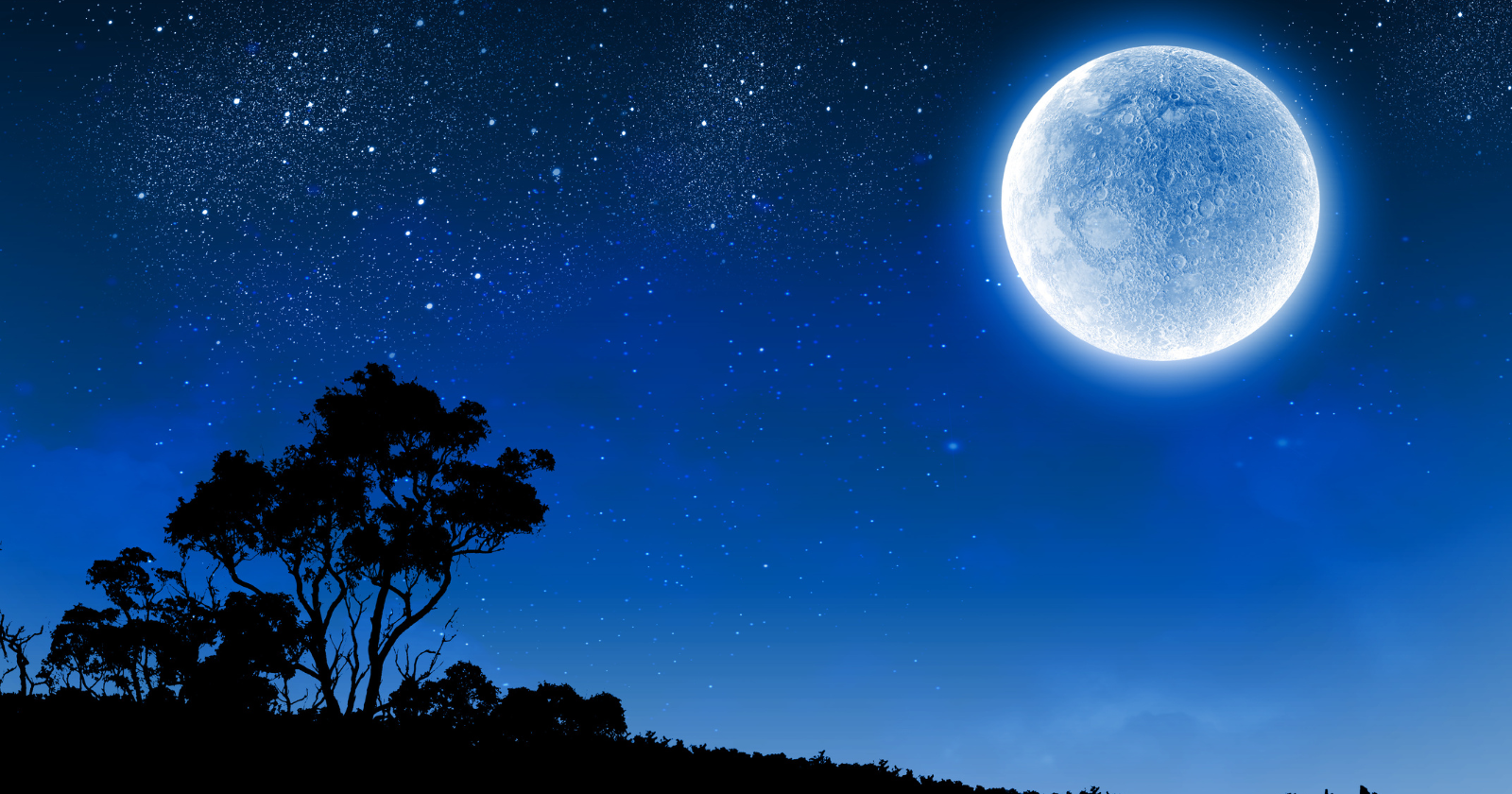
The Moon looks white in the night sky, sometimes silver, sometimes yellow or orange when it sits low on the horizon. The casual impression is of a bright object, possibly even of a slightly luminous one. That impression is wrong about the surface. The Moon’s average surface reflectance, the proportion of sunlight it scatters back into space, is about 10 to 12 percent. Most of the sunlight that strikes the Moon is absorbed rather than reflected. The actual colour of the lunar surface, when you take a piece of it down to a laboratory and look at it in ordinary light, is a dark grey close to the colour of an old asphalt road or a worn parking lot. The reason it appears so bright in the night sky comes down to a combination of factors, of which the surrounding background, the black emptiness of space, is the largest.
According to NASA’s official “Moonlight” reference page, written by Caela Barry of NASA’s Goddard Space Flight Center, only about one-tenth of the sunlight that hits the Moon is reflected back into space, compared with about three-tenths for Earth and well over half for Venus. The reason the Moon is so dark, despite being made of the same general kinds of material as the inner planets, is that much of its surface is volcanic basalt left behind by ancient lava flows. NASA’s reference page draws an explicit parallel between the lunar surface and the dark volcanic rocks found near volcanoes on Earth, including the slopes of Kilauea in Hawaii. These dark-coloured materials absorb most of the visible light that reaches them, which is precisely what defines a low-albedo surface.
What albedo actually measures
Albedo is the fraction of incoming light that a surface reflects, expressed as a number between 0 and 1. A surface with an albedo of 0 absorbs everything; a surface with an albedo of 1 reflects everything. Fresh snow sits at about 0.8 to 0.9. Desert sand is around 0.4. Bare soil is around 0.17. Open ocean is around 0.06. Fresh asphalt, the dark black surface a new road has when it has just been laid, sits at about 0.04 to 0.10. Worn asphalt, the lighter grey colour of an older road surface after years of oxidation and tyre wear, sits at about 0.10 to 0.15. The Moon’s geometric albedo, the measure that most closely corresponds to perceived brightness, is 0.12. Worn asphalt is conventionally cited at the same figure. The two surfaces really do reflect roughly the same fraction of light.
If a section of lunar regolith were transplanted to a road in any city on Earth, it would look like a slightly unusual but unremarkable patch of grey pavement. Apollo astronauts who walked on the Moon described the surface colour as varying between charcoal grey, brownish grey, and almost black, depending on the angle of the Sun and which region they were in. The darker basaltic plains, known as the lunar maria (Latin for “seas,” because early astronomers mistook them for bodies of water), have albedos as low as 0.06. The brighter highlands, which appear lighter to the naked eye from Earth, have albedos closer to 0.18. The average across the visible disc lands at the parking-lot figure.
Why a dark surface looks bright
The human visual system does not measure absolute brightness. It measures contrast. A patch of grey paper held up against a black sheet of paper will appear far brighter than the same patch of grey held up against a sheet of white paper, even though the grey is reflecting exactly the same amount of light in both cases. The brain interprets brightness relative to the surrounding field. When the surrounding field is dark, even a moderately reflective surface registers as bright.
The night sky is the most extreme dark background available to a ground-based observer. With minimal atmospheric scattering, no other illuminated objects in the field of view, and a backdrop of effectively black space, the Moon’s 12 percent reflectance is competing against nearly zero. The contrast ratio is enormous. The full Moon’s apparent magnitude is roughly −12.7, which is about 400,000 times dimmer than direct sunlight but about 1,700 times brighter than Venus at its brightest. The Moon’s ranking among bright objects in the sky is the result of three things working together: its large angular size (about half a degree across), its proximity (an average of 384,000 kilometres from Earth), and the full unattenuated sunlight illuminating its surface. The surrounding dark sky then magnifies the perceptual impact of that combination.
NASA’s Moonlight page puts the proximity argument particularly cleanly. The Moon, despite being darker than Venus, dominates the Earth’s night sky because it is so much closer. Venus, at its closest approach, is roughly 100 times farther from Earth than the Moon is. The amount of reflected light reaching Earth depends not only on what fraction is reflected but on how far the light has to travel before reaching the observer’s eye. The Moon’s small albedo is more than compensated for by its near-Earth orbit.
What full moonlight is actually doing
A full Moon at zenith on a clear, moonless night provides enough illumination at the ground to read large-print text and to walk around outdoors without artificial light. Earth’s overall reflectance, by comparison, is roughly three times the Moon’s, which is why astronomers can study Earth’s albedo by measuring earthshine on the dark side of a crescent Moon. According to NASA’s Earth Observatory reference on earthshine, this technique has been used continuously since 1998 to track variations in how much sunlight the planet reflects. The Moon, sitting at a fixed average distance with a known albedo, has been used as a kind of natural mirror for measuring Earth’s own brightness.
The next-brightest astronomical object after the Moon, Venus at maximum brilliance, is roughly 8 magnitudes fainter than the full Moon, which corresponds to a brightness ratio of about 1,700 to 1. The reason the Moon outranks Venus so dramatically, despite Venus being a far more reflective object, is the same combination of factors that makes the Moon outrank everything else in the night sky after the Sun. Distance and angular size do the work that intrinsic brightness cannot.
The Moon’s role as a nighttime light source has been so consistent throughout human history that human dark-vision and biological rhythms are partly calibrated to it. Hunter-gatherer cultures hunted, travelled, and gathered by full moonlight. Pre-industrial cities sometimes scheduled markets and judicial proceedings around the lunar cycle. The Moon was never a particularly reflective object. It was simply the brightest thing available in a sky that, before electric light, was very dark indeed. The contrast did most of the work.
