
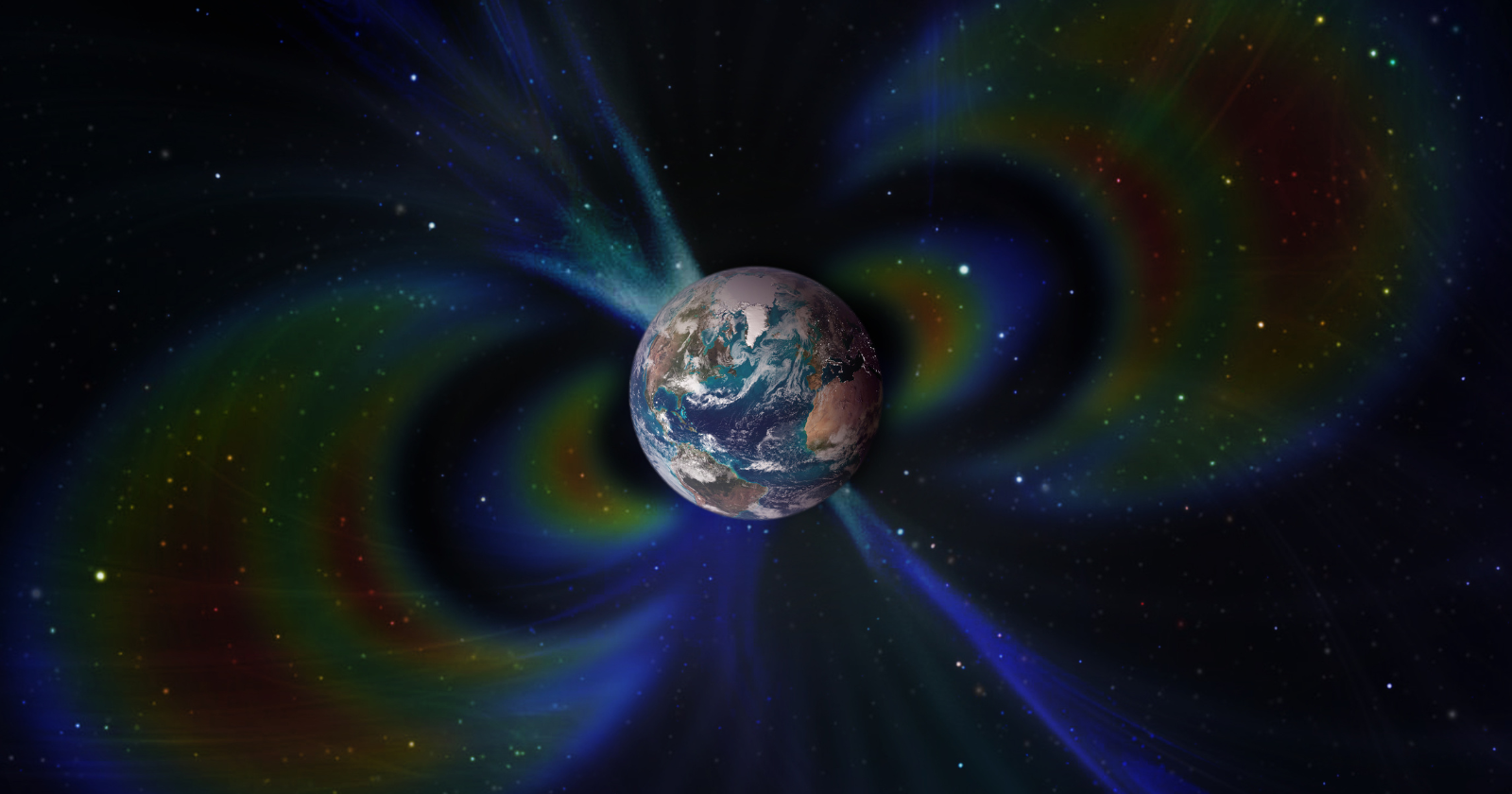
Magnetic reversals are real and common over geological time, but they do not run on a neat schedule. The switch is recorded in rock, and the fossil record shows no reversal ever wiping out life. It is one of those facts that sounds alarming and turns out to be reassuring once the detail is filled in.
The detail is worth filling in, because reversals attract more doomsday theory than almost any other ordinary geological process.
How the rock keeps the record
When molten rock cools, magnetic minerals inside it line up with Earth’s field and then lock in place as the rock solidifies, preserving the direction the field pointed at that moment. The same happens as sediments settle. Read enough of these frozen compass needles across the geological column and the pattern of past reversals emerges, including the striped magnetic bands on the seafloor that helped confirm plate tectonics in the 1960s.
From that record the numbers are firm. According to NASA, Earth’s magnetic poles have reversed 183 times in the last 83 million years, and at least several hundred times across the past 160 million. So “hundreds of times” is right, with the caveat that the count depends on how far back you reach.
No schedule, and a long current pause
The intervals between reversals are genuinely irregular. Depending on the slice of geological time used, the average comes out to a few hundred thousand years, but the average hides a wide spread, from tens of thousands of years to tens of millions. There is no clock.
The last full reversal, the Matuyama-Brunhes, happened about 780,000 years ago. That is more than twice the average gap, which is the kind of fact that gets turned into a headline about a reversal being overdue. It is not overdue in any meaningful sense, because the process is not periodic. An average is not a due date. A coin that has landed heads for a while is not owed a tail.
A flip is slow, and the field never vanishes
The word “flip” does most of the misleading work in the popular telling. It suggests something sudden, a single moment when the poles swap and a compass spins. The record shows nothing of the kind.
A reversal unfolds over a long span by human standards. Estimates for the Matuyama-Brunhes transition vary widely. Some reconstructions put the full process in the tens of thousands of years, while other summaries describe reversals more generally as taking hundreds to thousands of years. During that window the field weakens and becomes messy, with more than one pole appearing at the surface for a time, before it settles into the opposite orientation.
Crucially, the field weakens but does not switch off. There is no point in the record where Earth is left with no magnetic field at all. A weaker field during the transition would let slightly more solar radiation reach the surface, and would push aurorae toward lower latitudes, but Earth’s atmosphere provides its own substantial shielding against charged particles regardless. The planet is not left bare.
Why no reversal ever ended life
This is the part the factoid gets exactly right, and it is backed by the agencies that study it. NASA states that the geologic and fossil records from past reversals show nothing remarkable, no doomsday events and no major extinctions. The US Geological Survey puts it just as plainly: there is no evidence of a correlation between mass extinctions and magnetic pole reversals.
There is one honest complication, and it is worth stating rather than smoothing over. A 2021 study argued that a much shorter event, the Laschamp excursion around 41,000 years ago, when the field weakened sharply and briefly flipped before flipping back within a few centuries, coincided with environmental changes the authors linked to climate stress. The work was widely debated, and other researchers were sceptical that the timing lines up with the climate record. It also concerns an excursion, a brief wobble, rather than a full sustained reversal. The distinction matters: a short, deep weakening is not the same event as the slow, complete reversals the original claim is about, and even the disputed Laschamp case is a long way from wiping out life.
What to keep from the factoid
The claim holds, and the reassurance in it is earned rather than glib. Reversals are real, frequent over geological time, irregular, recorded faithfully in rock, and have never been shown to cause a mass extinction.
The single thing to carry alongside it is that a reversal is a slow process, not a switch, and the field thins rather than disappears while it happens. The next one, whenever it comes, will most likely announce itself over thousands of years and trouble our satellites and compasses more than our survival.
