
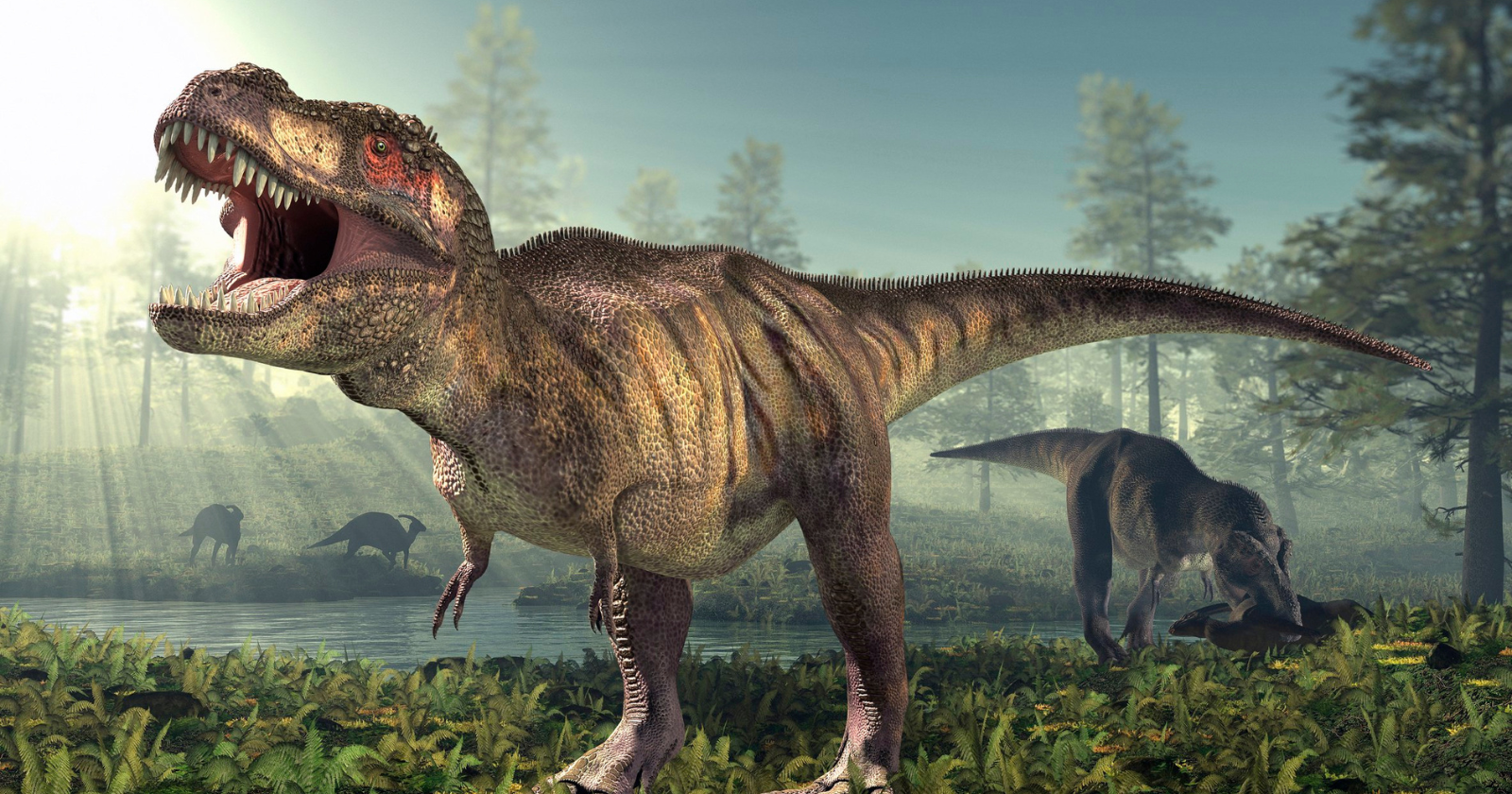
Tyrannosaurus rex lived between roughly 68 and 66 million years ago. Stegosaurus lived around 150 million years ago. The gap between them is on the order of 80 million years. The gap between T. rex and us is about 66 million years.
This means that if you were standing with a Tyrannosaurus and you asked it about Stegosaurus, the Stegosaurus would be more chronologically distant to it than the Tyrannosaurus is to you. The two most famous non-avian dinosaurs in popular culture never overlapped, never could have overlapped, and were separated by a stretch of time longer than the entire mammal-dominated Cenozoic era so far.
The US Geological Survey states the fact plainly on its public dinosaur page: “the time separating Stegosaurus and Tyrannosaurus is greater than the time separating Tyrannosaurus and you.” Riley Black, writing in Smithsonian Magazine, has made the same point about Apatosaurus and Tyrannosaurus, which are separated by roughly 83 million years.
What the numbers actually are
Stegosaurus is a Late Jurassic animal. Its known range in the fossil record sits in the Morrison Formation of western North America, alongside Allosaurus, Apatosaurus, and Diplodocus. By around 145 million years ago, the genus is gone from the record.
The next 80 million years are not empty. They contain the entire Cretaceous: the rise of flowering plants, the diversification of mammals into the niches they would later expand into, the appearance and spread of ceratopsians, hadrosaurs, and tyrannosaurids. The supercontinent Pangaea had already broken apart by the time Stegosaurus lived. By the time Tyrannosaurus appeared, the continents had drifted closer to their modern positions.
Tyrannosaurus rex itself had a short stratigraphic range. The species is known from roughly the last two million years of the Cretaceous, in what is now the western interior of North America. The asteroid impact at the Chicxulub site, around 66 million years ago, ends its run. After that, the Cenozoic begins, and the mammalian lineages that survived the extinction begin the slow climb that produces, eventually, the human reader of this paragraph.
So the arithmetic of the lede holds in either direction. T. rex is closer in time to a smartphone than it is to a Stegosaurus.
And by “us” we mean modern readers, not first humans in the loose evolutionary sense: smartphones, cities, writing, radio, and everything else we call the present.
Why the fact keeps catching people out
The reason this is surprising is not that the numbers are unknown. They are in textbooks. The reason it is surprising is that human intuitions about deep time are, by nature, quite bad.
The standard demonstration involves picturing a year. A year is a calibrated unit because we have one in our bodies. Ten years is harder, but still recognisable as a length of life. A hundred years stretches the available imagery. A thousand years requires historical reference points: the Norman Conquest, the Tang dynasty, the Vikings reaching Greenland. By a million years, the mental machinery has run out. We have no native reference for a million years. Beyond that, we are working with labels, not durations.
“The Age of Dinosaurs” is one of those labels. It refers to the Mesozoic Era, which lasted around 186 million years and contained three quite different geological periods, with quite different climates, continental arrangements, plant communities, and dinosaur faunas. The phrase makes the whole stretch feel like a single scene, the way “the Roman Empire” can feel like a single scene when it actually covers six or seven centuries of political and military change.
Once the phrase is in place, the various famous animals tend to collapse together inside it. Stegosaurus and Tyrannosaurus end up in the same frame on the same page of the same picture book, often with a Pterosaur in the air and a Brachiosaurus in the background, and the brain accepts the diorama because there is no felt distinction between 150 million and 70 million years ago.
What 80 million years actually contains
The gap between Stegosaurus and Tyrannosaurus is roughly equal to the time that has passed since the asteroid. Everything that has happened to mammals in the Cenozoic, from the first small generalists in the post-impact world to whales, bats, primates, and the entire human lineage, has happened in less time than separated the two dinosaurs from each other.
Put another way: more time elapsed between Stegosaurus and Tyrannosaurus than between Tyrannosaurus and the invention of writing. Or radio. Or, by quite a margin, the moment you are reading this sentence.
The implication is not that anything is wrong with the dinosaurs. The implication is that the categories we use to package deep time are doing a lot of compressing. “Dinosaurs” is a clade, not a moment. Inside it, generations of animals lived and went extinct without ever encountering the animals we instinctively pair them with. Even the famous dinosaurs we mentally group together through museums, toys, and films often came from very different chapters of Earth’s history. Most of the dinosaurs that ever existed never made it into the frame.
The scale we actually have
What is interesting about the T. rex-Stegosaurus fact, in our reading, is that it does not require any new science to land. The dates have been settled for a long time. What it requires is a willingness to sit with a comparison long enough for the numbers to register as durations rather than labels.
This is the thing that makes deep time difficult to teach, and easy to forget. The fossil record is not arranged on a single shelf. It is stretched across a stretch of time that the human mind cannot hold in one piece. The best we can usually do is to anchor it to something already understood, which is why so much popular writing about geology and palaeontology relies on the same handful of comparisons: a clock face, a football field, an outstretched arm with the dust of all human history brushed off the tip of one fingernail.
The comparisons are useful. They are also a sign of the underlying problem. We do not, in any direct way, perceive the durations involved. We perceive labels for the durations and we treat the labels as objects. “The Mesozoic,” “the Jurassic,” “the Cretaceous,” “the Age of Dinosaurs.” These are categories that allow conversation to proceed. They are not the same as the time they refer to.
What the lede is really pointing at
The framing in the opening sentence, that the gap between two famous dinosaurs is wider than the gap between one of them and us, works as a piece of writing because it forces a recalibration. The reader’s existing mental model places T. rex and Stegosaurus close to each other and humans far away. The sentence inverts that without raising its voice.
What it leaves the reader with, once the surprise wears off, is a slightly humbler sense of where we sit on the timeline. Sixty-six million years sounds like a lot, until you notice that the Mesozoic alone contained two and a half of those, and that the dinosaurs we treat as contemporaries were as distant from each other as we are from the last of them.
It is not a moral about humility, exactly. It is a fact about scale. The scale is the moral.
