
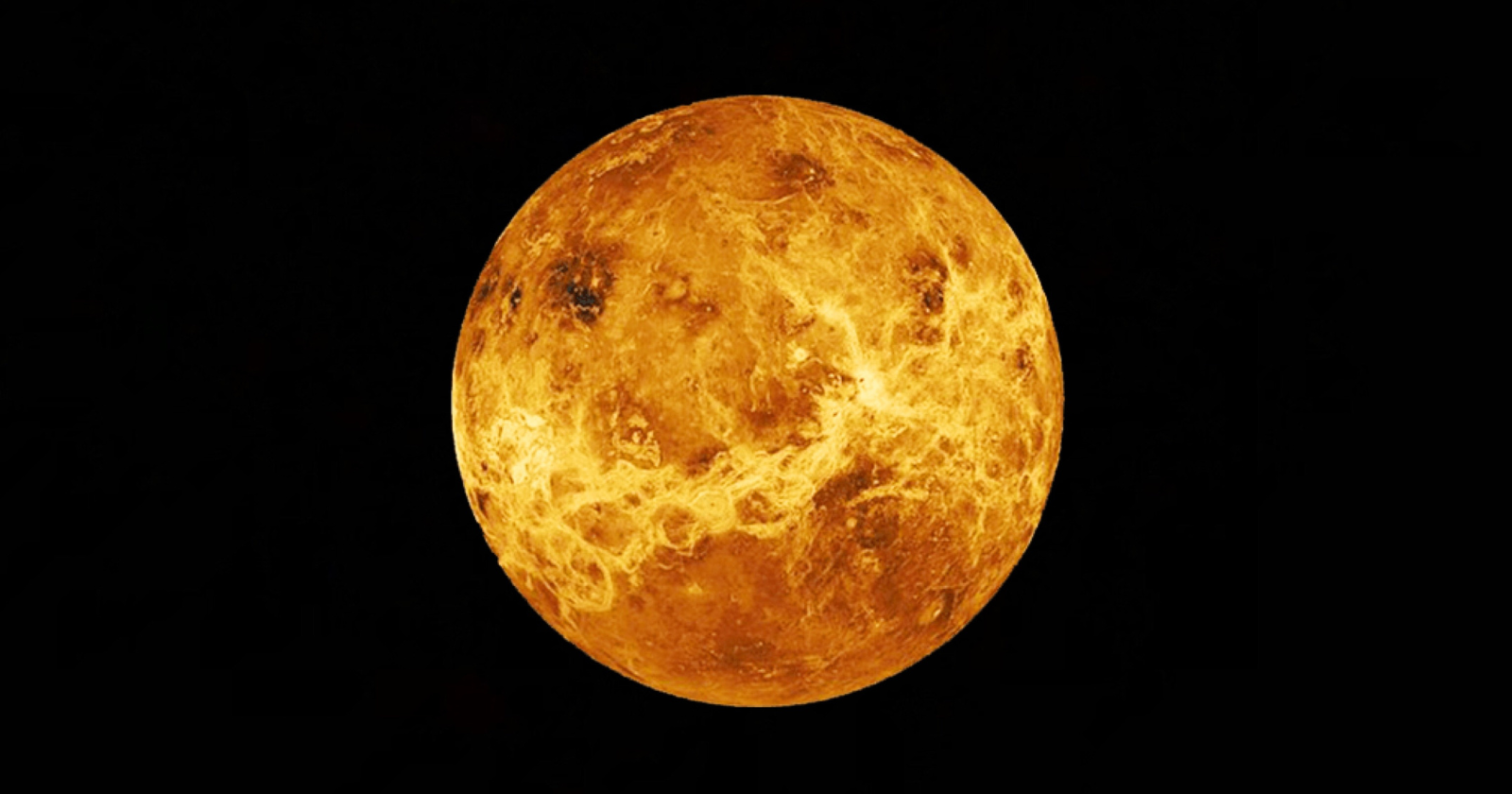
Venus takes about 243 Earth days to turn once on its axis. It takes about 225 Earth days to circle the Sun. On those figures a single rotation outlasts a whole Venusian year, which is the basis for the popular line that a day on Venus is longer than a year.
The figures are right. The phrasing hides a catch.
Two different days
“Day” can mean two things, and on Venus they are nowhere near each other.
The first is the rotation period, the time the planet takes to spin once relative to the distant stars. Astronomers call this the sidereal day. On Venus it runs to about 243 Earth days, and according to NASA’s Venus fact sheet that is indeed longer than the planet’s 225-day orbit.
The second is the solar day, the time from one sunrise to the next. That is the day you would actually live through, and on Venus it lasts about 117 Earth days. A little over half a Venusian year. The Sun comes up, sets, and comes up again roughly twice in every trip around the Sun.
NASA’s Space Place makes the consequence concrete: because the Sun rises only about every 117 Earth days, it rises close to twice during a single Venusian year, even though, by the rotation count, it is still the same long day.
Why the Sun rises in the west
Venus rotates backwards. Most planets in the Solar System, Earth included, spin in the same direction they orbit, west to east, which is why our Sun rises in the east. Venus turns the other way. Stand on its surface, somehow, and the Sun would come up in the west and go down in the east.
That reverse spin is also what pulls the solar day so far below the sidereal day. As Venus moves around its orbit, its slow backward rotation brings the Sun back to the same point in the sky sooner than a forward spin would, in about 117 days rather than 243.
The thick atmosphere would change the experience further. Venus is wrapped in dense cloud, so any sunrise at the surface would be a slow brightening rather than a sharp event at the horizon. The surface itself, at about 465 degrees Celsius and under crushing pressure, is not somewhere you would linger to watch it.
Why Venus spins this way is not settled
How Venus ended up with a slow backward spin is an open question, not a solved one.
One line of thinking points to a large impact early in the planet’s history, the kind of collision that could knock a young planet’s rotation off course and even reverse it. Another points to the atmosphere: solar heating drives strong atmospheric tides in Venus’s dense air, and over a very long time these may have braked the spin and helped tip it into reverse. Both are hypotheses. Neither is confirmed, and there is no agreement on which mattered more, or whether both played a part.
What is measured, rather than inferred, is the rotation rate itself. Earth-based radar observations have pinned Venus’s sidereal day at close to 243 Earth days, while also showing that the exact spin period can vary by tens of minutes, likely because the dense atmosphere exchanges angular momentum with the solid planet.
What to keep from the factoid
The headline holds, with a qualifier. Venus does take longer to spin once than to complete one orbit, and it is the only planet in the Solar System for which that is true.
But the day you would live through there is shorter than the year, a little over half of it. Venus does not hold a single sunrise across more than a year. It turns slowly, and backwards, and so the Sun comes up twice between one Venusian New Year and the next.
