
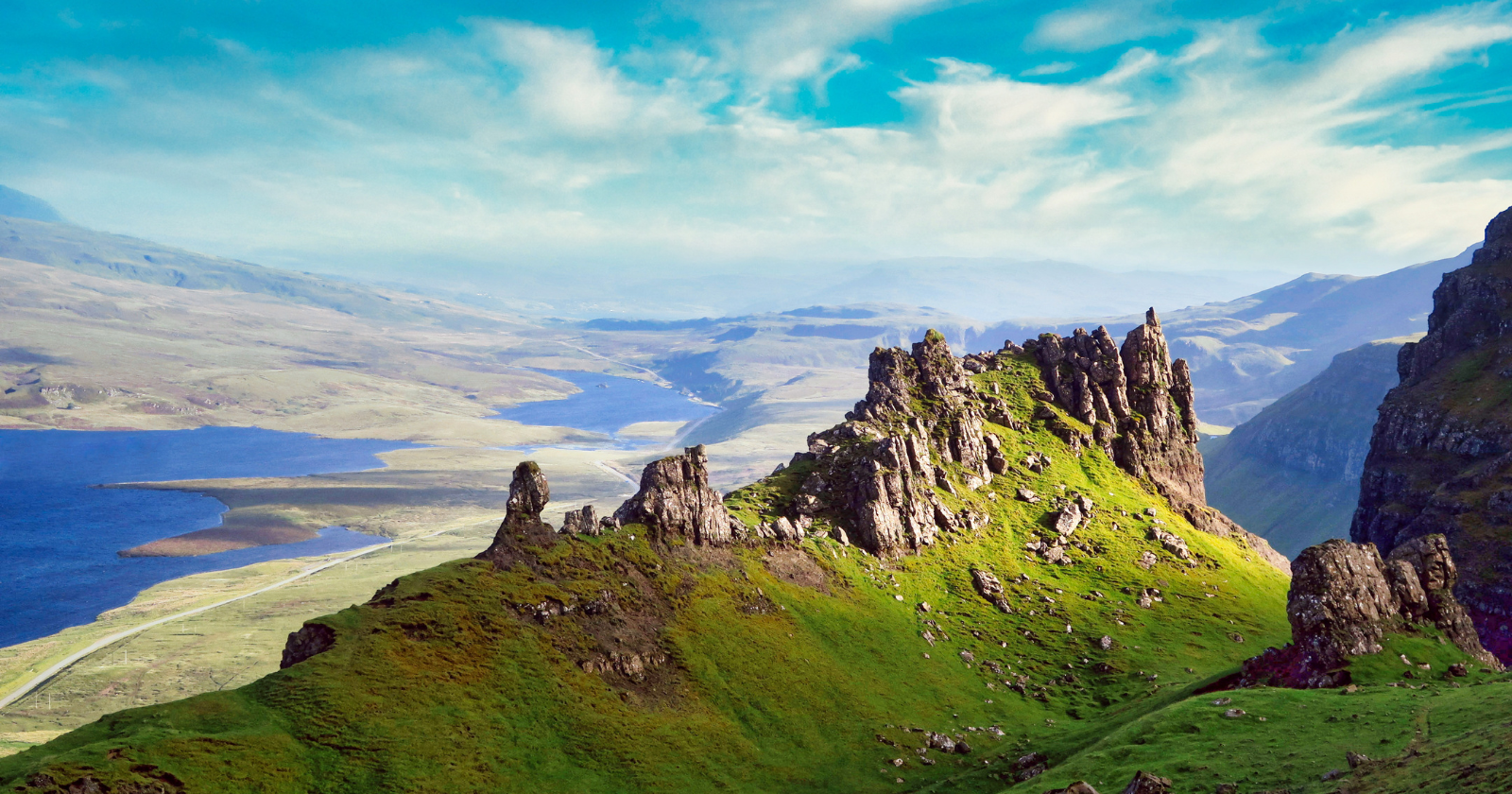
The rock formations of the Scottish Highlands and the western coast of Newfoundland match each other to a degree that surprises people the first time they see the comparison. The strata are of similar ages, similar compositions, and were deformed by the same tectonic events. The reason is straightforward, even if the time scale is hard to grasp. The two regions were once parts of a single, very large mountain range. Around 200 million years ago, that mountain range broke apart along a developing rift, and the two pieces drifted slowly away from each other as the Atlantic Ocean opened. Today the original range survives only as eroded remnants on opposite sides of the ocean, but the geological connection between them remains one of the cleanest pieces of evidence for plate tectonics that the planet provides.
The mountain range that built and broke
The mountain-building event responsible for the Highlands and the western Newfoundland uplands is known in Europe as the Caledonian Orogeny, named for the Latin word for Scotland. The same event in North America is more often called the Acadian Orogeny, after the early French colonial name for what is now eastern Canada. Both names describe the same fundamental process: the closure of an ocean called the Iapetus, which existed between roughly 600 and 420 million years ago, and the subsequent collision of the continents that had been separated by it.
According to the British Geological Survey’s “Earthwise” reference on the Iapetus Ocean, the Iapetus was a predecessor of the modern Atlantic, named after the father of Atlas in Greek mythology. It opened during the late Neoproterozoic and reached its maximum width by the beginning of the Ordovician Period, about 480 million years ago. Subduction at its margins then began to consume it, pulling the continents on either side closer together. The continents on the western shore included what is now North America (the ancient continent of Laurentia, which carried the future Newfoundland). The continents on the eastern shore included Baltica (the ancient core of Scandinavia) and Avalonia (a smaller landmass that included parts of what is now England, Wales, the southern Irish coast, and much of the Avalon Peninsula of southeastern Newfoundland).
The collisions produced an enormous mountain range. According to NatureScot’s account of Scotland’s geological foundations, the Caledonian Mountains were “a massive mountain range similar in scale to the Alps or even the Himalayas.” The British Geological Survey notes that “there are particularly clear geological links from southern Scotland, through Ireland, into Newfoundland, Canada.” The end result was a continuous mountain chain stretching from what is now Scandinavia, through Scotland, Ireland and Britain, across to Newfoundland, and down through the Appalachian Mountains of North America.
The chain stayed continuous for the next 200 million years, while it eroded down from Himalayan heights toward its modern remnants. Then, about 200 million years ago, during the breakup of the supercontinent Pangaea, a new rift began opening across what is now the North Atlantic. The rift cut directly across the old mountain range. On the western side, the broken pieces stayed with North America: the Appalachians and the Long Range Mountains of western Newfoundland. On the eastern side, they stayed with Europe: the Scottish Highlands and the mountains of Ireland and Norway. The continents carried their respective fragments away from each other at a few centimetres per year, and the gap between them widened into the present Atlantic.
What the matching evidence actually looks like
The geological correspondence between Scotland and western Newfoundland is not just at the level of “both have old mountains.” It is specific to the level of individual rock formations and the structural features that deformed them. The Dalradian Supergroup of metamorphic rocks in the Scottish Highlands has direct stratigraphic equivalents in the western Newfoundland uplands. The Highland Boundary Fault, which separates the Scottish Highlands from the Midland Valley to the south, can be traced through Ireland and across the Atlantic to the Cabot Fault in Newfoundland. The Iapetus Suture, the geological scar marking the location where the ancient Iapetus Ocean closed, runs through Britain from the Solway Firth to Lindisfarne, approximately along the present-day Anglo-Scottish border, and continues across the Atlantic into Newfoundland, where geologists call its main trace the Red Indian Line.
The clearest specific match is in the ophiolite assemblages, the fragments of ancient oceanic crust thrust onto the continental margins during the Caledonian collisions. The Shetland Islands of Unst and Fetlar preserve ophiolites that originally formed on the floor of the Iapetus Ocean. On the other side of the modern Atlantic, the Bay of Islands Ophiolite Complex on the western coast of Newfoundland, exposed in spectacular cross-section within Gros Morne National Park, preserves the same kind of Iapetus oceanic crust and upper mantle, dated to roughly 485 million years ago. Unst, Fetlar and the Bay of Islands are remnants of the same vanished sea.
What this tells you about the planet
The Scottish Highlands and the Long Range Mountains of western Newfoundland are about 3,500 kilometres apart now. They were neighbours 200 million years ago. The Caledonian-Appalachian system is one of the cleanest cases for continental drift that geology offers, and it was one of the lines of evidence that helped Alfred Wegener formulate his 1912 hypothesis of continental drift in the first place. The professional geological community resisted his hypothesis for decades. By the 1960s, with the discovery of seafloor spreading and the development of the modern theory of plate tectonics, the match between the two regions had become not just plausible but inevitable.
What stands now in the Scottish Highlands is the deeply eroded root of a mountain range that once towered over an ancient supercontinent. The same is true of western Newfoundland’s Long Range Mountains. The two are pieces of the same old highland, weathered for hundreds of millions of years on either side of an ocean that did not exist when the highland was new.
