
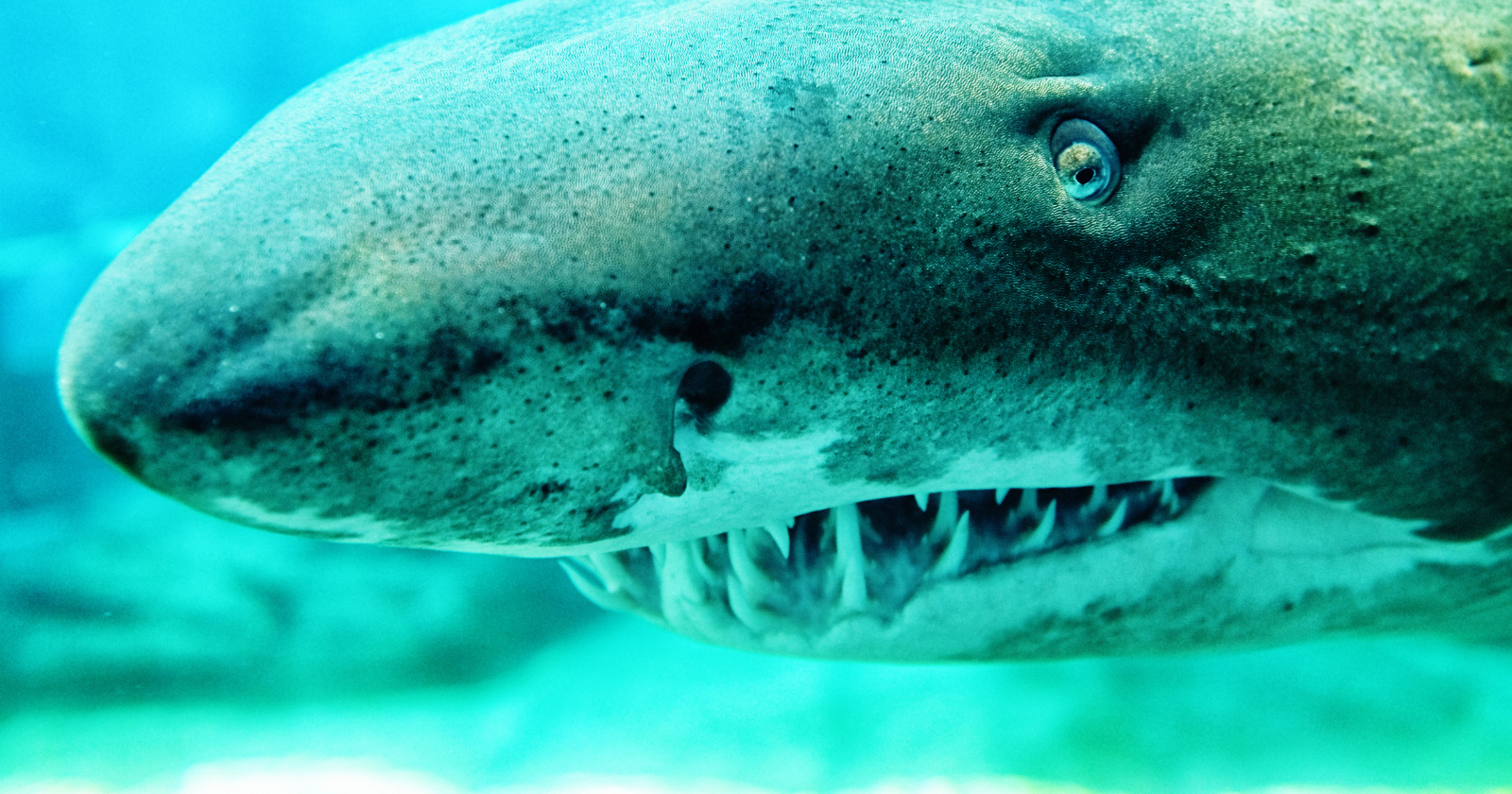
According to the Natural History Museum’s timeline of shark evolution, the earliest evidence of sharks in the fossil record consists of a few tiny scales found in Late Ordovician rocks roughly 450 million years old. These are dermal denticles, the same tooth-like skin structures that modern sharks still carry. Palaeontologists continue to debate whether the 450-million-year-old scales are from true sharks or from very closely related ancestors, and the earliest undisputed shark scales are about 420 million years old, from Silurian-era rocks in Siberia. By either measure, sharks predate almost every other living lineage of vertebrate, and they predate the first true trees by a margin that takes some effort to grasp.
The comparison most often invoked is “sharks are older than trees,” and it is true. The specific gap, however, is smaller than the round figures sometimes attached to it suggest. The first trees, by current evidence, appeared roughly 385 million years ago. The shark fossil record begins around 450 million years ago. The gap is therefore approximately 65 million years, which is roughly the same time interval that separates the modern day from the extinction of the dinosaurs. By the time the first organism that could reasonably be called a tree existed, sharks had been swimming for an interval longer than the entire age of mammals.
What the world looked like when sharks first appeared
The Late Ordovician period, when the first shark-like scales were being deposited in shallow seas, was a planet that would look almost unrecognisable to a modern observer. The continents were arranged differently, with most of the dry land assembled into a southern supercontinent called Gondwana. The seas were full of trilobites, brachiopods, early jawless fish, and the eurypterids that would later grow into the largest arthropods that ever lived. The land was something else entirely.
By 450 million years ago, plants had been moving onto land for perhaps 20 million years. They had not made much progress. The earliest land plants were liverworts and mosses, related to the bryophytes that still grow on damp rocks today. They were small, simple organisms with no roots, no proper stems, and no leaves in any modern sense. They grew flat against the ground in damp places. They could not stand upright because they had not yet evolved the lignin-stiffened tissues that would later allow vascular plants to support their own weight. The tallest land plants in the world, at the moment when sharks were first leaving fossils in the ocean record, were probably no more than a few centimetres high.
The first vascular plants, the group that would eventually produce trees, appear in the fossil record around 430 million years ago, about 20 million years after the first sharks. These early vascular plants, including the genus Cooksonia, were spindly, branching, leafless organisms that stood only a few centimetres tall and would have looked, to a modern observer, like green wire stuck in the mud. By 420 million years ago, plants like Baragwanathia were reaching heights of perhaps 20 to 30 centimetres, but still nothing recognisable as a forest. The closest thing to a forest on Earth at this time was a low scrubland of knee-high vascular plants growing in damp coastal margins. Sharks, by then, had already been an ocean lineage for 30 million years.
When trees finally appeared
The first true trees did not show up until the Middle Devonian, about 385 million years ago. The earliest known specimen is Wattieza, identified from fossils at Gilboa, New York, and described in 2007 from material that had been excavated and partially studied as far back as 1870. Wattieza resembled a modern tree fern, with a trunk reaching about 8 metres in height and a crown of fern-like foliage on top. It is currently held as the oldest fossil organism that meets the technical definition of a tree, namely a plant with a substantial woody trunk that supports a crown of foliage well above the ground.
Almost contemporary with Wattieza, and arguably more important in evolutionary terms, was Archaeopteris, the genus that would eventually form the first true forests. According to Britannica’s account of Archaeopteris, this plant had a woody trunk, fern-like foliage, and a branching pattern similar to modern conifers. The largest specimens reached perhaps 30 metres in height. A 2019 study published in Current Biology by William Stein of Binghamton University and colleagues, summarised in Smithsonian Magazine, described an Archaeopteris root system in fossil soils near Cairo, New York, at 385 million years old, providing the strongest evidence to date of what an early forest actually looked like at ground level.
By the time these first proper forests had risen, sharks were 65 million years into their evolutionary history. The early shark lineage had already diversified, lost some early forms, and given rise to Cladoselache, a roughly 1 to 2 metre-long fish from the late Devonian that is the oldest known shark from which complete skeletons have been recovered. Cladoselache lived in the same period as the first forests. By that point, the shark body plan had been refined over tens of millions of years of evolutionary work.
What the comparison is and is not
The popular framing of “sharks are older than trees” has its limits. Modern sharks, the ones that swim in modern oceans, are not the same animals that swam in the Ordovician. The genus Carcharodon, which includes today’s great white, is only a few million years old. Most of the families of sharks that exist now appeared within the last 100 to 150 million years. The lineage that connects modern sharks to those Ordovician scales is unbroken, but the specific animals at the two ends look very different.
What has been continuous is the cartilaginous-fish body plan, the chondrichthyan group to which sharks belong, evolving and adapting through the rise of forests, the appearance and extinction of the dinosaurs, the development of mammals, and every climate event the planet has experienced since. Sharks were swimming when the first plants developed the trick of supporting their own weight on land. They were swimming when those plants invented bark, then leaves, then seeds. They were swimming when the first vertebrates crawled out of the water and gave rise to amphibians, reptiles, dinosaurs and birds. They are still swimming now.
The 450-million-year figure is a useful one for placing the lineage in deep time, even with the caveat that the earliest scales are debated. The body plan that produced today’s sharks has been working continuously for longer than any forest on Earth has existed, longer than any flower has bloomed, and longer than any insect has flown. The trees on either side of any modern coastline, however ancient they appear, are evolutionary newcomers by comparison.
