
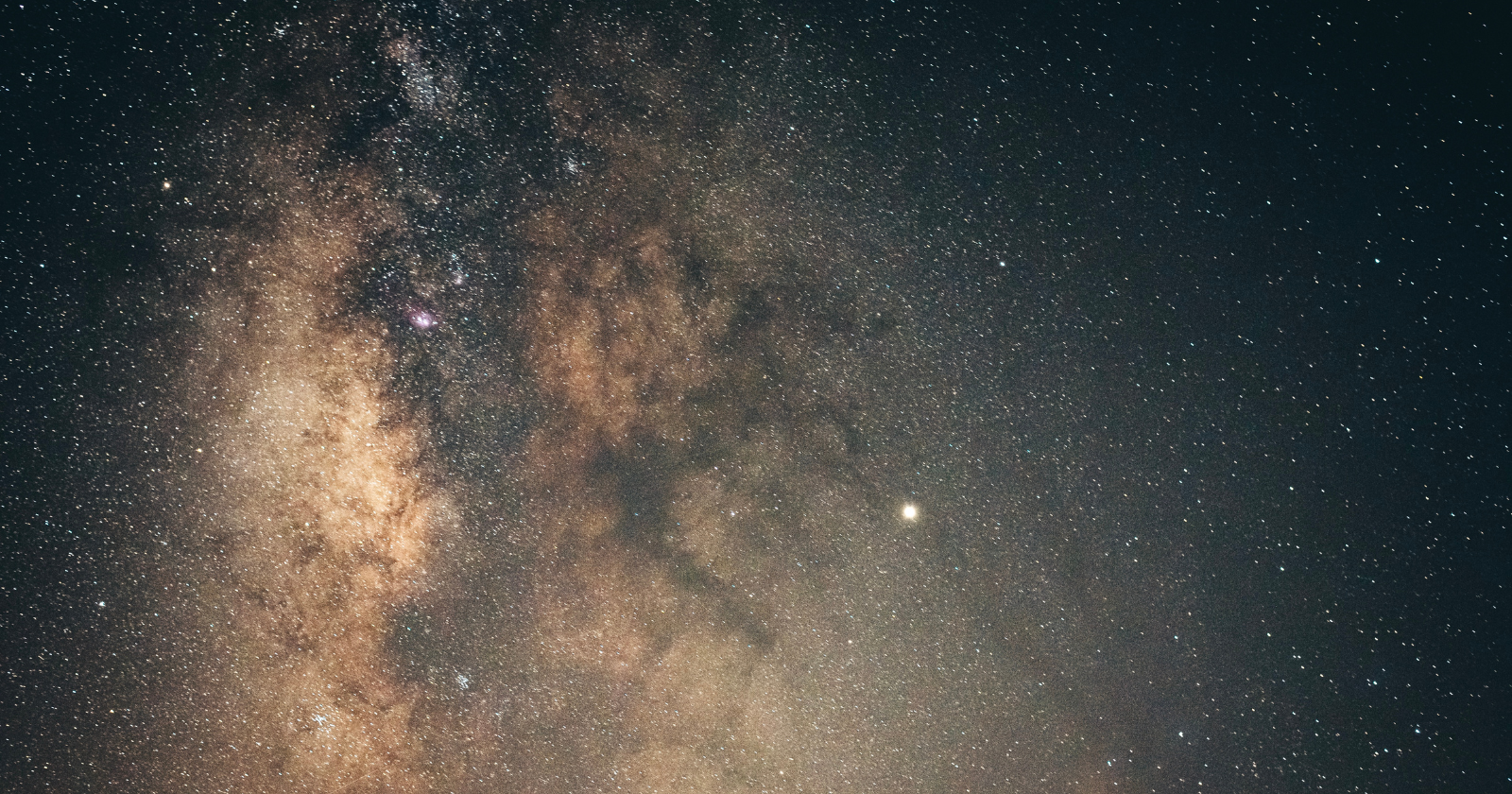
In the direction of the constellation Boötes there is a roughly spherical region of space, around 330 million light-years across, in which almost nothing is found. It is called the Boötes Void, sometimes the Great Void, and it is one of the largest known empty regions in the observable universe. Its centre lies about 700 million light-years from Earth.
It was identified in 1981 by the astronomer Robert Kirshner, working with Augustus Oemler, Paul Schechter, and Stephen Shectman, during a survey that measured the redshifts of galaxies to map how matter is spread across the sky. The full survey confirming it appeared in the Astrophysical Journal in 1987, and the original paper is still on the record.
Empty, but not empty
The word “void” oversells it slightly. The region is not a true vacuum, and it is not free of galaxies.
As of the surveys done since its discovery, about 60 galaxies have been found inside it. The point is the comparison. A volume of that size, filled at the average density of the universe, would be expected to hold somewhere around 2,000 galaxies. So the void contains a small fraction of what a typical patch of space its size would. It is dramatically underpopulated rather than swept clean. The few galaxies that are there tend to lie along a tube-shaped strand running through the middle, which is part of why some astronomers think the void formed from several smaller voids merging, in the way soap bubbles join into larger ones.
Estimates of the void’s diameter vary with the survey and the assumptions, commonly falling between about 250 and 330 million light-years. The figures are approximate by nature, since the edge of a void is a gradual thinning rather than a sharp wall.
The line about not knowing other galaxies existed
The most repeated way of conveying the scale comes from the astronomer Greg Aldering. He put it as a thought experiment: if the Milky Way sat at the centre of the Boötes Void, “we wouldn’t have known there were other galaxies until the 1960s,” as NASA’s account of the void records.
The force of that line depends on a fact it leaves unsaid. In our actual history, other galaxies were established in the 1920s, when Edwin Hubble showed that what had been called spiral nebulae were separate galaxies far beyond the Milky Way. Aldering’s point is that from the middle of the void, the nearest other galaxies would be so distant and faint that the same discovery might have waited four more decades, until telescopes had improved enough to detect them.
It is worth treating that as the vivid illustration it is, rather than a precise calculation. Aldering is conveying how far you would have to look from the void’s centre before anything turned up, not delivering a firm date for an alternative history. As a way of feeling the emptiness, it works. As a literal prediction, it carries all the uncertainty of any counterfactual.
Why a void this big is not a problem
A region this empty sounds like it should be an anomaly. It is not. Voids are an expected feature of how the universe is built.
On the largest scales, matter is not spread evenly. It is gathered into a network sometimes called the cosmic web: dense clusters of galaxies linked by long filaments and sheets, with large, near-empty voids in the spaces between. Voids are the gaps in that structure, and they make up most of the volume of the universe. The Boötes Void is unusual mainly for its size, not for existing. Its presence is consistent with the standard model of how cosmic structure grew from small density variations in the early universe, and it does not require any exotic explanation.
That is the part the dramatic framing tends to skip. The void is striking because it is large and close enough to study, not because it breaks the physics. If anything, finding voids of roughly this kind is what the standard picture predicts.
What the void is good for
The emptiness has scientific uses. A region with so few galaxies is a clean environment for testing how galaxies form and evolve when they are isolated, away from the crowding and collisions that shape galaxies in clusters. The handful of galaxies inside the void are studied for exactly that reason. Voids on the whole also serve as test beds for cosmological models, because their sizes and the way they are distributed depend on the underlying physics of structure formation and the expansion of the universe.
The Boötes Void remains one of the largest single voids catalogued, though surveys have since mapped the cosmic web in far more detail and turned up other large underdense regions. What it offers is less a curiosity about emptiness than a clear example of the gaps in the cosmic web, near enough that its few residents can be counted one by one.
