
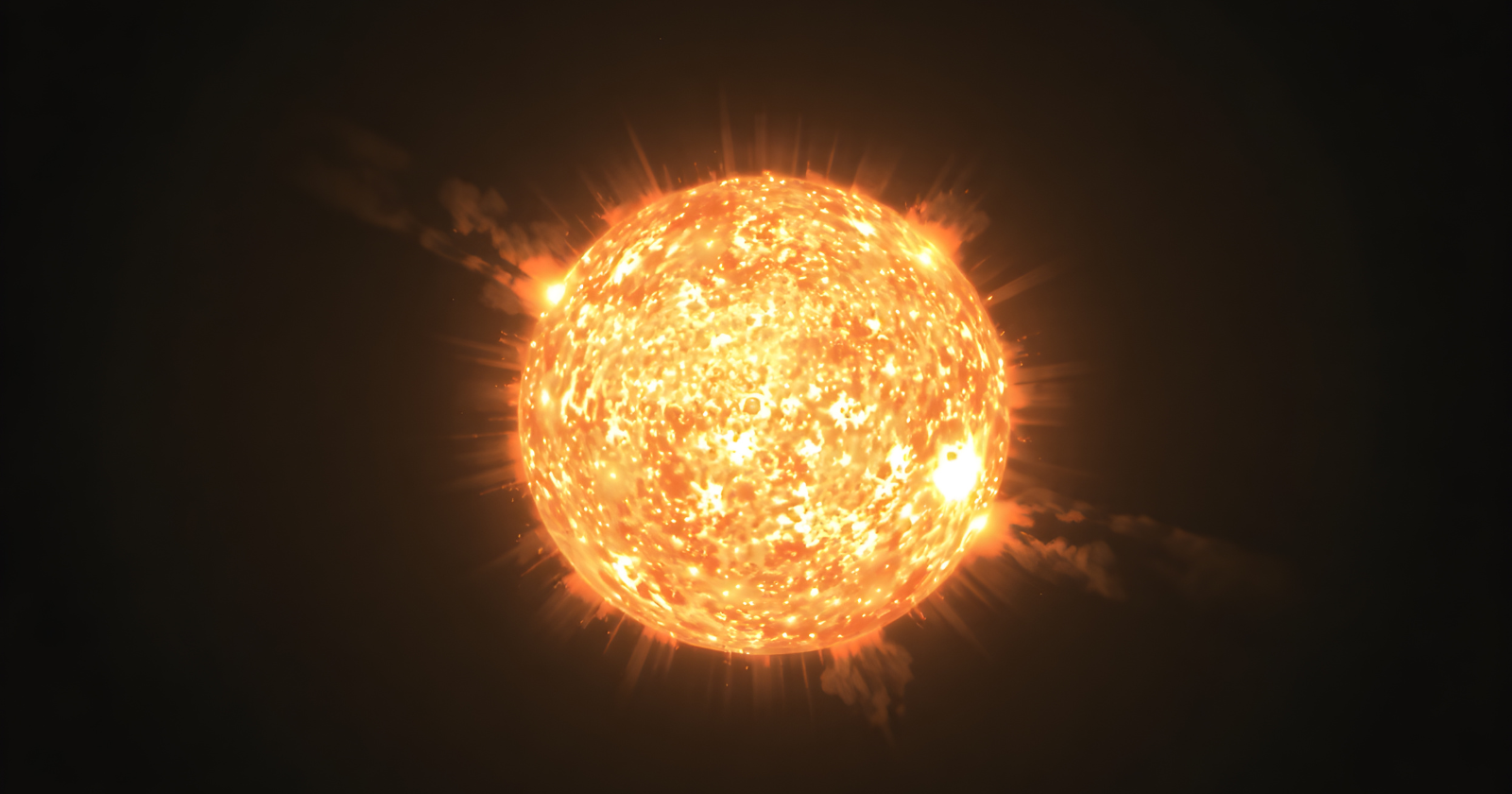
The visible surface of the Sun, the photosphere, sits at around 5,500 degrees Celsius. Its outer atmosphere, the corona, runs to one or two million degrees, and in places hotter still. The cooler layer is below; the far hotter one is above it. At these scales the difference between Celsius and kelvin is rounding error, so the gap is real and enormous either way.
That inversion has a name in solar physics. It is called the coronal heating problem, and it has been open since the early 1940s, when the temperature of the corona was first worked out from its spectrum. After more than eighty years it is still not fully resolved.
Why this is not heat flowing uphill
The first thing to clear away is the impression that the photosphere is heating the corona the way a stove heats a pot, with warmth flowing from the hot thing to the cold thing. If that were the picture, the corona being hotter than the surface beneath it really would break a law of thermodynamics. It does not, because that is not how the energy gets there.
Heat conduction does flow from hot to cold, and it always will. But the corona is not heated by conduction from the photosphere. The energy that warms it is generated below the surface, in the churning convective layers of the Sun, and is carried upward through the Sun’s magnetic field as magnetic and mechanical energy rather than as heat. It is then released, as heat, high in the corona. No law is violated. The energy simply travels by a route other than the one intuition reaches for.
So the question is not how heat climbs uphill. It is what mechanism deposits all that magnetic and mechanical energy in the corona, and why it does so efficiently enough to drive the temperature to millions of degrees.
What is agreed, and what is not
A good deal is settled. There is broad agreement that the magnetic field is responsible for carrying and releasing the energy. The disagreement is over the mechanism, and the field has spent decades narrowing it to two main candidates.
The first is wave heating. Disturbances called Alfvén waves, ripples travelling along magnetic field lines, can carry energy up from the surface and dissipate it in the corona, often through turbulence. The second is nanoflares, an idea proposed by Eugene Parker in 1988. The Sun’s magnetic field lines are constantly tangled and braided by motions below, and Parker argued that they would snap and reconnect in countless tiny bursts, each releasing roughly a billionth of the energy of an ordinary solar flare. Individually they are too small to see. In aggregate they might supply the heat.
Neither has been observed directly in a way that closes the case. Nanoflares are below the resolution of current instruments by definition. Wave dissipation is hard to pin to a specific location and rate. The prevailing view is that both probably operate, in different regions and different proportions, rather than one being the single answer.
What recent missions have added
The problem has not stood still. NASA’s Parker Solar Probe, launched in 2018, became the first spacecraft to fly through the corona itself in 2021, and on 24 December 2024 it made its closest approach, passing about 6.1 million kilometres from the Sun’s surface, nearer to a star than anything humanity has sent before. The mission and that record pass are described by the Johns Hopkins Applied Physics Laboratory, which operates the spacecraft for NASA.
Flying through the corona lets the probe measure the plasma and magnetic field in place rather than from a distance. One result shows how this work proceeds, often by elimination. Parker found that the S-shaped magnetic kinks called switchbacks, once a leading suspect for heating, are common in the solar wind farther out but absent inside the corona itself. A team at the University of Michigan reported that this narrowed the list of explanations by one, at least for switchbacks in the form expected. Other work, using Parker’s direct measurements of how waves transfer energy to protons, has found evidence for a specific wave-heating process called cyclotron resonant heating, reported in Physics from the American Physical Society.
It is worth being precise about what this progress amounts to. Scientists now understand the acceleration of the solar wind considerably better than they did a decade ago. The heating of the corona is a related question, and it has moved, but it has not been closed. The candidate mechanisms are better constrained, some specific versions have been ruled out, and direct evidence for at least one wave process now exists. The overall accounting, how much heat each mechanism supplies and where, is not finished.
Why it stays hard
The deepest obstacle is scale. The events that may do the heating, individual nanoflares and the fine structure of wave dissipation, happen at sizes smaller than current telescopes and probes can resolve. You can measure their aggregate effects, the temperature, the wave energy, the plasma flows, without isolating the individual events that produce them. That is why the problem yields slowly, by ruling candidates in and out rather than by a single decisive observation.
Parker is now in its closest orbit, returning every three months for repeated passes through the corona, and the European Space Agency’s Solar Orbiter is observing in tandem from a different vantage. The next stretch of data will come from inside the layer that needs explaining. That is the place to watch, and the reason the question, after eighty years, is still being actively worked rather than filed away.
