
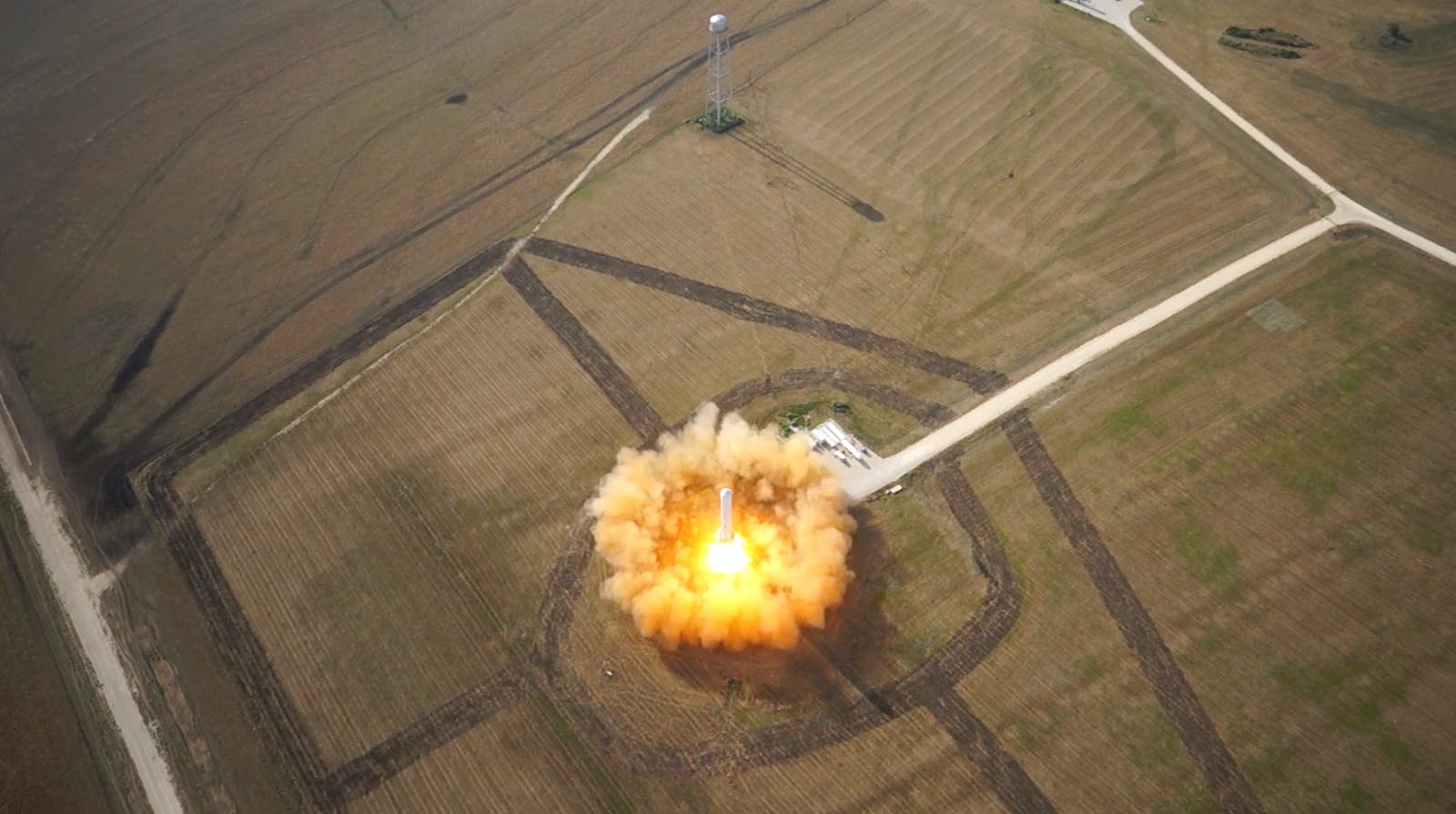
Blue Origin’s New Glenn rocket exploded on its launch pad at Cape Canaveral on the evening of May 28, destroying the vehicle and inflicting heavy damage on Launch Complex 36 during what was meant to be a routine static-fire test. No one was injured, but the loss has grounded the company’s only heavy-lift pad indefinitely — and it landed two days after NASA had publicly tied a piece of its Moon program to exactly this rocket.
The failure happened at roughly 9 p.m. Eastern as the first stage’s seven BE-4 engines fired. The rocket was being readied for the NG-4 mission, scheduled for as soon as June 4 with a payload of Amazon Leo broadband satellites. Amazon has confirmed no satellites were aboard during the test.
The worst pad incident at the Cape in nearly a decade
The fireball at Launch Complex 36 is the most destructive event at Cape Canaveral since SpaceX lost a Falcon 9 during a fueling test at neighboring SLC-40 in September 2016. That pad sat dormant for about 16 months before returning to service in December 2017. A loss of this magnitude, depending on the structural damage, could follow a similar timetable.
Video circulated within minutes. The blast was visible across the Space Coast, with a mushroom cloud rising over Brevard County and debris scattered across the pad. Space Launch Delta 45 later warned that debris could wash ashore along public areas in the days and weeks afterward.
Blue Origin acknowledged an anomaly during the hotfire test within roughly half an hour and said all personnel were accounted for.
Bezos and Isaacman respond
Jeff Bezos addressed the loss publicly that night on X. “All personnel are accounted for and safe,” he wrote, adding that it was too early to know the root cause but the company was already working to find it, and that it would rebuild and return to flight.
NASA Administrator Jared Isaacman — who only two days earlier had named Blue Origin hardware to the agency’s first Moon Base mission — said NASA was assessing near-term mission impacts and would provide timeline updates as information became available.
The choreography is by now familiar from high-stakes commercial space failures: acknowledge the loss, frame it as part of the iterative process, get back to the pad. What is different this time is the dependency stack that has built up around New Glenn over the past two years.
Amazon’s constellation hits a wall
Amazon has 24 launches under contract with Blue Origin for its Amazon Leo broadband constellation, with NG-4 slated to carry the first batch of satellites. The entire manifest is now suspended with no resumption date until LC-36 is rebuilt and New Glenn returns to flight.
Leo is already under FCC-imposed deployment deadlines, and every grounded launch tightens that timeline. Amazon faces uncomfortable questions about whether to diversify away from Blue Origin’s heavy lifter, even as alternatives remain scarce. SpaceX, the only operator with comparable cadence, is a direct competitor to Leo through Starlink.
Smaller commercial customers, including those who have looked at New Glenn for direct-to-device launches, are likely to shift toward Falcon 9 manifests already running near capacity.
The Artemis dependency problem
The explosion’s most consequential ripple reaches NASA’s lunar program. Just two days earlier, on May 26, NASA had announced its Moon Base plan, naming Blue Origin’s Mk1 “Endurance” lander to fly the first privately funded lunar lander mission — Moon Base I — to the Shackleton Connecting Ridge near the lunar south pole, carrying NASA’s SCALPSS and a Lunar Retroreflector Array, targeting no earlier than fall 2026.
Endurance launches on New Glenn. The vehicle that would have carried it is now scattered across LC-36, and the pad it would have flown from is the damaged one.
A program already under strain
New Glenn’s operational record is short and uneven. It first flew in January 2025, reaching orbit but failing to recover its booster. NG-2 in November 2025 carried NASA’s ESCAPADE Mars probes and landed its booster for the first time. NG-3, launched April 19, 2026, landed the booster again but suffered an upper-stage cryogenic leak that stranded an AST SpaceMobile satellite in the wrong orbit. The FAA grounded the vehicle, and Blue Origin only received clearance to resume flights on May 22 — six days before this static-fire failure.
NASA’s broader lunar architecture is not positioned to absorb new delays gracefully. The Blue Moon lander, which NASA is counting on as one of two crewed-landing options, also depends on New Glenn to reach space. A rocket that cannot fly cannot demonstrate the launch reliability the agency wants to see before committing crews to Artemis missions later this decade.
The institutional question
Heavy-lift development is brutally hard. SpaceX absorbed multiple Falcon 9 losses on its way to dominance, and Starship has exploded repeatedly during test campaigns. The industry’s tolerance for these failures has grown because the iterative model has produced results.
What sets this incident apart is the timing. Blue Origin secured a flagship NASA role on May 26; its rocket exploded on May 28. The whiplash exposes a fragility that policymakers have been reluctant to confront: NASA’s Moon plans, Amazon’s constellation, and a meaningful share of upcoming national-security launches all flow through a small number of providers whose hardware can fail catastrophically on a single evening.
Bezos has been here before. Years of test failures and skepticism preceded Blue Origin’s first crewed New Shepard flight in 2021, and the company eventually delivered. The open question now is whether New Glenn can recover on a timeline that preserves its role in NASA’s lunar architecture, or whether the agency quietly rebalances toward SpaceX while the investigation runs.
What comes next
The immediate work is forensic. Blue Origin and the FAA will reconstruct what happened during the hotfire. Pad damage will be assessed and insurance claims filed. Range officials in coordination with Blue Origin are evaluating data to determine the cause.
The longer-term question is institutional. On May 26, NASA framed the Moon Base program as its bet on commercial partners to lower costs and accelerate timelines. That bet now depends on Blue Origin showing that May 28 was an anomaly rather than a pattern — and on how fast LC-36, the only pad built for New Glenn, can be rebuilt.
Blue Origin invested more than $1 billion to rebuild that pad before bringing it back into service in 2021. Whether the company’s investors and NASA’s planners have the patience for another long recovery is a separate question — and one that, after a single Thursday evening, is no longer hypothetical.
