
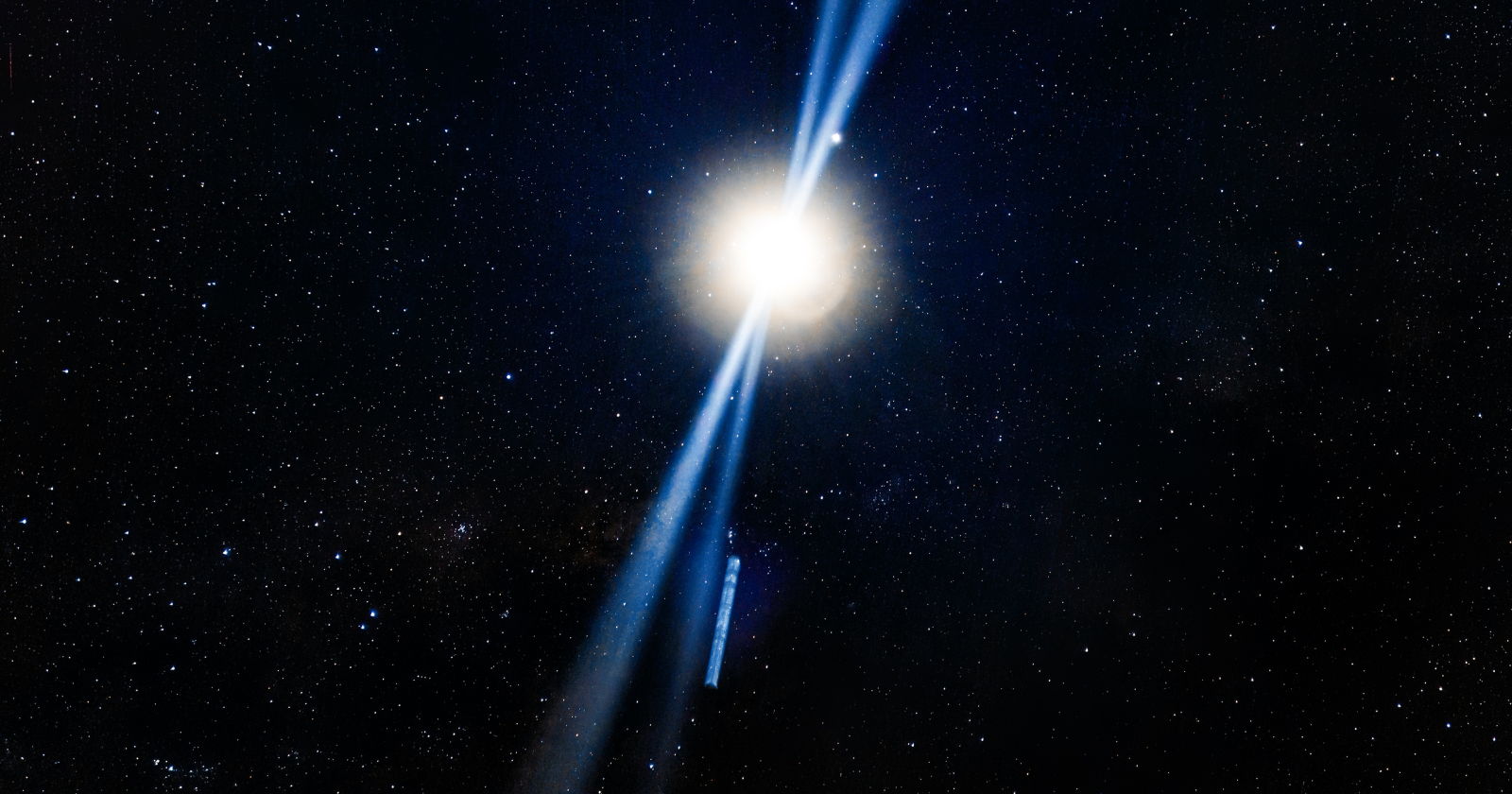
In 1987 a star exploded in a nearby galaxy, and detectors deep underground caught the burst of neutrinos roughly three hours before any telescope on Earth saw the light arrive. The star was Sanduleak -69 202, a blue supergiant in the Large Magellanic Cloud, about 168,000 light years away. The event was logged as SN 1987A, the closest supernova to Earth since the invention of the telescope.
The order of arrival is the part worth sitting with.
The neutrinos came first and the photons came later. Both travel at, or extremely close to, the speed of light, so the head start was not a race between fast particles and slow ones. It was a consequence of where each signal came from inside the dying star.
What the detectors recorded
At 7:35 Universal Time on 23 February 1987, three underground detectors registered a brief excess of events above their background. Kamiokande-II in Japan recorded about a dozen, the Irvine-Michigan-Brookhaven detector (IMB) in the United States eight, and the Baksan telescope in the Soviet Union five. The whole burst lasted under about 13 seconds. The Kamiokande-II and IMB results were reported by their collaborations in Physical Review Letters that year.
That is roughly two dozen particles, from a star 168,000 light years away. It does not sound like much. It was enough to test a theory that had been waiting decades for one.
A fourth instrument, the Liquid Scintillator Detector beneath Mont Blanc, logged a separate five-event burst some hours earlier, at 2:52 UT. That earlier signal is generally not regarded as coming from SN 1987A, and its status is contested rather than settled. The 7:35 UT burst, seen by three detectors at once, is the one the physics rests on.
Why the neutrinos came first
A massive star ends when its core exhausts its fuel and collapses. The collapse happens at the centre, in about a second, and most of the gravitational energy released, on the order of 99 per cent, leaves almost immediately as neutrinos. Neutrinos barely interact with matter, so they pass straight out through the overlying layers and head into space.
The light is a different matter. Visible brightening only appears once the shock wave from the collapsed core travels outward and reaches the star’s surface, which takes a few hours for a star this size. The neutrinos left first, the photons left later, and that gap survived the 168,000-year trip more or less intact.
The exact size of the gap depends on when the optical light is reckoned to have first been seen, and published figures sit between roughly two and three hours. The principle holds either way.
What the burst confirmed
Before 1987, the idea of a core-collapse supernova as a neutrino event was theory. The detection turned it into something observed. The number of events, their energies, and the total energy they implied, around 3 × 1053 erg, matched what models predicted for a stellar core collapsing to a neutron star. The CERN Courier’s account of SN 1987A sets out how closely the observed signal tracked the predictions.
The timing did separate work. Neutrinos and photons set off within hours of each other and arrived within hours of each other after 168,000 years. That puts a tight bound on how close the neutrino speed sits to the speed of light, and an upper limit on the neutrino mass, both extracted from a handful of particles.
It was also the first detection of neutrinos from beyond the Solar System. Masatoshi Koshiba, who led the Kamiokande work, shared the 2002 Nobel Prize in Physics, cited in part for the detection of cosmic neutrinos. Neutrino astronomy has a clear starting point, and this is it.
The question that stayed open
The burst implied that the collapse left behind a compact object, a neutron star or a black hole. For decades, no one could find it. The expected neutron star showed no clear signature in the expanding debris, and its absence became one of the longer-running puzzles attached to the supernova.
In February 2024, a team led by Claes Fransson of Stockholm University reported in the journal Science evidence from the James Webb Space Telescope: ionised argon and sulphur near the centre of the remnant, of a kind that requires a source of high-energy radiation to produce. The authors argue the most likely source is a newly formed neutron star, as set out in NASA’s summary of the Webb result. It is the strongest evidence yet for the object the 1987 neutrinos pointed to, though it is an inference from the ionisation pattern, not a direct image of the star.
What to watch
The remnant is still expanding, and the material around the suspected neutron star thins year by year. Further observations with Webb and ground-based telescopes are planned, and the central source should grow easier to study as the debris clears. Physics World has tracked how the object has entered successive phases over the decades.
The neutrino side is harder to repeat. A burst like 1987A’s needs a supernova close enough for a few dozen events to register, and the last one of those arrived in 1987. Detectors today are far larger, and a supernova in our own galaxy would now yield thousands of events rather than tens. The instruments are ready. The next nearby star has not yet obliged.
