
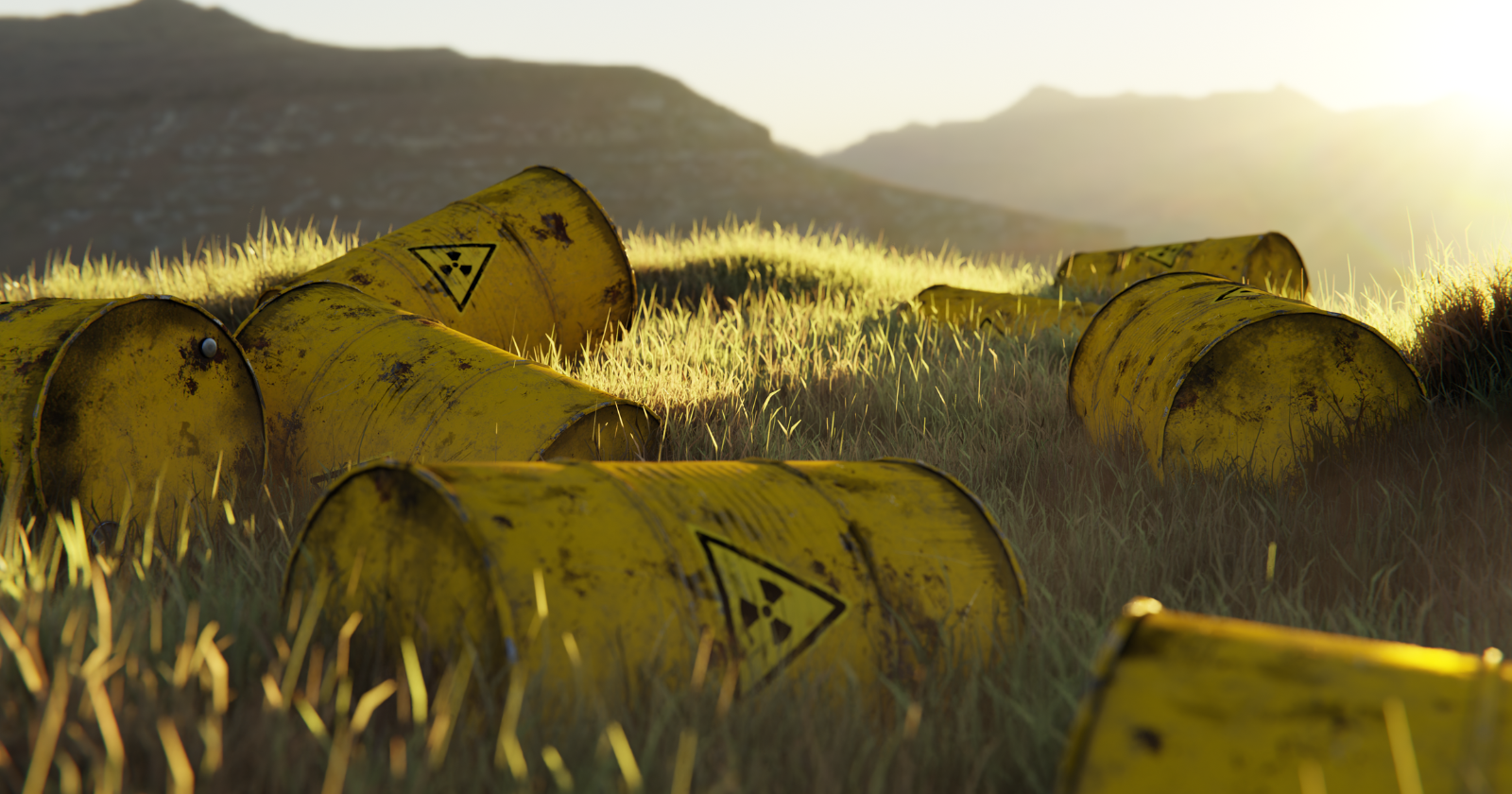
Finland’s Posiva Oy is preparing to begin the first operational disposal of spent nuclear fuel in a deep geological repository, at the Onkalo site on Olkiluoto island. According to Posiva’s published description of the facility, the repository sits in bedrock at a depth of 400 to 430 metres, with spent fuel sealed inside copper canisters surrounded by bentonite clay and emplaced in vertical deposition holes drilled into the host rock. The facility is designed for an isolation period in the order of 100,000 years.
The engineering bet underneath that number is unusual, and worth describing precisely. Posiva and its Swedish counterpart SKB are committing to a barrier system in which the longest-lived of the engineered components, the copper canister, has been the subject of an active scientific dispute about how long it will actually last. The answer the operators have settled on is to rely less on the metal and more on the rock.
What the canister is being asked to do
Posiva’s repository concept, known as KBS-3 and shared with SKB, places spent fuel inside a cast-iron insert, sealed inside a copper canister approximately five metres long and one metre in diameter, surrounded by a bentonite clay buffer, and emplaced in granite at depth. Posiva describes four nested barriers: the canister, the clay, the host rock, and the geochemical environment of the deep groundwater.
The argument for copper is that, in the chemically reducing, oxygen-free environment of the deep Fennoscandian shield, the metal is expected to corrode very slowly. The argument against is associated most prominently with Peter Szakálos and Gunnar Hultquist at KTH Royal Institute of Technology in Stockholm, who have published a series of papers since 2007 arguing that pure water can corrode copper even in the absence of oxygen, generating hydrogen and producing a copper oxy-hydride phase. In their reading of the laboratory work, unalloyed copper canisters of the KBS-3 design could begin to crack on a timescale of decades to centuries, with hydrogen embrittlement concentrating at the friction-stir welds that seal each canister.
This is not the consensus position. The Swedish Nuclear Fuel and Waste Management Company, SKB, commissioned replication work at Uppsala University and the University of Toronto. The Uppsala group reported no detectable reaction in pure water. The Toronto group observed a reaction but characterised it as too slow to matter for the repository timeframe. Both studies were commissioned by SKB and are documented in SKB’s published technical report series. Quantum-mechanical calculations published by SKB in 2010 concluded that the proposed corrosion product, even if it exists, could not form from copper in pure water on thermodynamic grounds. The Swedish Radiation Safety Authority has reviewed the evidence on more than one occasion.
That is the state of the corrosion argument. It is not settled in the sense that everyone in the field agrees. It is settled enough that the Finnish government granted Posiva a construction licence in November 2015. Posiva submitted an operating licence application in December 2021, for a disposal period running from March 2024 to 2070. As of mid-2026, that licence has not yet been granted: STUK, the Finnish nuclear safety authority, has extended its review deadline three times and has stated that Posiva’s submitted materials remain incomplete. The mid-2020s start date the project originally targeted is now in doubt.
Why the rock does the heavier work
The depth of 400 to 430 metres is not arbitrary. It puts the canisters below the zone of surface oxygenation, below the influence of expected glacial cycles, and inside a body of rock whose age and tectonic history is exceptional.
The Olkiluoto bedrock belongs to the Svecofennian domain of the Fennoscandian shield. According to peer-reviewed geochronology, the gneisses of the surrounding Satakunta region were formed in the Paleoproterozoic, between roughly 1.9 and 1.8 billion years ago. In-situ Lu-Hf dating of garnet at the Olkiluoto site itself, published by Michallik and colleagues, dates the metamorphic peak to 1834 plus or minus 7 million years ago. The rock at depth was already old before multicellular life had emerged on Earth, and before the atmosphere reached anything like its present oxygen concentration.
The site has not seen significant tectonic activity for a very long time. It has been overridden by ice sheets repeatedly during the Quaternary. Posiva’s safety case explicitly accounts for future glaciations as a foreseeable load on the system, rather than treating present conditions as a permanent baseline.
This is the geological logic that allows the engineers to keep building even while the copper question remains contested. The case does not depend on the canister lasting 100,000 years on its own. It depends on the canister, the clay, the rock, and the groundwater chemistry failing in different ways and at different rates, so that no single mode of failure releases the inventory.
What this does not settle
The Onkalo project is the first deep geological repository for spent nuclear fuel anywhere in the world to reach the operational threshold. It is not a generalisable answer.
The Fennoscandian shield is not available everywhere. The United States, the United Kingdom, Germany, France, Japan, and Canada are each working through their own siting questions in their own geologies, with their own political histories. Some of those geologies are more accommodating than Finland’s. Most are not.
The corrosion debate is also not closed by Posiva pouring concrete. If long-term in-situ monitoring at Onkalo or its Swedish analogue at Forsmark eventually shows canister behaviour outside the predicted envelope, that will matter for every KBS-3 derivative anywhere. The relevant timescales are long enough that the people who will see those results are not the people building the facility now.
What to watch in the near term has grown more complicated than the project’s original timeline suggested. STUK has now extended its review deadline three times, most recently to mid-2026, after stating that Posiva had not completed the materials necessary for a full safety assessment. The government makes the final licensing decision, but a positive STUK opinion is required first.
Trial emplacements with empty and instrumented canisters have already been conducted underground. The first actual spent fuel emplacement, when it occurs, will be the first time the full system has been loaded as designed. After that, the geology takes over.
