
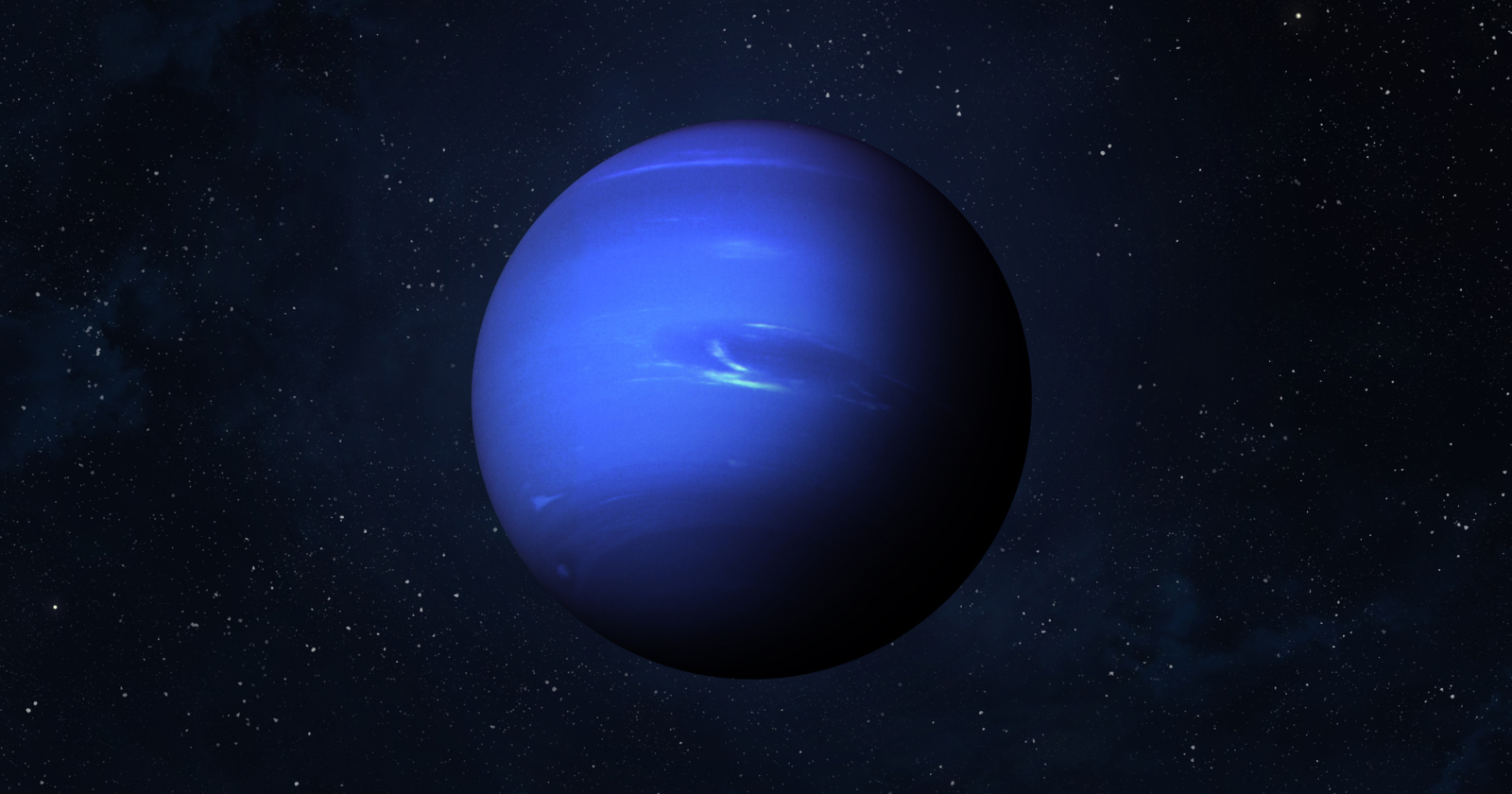
On the night of 23 September 1846, an astronomer at the Berlin Observatory pointed a telescope at a particular patch of sky, compared what he saw against a star chart, and found a planet that no chart recorded. It was Neptune. He found it within a degree of a position that had been worked out, on paper, by a man in Paris who never looked through the telescope at all.
The man in Paris was Urbain Le Verrier. He had not searched for Neptune in any usual sense. He had calculated where it must be.
The problem with Uranus
Uranus had been found in 1781 by William Herschel, and found the ordinary way, by a careful observer noticing that one point of light was not a star. In the decades after, a difficulty emerged. Uranus did not move as it should. Tables of its predicted positions, most carefully drawn up by Alexis Bouvard, kept disagreeing with where the planet actually appeared. It ran ahead of prediction, then fell behind.
One explanation, among several considered, was that an undiscovered planet further out was pulling on Uranus with its gravity. This was not the only possible answer. It meant treating Uranus’s mismatch not as a failure of observation or theory, but as a clue to an unseen body farther out.
The hard part was that knowing a planet is there does not tell you where it is. To turn the wobble of Uranus into a position in the sky, someone had to work backwards from the disturbance to the size, distance and location of whatever was causing it.
The prediction and the telescope
Le Verrier, working at the request of the director of the Paris Observatory, did exactly that. He presented his analysis to the French Académie des Sciences across 1845 and 1846, ending with a specific predicted position for the unseen planet.
French observatories showed little urgency about looking. So Le Verrier wrote to Johann Galle at the Berlin Observatory, asking him to search. Galle received the letter on 23 September and turned to the recommended part of the sky that evening, helped by his assistant Heinrich d’Arrest and by a recently completed star chart of the region. Anything that appeared in the telescope but not on the chart was worth a second look. In under an hour, they had it. A repeat observation the following night confirmed that the object moved against the background stars, as a planet would.
The planet sat within one degree of Le Verrier’s predicted position.
The part usually told as a tie
The familiar version of this story has two heroes. In England, a young Cambridge mathematician named John Couch Adams had been working on the same Uranus problem, independently, and had produced his own estimate of where the planet should be. For much of the past century and a half, Adams and Le Verrier were presented as co-predictors who arrived at the same answer at roughly the same time.
The fuller account is less symmetrical. Adams’s work was genuine and genuinely independent, but it was not published in any substantial form until after Berlin had already found the planet, and it was less complete and less consistent than the later legend suggested. The Astronomer Royal, George Airy, did prompt a search in England, carried out by James Challis at Cambridge. Challis actually recorded Neptune in August 1846, weeks before Berlin, but had not checked his observations closely enough to notice that one of his points of light had moved. He had seen the planet without seeing it.
Adams himself never claimed priority and openly credited Le Verrier. The discovery followed from Le Verrier’s prediction and Galle’s night at the telescope. Adams’s contribution is better described as a parallel calculation that history attached to the event, rather than a cause of it.
How much was prediction, how much was fortune
The one-degree match is genuinely striking, and it is worth being honest about why it was that good.
Both Le Verrier and Adams had to assume a distance for the unknown planet, and both leaned on the rough numerical pattern known as Bode’s law, which put the planet considerably further out than Neptune actually orbits. The orbits they derived were, in consequence, wrong. Yet the positions they predicted for the sky of the 1840s were close to correct.
The reason is timing. As historians of astronomy including the work summarised by the University of St Andrews mathematics archive have noted, Neptune takes about 165 years to circle the Sun, and the predicted orbits and the real orbit happened to run close together for the short stretch of sky where the planet sat in 1846. Calculations made decades earlier or later would have pointed astronomers to the wrong place. The achievement was real. The precision of it owed something to the moment at which it was attempted.
The sequel that did not work
The success was so clear that Le Verrier tried the method again. Mercury’s orbit also carried a small unexplained anomaly, a slow turning of its closest point to the Sun that Newtonian calculations could not fully account for. Le Verrier proposed that the cause was the same as for Uranus: an undiscovered planet, this time orbiting closer to the Sun than Mercury. He gave it a name, Vulcan.
Vulcan was never found, because it does not exist. The anomaly in Mercury’s orbit was eventually explained in 1915, by Albert Einstein’s general theory of relativity, which showed that Newtonian gravity itself was slightly incomplete near the Sun.
The two episodes make a single point worth keeping. Reading an orbital anomaly as a hidden mass works only when the underlying theory of gravity is sound. When it is, the method can find a planet before anyone sees it. When it is not, the missing planet is really a sign of missing physics. Neptune and Vulcan came from the same calculation. Only one of them was there.
