
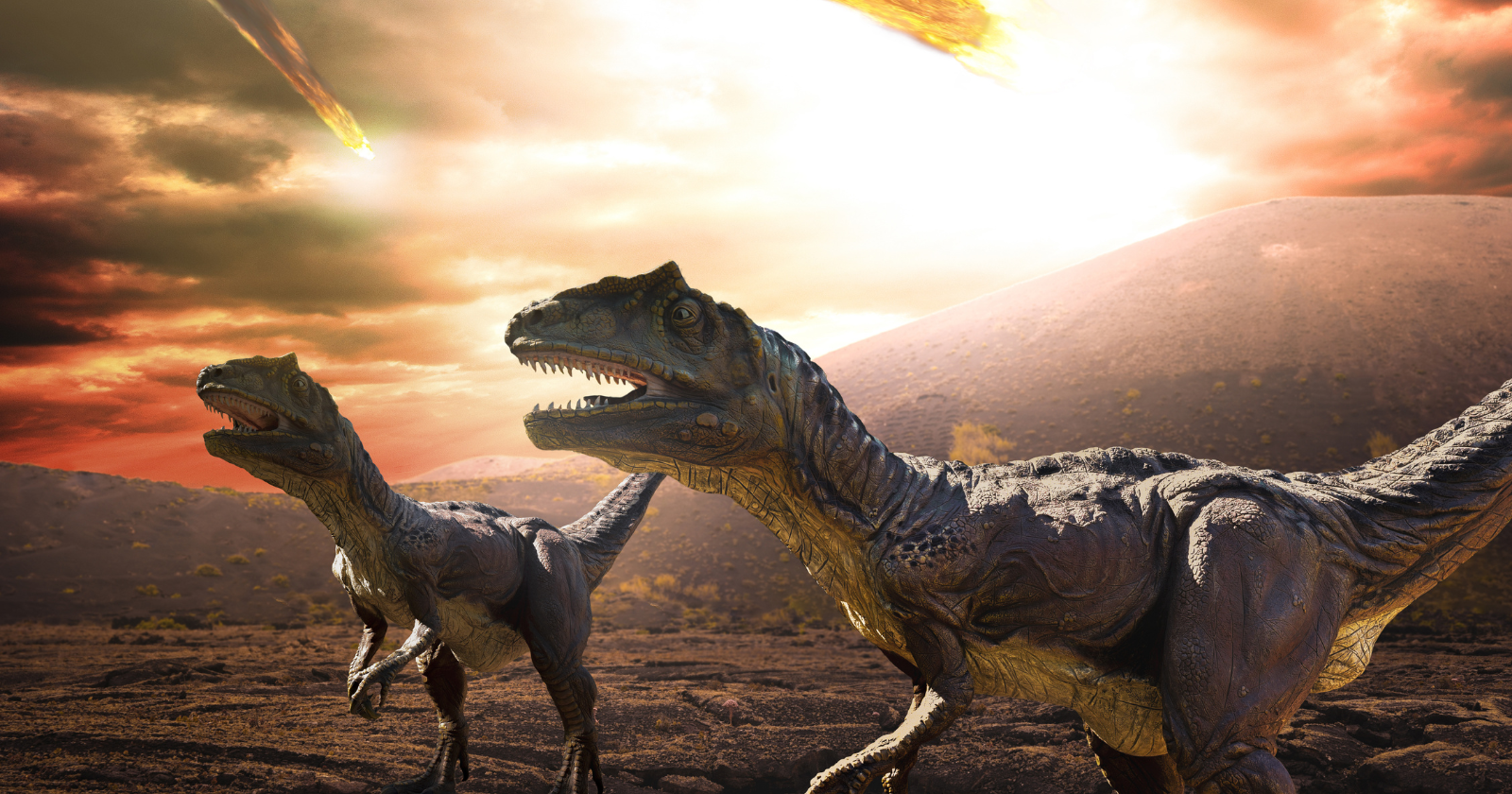
The asteroid that struck near Chicxulub, in what is now the Yucatán Peninsula, about 66 million years ago did not hit a random patch of the planet. It hit a shallow tropical seabed layered with sulphur-bearing rock and buried hydrocarbons. A 2017 paper in the journal Scientific Reports argues that this detail did much of the work. Its authors, Kunio Kaiho of Tohoku University and Naga Oshima of Japan’s Meteorological Research Institute, estimate that an asteroid of the same size hitting most other parts of the Earth’s surface would not have triggered a mass extinction at all.
This is one modelling study, not a settled consensus. The asteroid impact itself is about as well established as anything in the Earth sciences. The further claim, that the extinction depended on the geology beneath the impact, rests largely on this paper and the modelling behind it, and is worth treating as a serious argument rather than a closed case.
What is firmly established, and what the paper adds
The impact is not in question. The case for an asteroid strike at the end of the Cretaceous was made by Luis and Walter Alvarez and colleagues in 1980, and the Chicxulub crater was later identified as the site. That a roughly 10-kilometre asteroid hit the Earth then, and that a mass extinction followed, is mainstream science.
What Kaiho and Oshima add is a question about contingency. Their earlier work argued that the global extinction was driven less by the immediate blast than by the climate shock that followed. The heat of the impact burned hydrocarbons in the target rock and lofted soot high into the stratosphere, where it absorbed sunlight and cooled the surface for years. The 2017 paper takes that mechanism and asks a counterfactual: how much of the Earth’s surface, in the late Cretaceous, held enough hydrocarbon-rich rock to produce soot on that scale.
What the paper actually modelled
Their answer is about 13 per cent.
Using a coupled atmosphere-ocean climate model, the pair estimated how much soot different target rocks would have generated and what each case would have done to global temperature. In their results, only the hydrocarbon-rich coastal sediments, the kind found at Chicxulub, produced enough stratospheric soot to drive the severe, sustained cooling associated with the extinction. The authors put that cooling at roughly 8 to 11 degrees Celsius globally, with sharper drops on land, alongside a steep fall in rainfall. Rock with low to medium hydrocarbon content, which covered most of the planet including most of the ocean floor, produced milder cooling in the model, not enough to end the dinosaurs’ reign.
The 13 per cent figure is a model output, tied to a particular reconstruction of where hydrocarbon-rich rock lay 66 million years ago. It is not a measured property of the planet. It should be read as the result this model produced, not as a precise odds calculation.
A second line of argument about a worst case
Kaiho and Oshima’s paper is not the only one to suggest the impact was unusually severe for reasons beyond the asteroid’s size. In 2020, a team led by Gareth Collins at Imperial College London published work in Nature Communications on the impact’s trajectory. Reconstructing the crater’s buried structure, they argued the asteroid came in at a steep angle, around 60 degrees, from the northeast.
That angle matters because, in their simulations, a steep strike ejects more vaporised rock and climate-altering gas than either a grazing or a near-vertical one. The two papers are not the same argument. One concerns the chemistry of the ground that was hit; the other concerns the geometry of the strike. They point in a similar direction. Several independent features of the Chicxulub event, taken separately, look like the more damaging end of the range rather than the average.
What the argument does not show
A few limits are worth stating plainly.
The contingency claim is, by its nature, a counterfactual. There is no second Earth on which to test where else the asteroid might have landed, so the 13 per cent estimate cannot be checked directly. It stands or falls with the model and its inputs.
The soot mechanism itself is one interpretation rather than a closed question. Other work has emphasised sulphate aerosols from the vaporised sulphur-rich rock, and a 2023 study argued that fine silicate dust played a larger role in blocking sunlight than previously credited. These are not fringe positions. They indicate that the precise chain from impact to global cooling is still being worked out, and the weighting Kaiho and Oshima give to soot is part of that ongoing discussion.
There is also the longer dispute over the Deccan Traps, the enormous volcanic eruptions in present-day India that overlapped with the end of the Cretaceous. How much the eruptions contributed, alongside the impact, remains debated.
What survives all of that is a narrower and still interesting point. If the soot-driven cooling was the principal killer, then the composition of a few kilometres of rock in one corner of the Cretaceous world was part of the causal chain. The paper does not prove the dinosaurs would have lived had the asteroid struck elsewhere. It makes a specific, modelled case that they might have, and that the outcome was closer to a coin toss than the scale of the impact alone would suggest.
Whether that case strengthens depends on better reconstructions of late-Cretaceous geology and on which cooling mechanism the evidence ultimately favours. Both are still open.
