
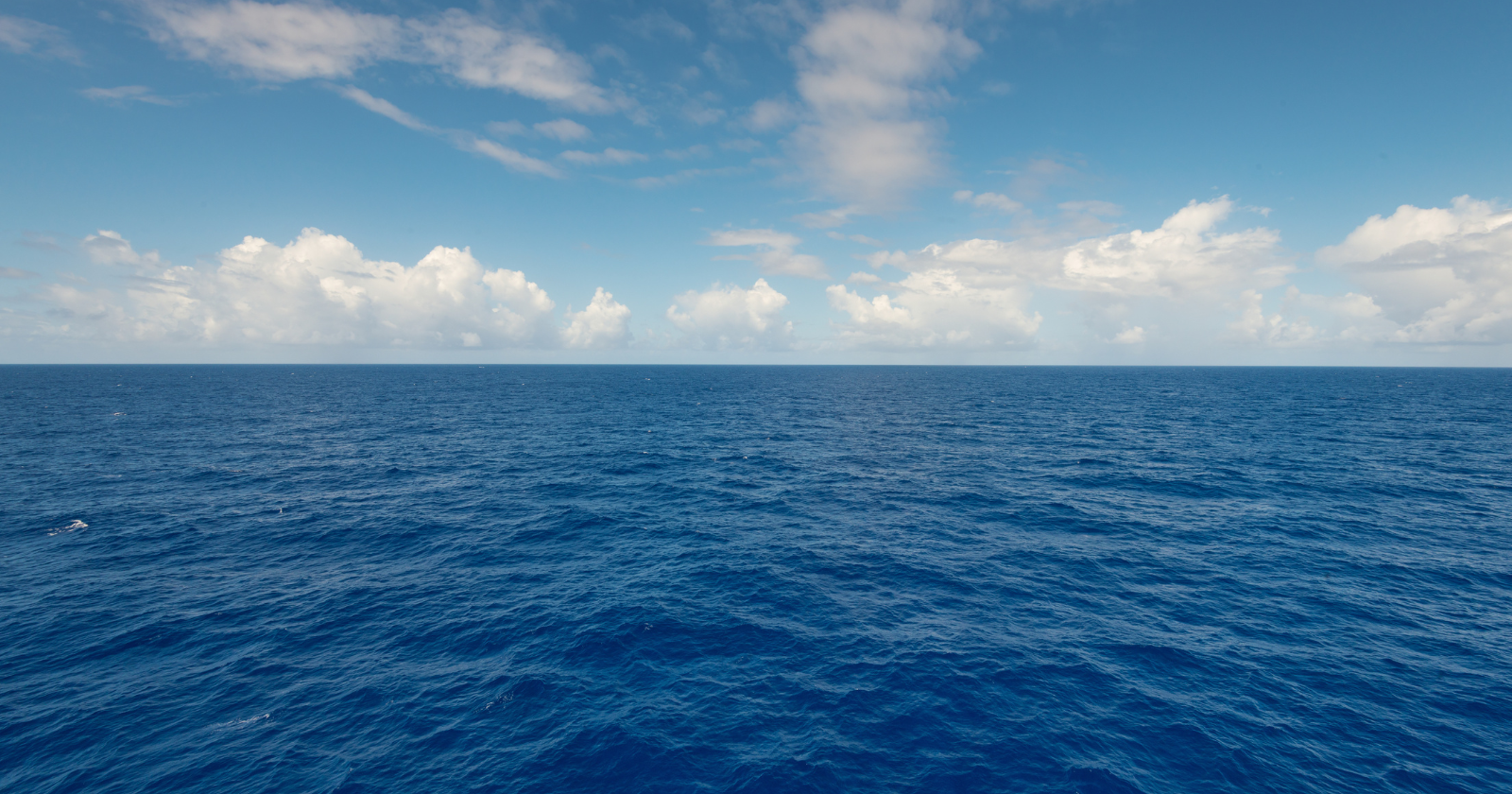
There is a location in the South Pacific so far from land that, for stretches of any given day, the closest human beings to it are not on the Earth’s surface at all. They are the crew of the International Space Station, passing roughly 400 kilometres overhead. The nearest land is about 2,688 kilometres away, and no one lives on it.
The place is called Point Nemo, and the coincidence is not only a curiosity. The same emptiness that puts the station’s crew nearer than anyone on land is the reason space agencies have been steering spacecraft into the water there for more than fifty years.
Where Point Nemo is, and why it is empty
Point Nemo is the oceanic pole of inaccessibility: the single point in the ocean farthest from any land. It sits at 48°52.6′S 123°23.6′W, in the South Pacific roughly between New Zealand and southern Chile. Three small, uninhabited pieces of land lie almost equidistant from it, each about 2,688 kilometres away. Ducie Island, in the Pitcairn group, lies to the north. Motu Nui, an islet near Rapa Nui, lies to the northeast. Maher Island, off the Antarctic coast, lies to the south.
The point was not found by an expedition.
It was calculated. In 1992 the Croatian-Canadian survey engineer Hrvoje Lukatela worked it out with a geospatial program, modelling the curvature of the Earth to find the spot at maximum distance from any coastline. Lukatela never went there. By his own account it is possible that no one has ever passed through the exact coordinates. The figure for Point Nemo is described well by the entry for the oceanic pole of inaccessibility in Encyclopaedia Britannica.
The water is around 4,000 metres deep. The point lies inside the South Pacific Gyre, a slow rotating system of currents that keeps nutrient-poor water moving through the region, which leaves marine life sparse. It is also well outside commercial shipping lanes.
Why spacecraft are brought down there
Not everything that comes back from orbit burns up.
Large structures, dense components, fuel tanks and pressure vessels can survive the heat of reentry and reach the surface as debris. For a controlled deorbit, an agency wants that wreckage to land where it can injure no one. Point Nemo, and the wider area around it, answers that requirement better than anywhere else on the planet.
Space agencies refer to the region formally as the South Pacific Ocean Uninhabited Area. The informal name is the spacecraft cemetery. It has been used for controlled disposals since 1971. By one widely cited count, more than 260 spacecraft were brought down in the region between 1971 and 2016, most of them Russian Progress cargo freighters, along with Japanese and European resupply craft and several space stations.
The largest object deliberately deorbited there so far is Mir. The Russian station made its final descent in March 2001, breaking up over the South Pacific after about fifteen years in orbit. It remains the heaviest single spacecraft brought down at Point Nemo.
The ISS is a different size of problem
Mir’s record is expected to be broken by the International Space Station. The ISS is several times heavier, with a mass of roughly 420 tonnes, and its main truss runs about 109 metres end to end. Letting a structure of that size come down on its own is not a workable option. An uncontrolled reentry would scatter surviving debris along a long and unpredictable ground track.
NASA’s plan, developed with the station’s international partners, is a controlled deorbit at the end of the station’s operational life, currently set at around 2030. In June 2024 the agency awarded SpaceX a contract worth up to 843 million US dollars to build the United States Deorbit Vehicle, a spacecraft based on SpaceX’s Dragon but heavily modified, carrying far more propellant and power than the cargo version. Unlike Dragon, the deorbit vehicle will be owned and operated by NASA rather than by SpaceX.
The sequence is staged. The station’s orbit is allowed to decay. The final crew departs. The deorbit vehicle, already docked, then fires to drive the station down on a steep, deliberate path aimed at the empty water near Point Nemo, so that whatever survives the breakup comes down far from anyone.
What is still unsettled
Two parts of this plan are worth watching. The first is timing. The 2030 retirement date appears throughout NASA’s budget documents, but it is not fixed. Members of the United States Congress have pressed to keep the station flying longer, and the deorbit vehicle contract itself includes the option to store the spacecraft on the ground into the mid-2030s if operations are extended. Russia has committed to the station only through 2028. The schedule is a stated plan, not a settled date.
The second is the disposal itself. The spacecraft cemetery lies in international waters, beyond the jurisdiction of any single country, which means it operates with relatively little formal oversight. Researchers have raised questions about the longer-term effect of decades of metal, composite material and propellant residue accumulating on the deep seabed. The volume is small set against the size of the ocean, and protecting people on land is exactly what the site is designed to do. The longer environmental account is less well understood.
The next deorbit into that water will be the largest ever attempted. When it happens, and whether the 2030 date holds, is still being decided.
