
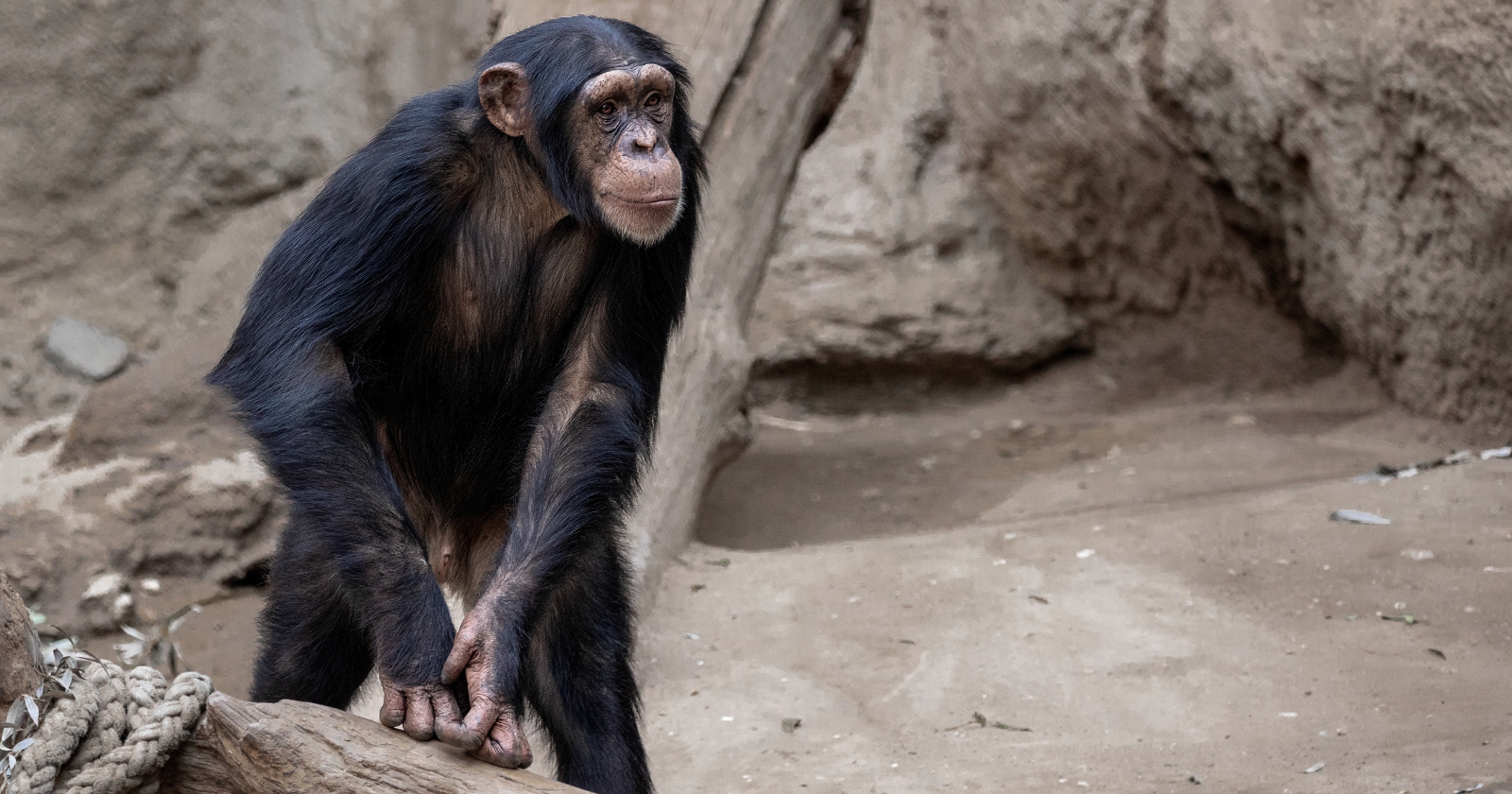
In January 1961, three months before Alan Shepard became the first American astronaut to travel into space, the United States space program launched a chimpanzee on a suborbital flight aboard the second Mercury-Redstone mission. The chimpanzee survived. The flight was the final test before the program was prepared to risk a human being on the same trajectory. The chimpanzee was, in a meaningful sense, the prerequisite for the entire American crewed space program that followed.
The chimpanzee was known to the public, throughout the lead-up to the mission and across the duration of the flight itself, as Number 65. The number was deliberate. NASA had made the decision to withhold any human name for the chimpanzee until the flight had been completed successfully. The concern was that if the chimpanzee died, the public response to the death of a named animal with a personality the public had attached to would be much harder to manage than the death of an anonymous test subject. The flight succeeded. The chimpanzee returned alive. The name was then released. The name was Ham.
Where Ham came from
The chimpanzee was born in July 1957 in what was then French Cameroon, in west central Africa. He was captured by animal trappers in the rainforests of his birth region, separated from his mother in circumstances the available documentation has been reticent about, and shipped to the United States, where he ended up at a Florida wildlife attraction called the Rare Bird Farm in Miami. The Rare Bird Farm was a commercial supplier of exotic animals to various buyers across the American market.
In July 1959, the United States Air Force purchased the young chimpanzee for $457. The purchase was part of a wider Air Force program to acquire chimpanzees for aerospace medical research, including the developing American space program. He was transferred from the Rare Bird Farm to Holloman Air Force Base, near Alamogordo in southern New Mexico. He was about two years old at the time. He was given the designation Number 65, standard practice for the chimps in the Holloman program. In handler-internal usage he was also called Chang.
Holloman Air Force Base was, in the late 1950s, the operational home of a specialized facility called the Holloman Aerospace Medical Center, responsible for the medical research and training the Air Force and the developing NASA program required. Britannica’s documentation of the program describes the setup directly. The center had acquired a colony of approximately 40 young chimpanzees, all from Cameroon or neighboring regions of west central Africa, and had been training them on a series of tasks designed for the requirements of spaceflight.
What the training involved
The training was more elaborate than the standard retelling suggests. The chimps were not, in any meaningful sense, just along for the ride. They were being prepared to perform specific cognitive tasks during the flight, which would allow the engineers on the ground to verify that a creature physiologically similar to a human could maintain functional cognition across the stresses of launch, weightlessness, and reentry.
The chimps were trained to operate a series of levers in response to light and sound cues. When a light came on, the chimp had about five seconds to pull the correct lever. A correct response within the time window produced a reward of a banana-flavored food pellet and a sip of water. An incorrect response, or a response that took longer than five seconds, produced a mild electric shock to the soles of the chimp’s feet. The conditioning was effective. The chimps learned the task quickly and performed it reliably.
They were also exposed to the physical stresses they would encounter during the actual flight. They were placed in centrifuges to simulate the g-forces of launch and reentry. They were placed in vacuum chambers to test their tolerance for variations in atmospheric pressure. They were placed in restraint chairs for extended periods to habituate them to the configuration they would actually be in during the spaceflight. The training proceeded across about eighteen months. The original group of 40 was gradually narrowed to 18, then to six finalists.
The six finalists were transferred from Holloman to Cape Canaveral, Florida, in early January 1961. They were separated into two groups to prevent the spread of any infection that might compromise the available candidates. On the morning of January 31, 1961, the Air Force veterinary team made the final selection. Number 65 was chosen. His alternate was a female chimp who would later be named Minnie.
The flight
The Mercury-Redstone 2 mission launched from Cape Canaveral at 11:54 a.m. Eastern Standard Time on January 31, 1961. The booster was a modified ballistic missile of the Redstone series, similar to the booster that would carry Alan Shepard into space about three months later. The capsule was a standard Mercury capsule, modified for the chimp passenger with a restraint chair, a panel of training levers, the physiological sensors required to monitor the subject’s condition, and the supply of banana pellets that constituted the reward system.
The flight did not go entirely according to plan. NASA’s own historical documentation describes what went wrong directly. The original flight plan had called for an altitude of 115 miles and speeds up to 4,400 mph. Due to technical problems with the booster, the capsule reached 157 miles and a speed of 5,857 mph, landing 422 miles downrange rather than the anticipated 290 miles. The reentry was correspondingly more severe than planned. The chimp experienced peak deceleration forces of about 14.7 g, nearly fifteen times normal gravity, which was substantially higher than the chimps had been exposed to during training.
The chimp performed his lever-pulling tasks throughout the flight, with only marginal degradation in performance. The significance was considerable. A creature physiologically similar to a human had been able to maintain functional cognition across an entire spaceflight, including the periods of weightlessness and the various acceleration stresses. On the available data, that was sufficient evidence for the engineering team to conclude a human being could probably do the same.
The capsule landed in the Atlantic Ocean about 60 miles from the recovery ship. The recovery operation took longer than mission planners had hoped, and the capsule took on water before the U.S.S. Donner could retrieve it. The chimp was, on the recovery team’s initial inspection, alive but agitated. He had spent 16 minutes and 39 seconds in flight, of which about 6.6 minutes had been in weightlessness.
The name
The chimp’s public identity changed in the hours after recovery. The Air Force and NASA released, for the first time, the name the handlers at Holloman had been using internally for some of the previous weeks. The name was Ham. AmericaSpace’s detailed account of the name’s origin describes it as an acronym for the Holloman Aerospace Medical Center, the facility that had trained him. The acronym was also a personal tribute to Lieutenant Colonel Hamilton “Ham” Blackshear, the commander of the Holloman Aeromedical Laboratory at the time.
Withholding the name until after the flight was a piece of public-relations engineering. NASA had been thinking about the public response that would follow a fatal mission outcome. The American public had, by then, become emotionally invested in the various preparations for the first crewed flights. A fatal mission with an unnamed chimp would have been a setback. A fatal mission with a named chimp the public had been encouraged to attach to would have been considerably worse. Withholding the name was the agency’s protection against the worse version of the public response.
The flight succeeded. The name was released. Ham appeared in the photographs the recovery team took aboard the U.S.S. Donner, smiling for the cameras in what the popular retelling absorbed as a piece of charming post-mission imagery. The smile was not actually a smile. Chimpanzees produce that particular facial expression as a response to fear or stress, not pleasure. The chimp was, more accurately, terrified. The expression got absorbed as a smile anyway.
What happened to Ham after the flight
Ham did not fly in space again. The Air Force kept him at Holloman for a period after the mission, then transferred him in 1963 to the National Zoo in Washington, D.C., where he lived alone for the next seventeen years. The isolation was inappropriate by any honest standard of how chimpanzees actually thrive. Chimpanzees are deeply social animals. The solitary confinement at the National Zoo was a continuation of the conditions that had defined Ham’s entire post-capture life.
In 1980, Ham was transferred to the North Carolina Zoo in Asheboro, where he lived with a small group of other chimpanzees for the remaining years of his life. He died on January 17, 1983, at about 25 years of age. NASA’s own records note that his skeleton was retained by the Armed Forces Institute of Pathology. His other remains were laid to rest in front of the International Space Hall of Fame at the New Mexico Museum of Space History in Alamogordo, near the air force base where he had been trained.
