
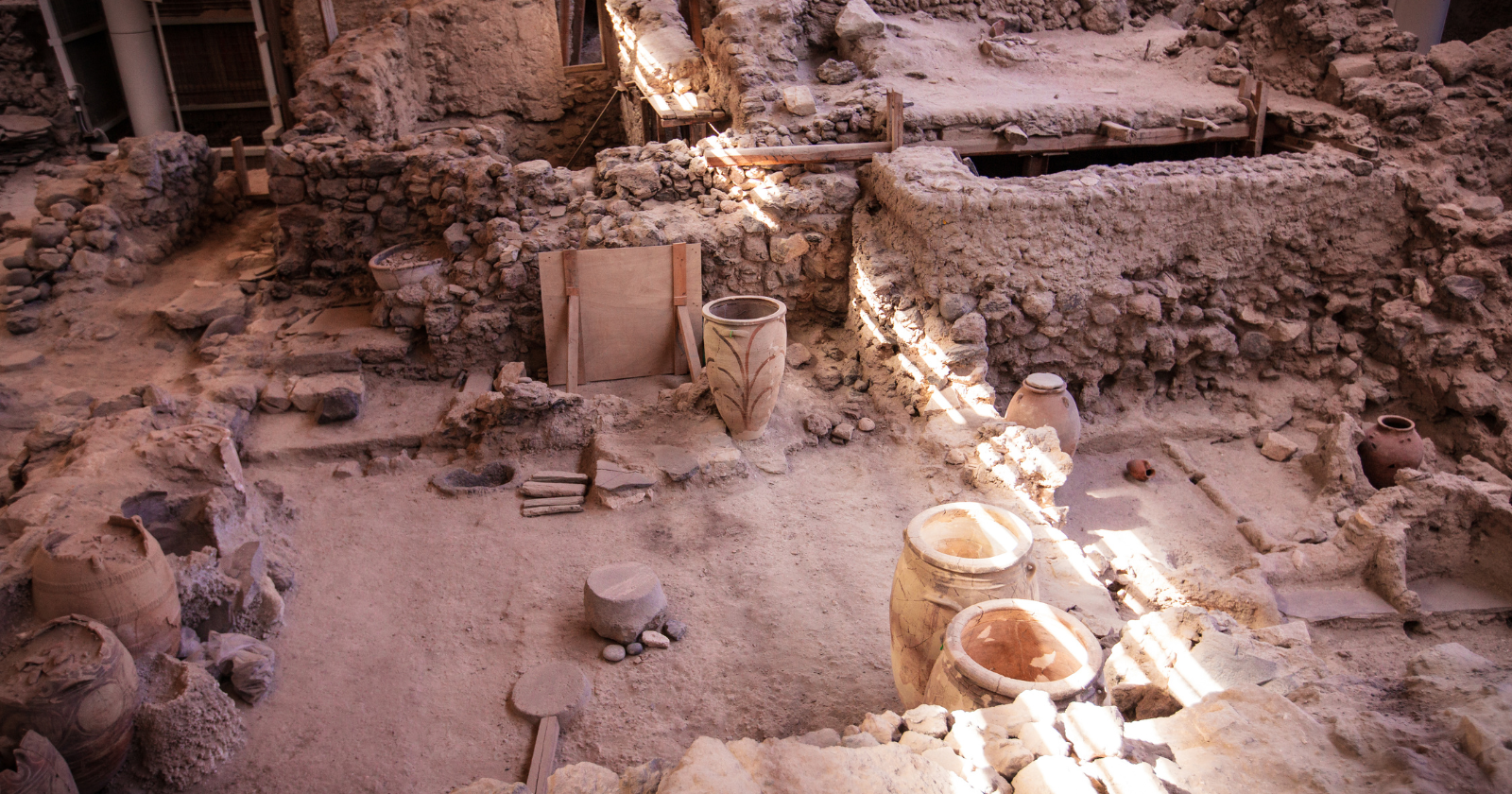
On a small Greek island in the southern Aegean Sea, sometime around 1600 BCE, the inhabitants of a Bronze Age city called Akrotiri did something that most populations facing imminent volcanic catastrophe across the subsequent three and a half millennia have mostly failed to do. They evacuated. They evacuated in time. They evacuated essentially everyone, took most of their valuables with them, and left the city to be entombed under about sixty meters of volcanic ash by what would turn out to be one of the largest eruptions in recorded human history.
The eruption was the Minoan eruption of Thera. It destroyed the island of Santorini in its previous geographic configuration. It sent tsunamis across the Aegean basin, deposited ash as far as Egypt, and was comparable in scale to the 1883 eruption of Krakatoa. It buried Akrotiri so completely that the city remained unknown for around 3,500 years. It also buried, on the evidence so far recovered, no one.
What the inhabitants saw coming, how they recognized it, and where they went afterward are among the more genuinely unsolved mysteries in the archaeological record of the Bronze Age Mediterranean.
What the absence of bodies establishes
It is worth being precise here, because the story has tended to circulate in vaguer terms than the evidence warrants.
Systematic excavation of Akrotiri began in 1967 under the direction of the Greek archaeologist Spyridon Marinatos, who had spent decades developing the theory that the Thera eruption was responsible for the collapse of Minoan civilization on Crete. Marinatos’s trenches began revealing the buried city within hours of being opened. The buried structures included multi-story buildings with intact frescoes, paved streets, an elaborate drainage system, storage vessels still containing their original contents, and the other features of a prosperous Bronze Age port city.
What the excavations have not revealed, across nearly six decades of subsequent work, is any human remains in eruption context. The absence is the most significant single feature of the site. Academic Press documentation of how this contrasts with Pompeii is direct. Pompeii, buried by Vesuvius in 79 CE, contains the plaster-cast remains of large numbers of victims caught in the eruption, including the famous figures in the Garden of the Fugitives. Akrotiri contains nothing comparable. The buildings are there. The streets are there. The contents of the storage rooms are there. The people are not.
The absence is accompanied by what else is missing. The site contains a striking lack of gold, silver, or other high-value portable goods. The inhabitants did not just leave. They took the valuables with them. The implication is that the evacuation was conducted with enough time and enough organization for the inhabitants to pack, gather portable wealth, and depart, leaving behind only what was too heavy or too perishable to be worth transporting.
How they knew the eruption was coming
How the inhabitants recognized what was coming is where the most substantial recent scientific work on Akrotiri has been concentrated. The answer is that the eruption was preceded by a sequence of precursor events that provided warning across what may have been weeks or months.
A peer-reviewed study in the Journal of Volcanology and Geothermal Research established the sequence directly. The study, by an international team of volcanologists and archaeologists, documents that the main Plinian eruption was preceded by a series of seismic and minor eruptive events whose deposits are still preserved in the stratigraphic record. The precursor events included earthquakes substantial enough to damage standing buildings, along with smaller volcanic emissions that would have signaled the rising magma below.
The archaeological evidence at Akrotiri matches the geological record. Excavators have found broken steps, collapsed walls, and entire houses that had partially given way before the main eruption occurred. The inhabitants had been repairing some of this damage in the period leading up to the evacuation. They had also gathered and stacked heaps of debris before abandoning the city, suggesting that the population had been actively responding to earthquake damage in the weeks or months before the final departure.
The physical damage to the city, combined with the smaller volcanic emissions the geological record indicates were occurring, would have provided multiple convergent warning signs. The people of Akrotiri were, by virtue of their maritime culture, accustomed to reading natural signals carefully. They were sailors. They had been operating in the Aegean for centuries. Their collective attentiveness to the environment is what allowed them to recognize what the precursor events were leading toward.
The eruption itself
The eruption that eventually buried Akrotiri was one of the largest explosive events in the last several thousand years of geological history. American Scientist’s documentation describes it as comparable in scale to the 1883 eruption of Krakatoa. It altered the geographic form of the island, replacing what had been a roughly circular landmass with the crescent-shaped caldera that constitutes modern Santorini. It deposited pumice up to 60 meters thick across portions of the surrounding terrain. All life on the island was extinguished.
It proceeded in phases. The initial Plinian phase produced the towering eruption column and the pumice fall that buried Akrotiri. Subsequent phases produced pyroclastic flows, the fast-moving currents of superheated gas and ash that are typically the most lethal feature of explosive eruptions. The collapse of the magma chamber under the island produced the caldera. The caldera collapse displaced massive volumes of seawater, generating tsunamis that propagated across the Aegean and damaged coastal communities at significant distances from Santorini.
The dating remains the subject of continuing scientific debate. Different methods have produced estimates ranging from about 1645 BCE to about 1600 BCE. Recent radiocarbon and dendrochronological work has been converging on a mid-16th-century BCE date, but the exact year remains uncertain. What is clear, regardless of the precise date, is that the eruption occurred during the height of Akrotiri’s prosperity, when the city was one of the more substantial trading centers in the eastern Mediterranean.
Where the people went
Where the inhabitants went after they left is where the genuinely unsolved part of the mystery lives. The archaeological record at Akrotiri tells us a great deal about the evacuation itself. It tells us almost nothing about what happened to the evacuees afterward.
Several hypotheses have been proposed. The first is that the inhabitants fled in boats to the nearby island of Crete or to other settlements in the Aegean network. The idea is plausible. The population of Akrotiri was maritime. They had the boats. They had the navigation skills. They had the trading relationships with other settlements in the region. The hypothesis would predict that some of the evacuees should appear in the archaeological records of nearby sites in the period following the eruption. The prediction has not been clearly confirmed.
The second hypothesis is that some or many of them were caught by the tsunamis generated when the caldera collapsed. The tsunamis were substantial. The displaced water would have been enough to overwhelm small vessels at significant distances from the eruption itself. A 2022 study published in the Proceedings of the National Academy of Sciences, led by Vasıf Şahoğlu of Ankara University and Beverly Goodman-Tchernov of the University of Haifa, documented the first human victims ever directly linked to the Thera eruption. The remains, including a young male and a dog, were recovered from tsunami deposits at the coastal site of Çeşme-Bağlararası in western Turkey, around 200 kilometers from Santorini. The site contained evidence of at least four consecutive tsunami waves that had inundated the settlement following the eruption. The Turkish finding establishes that the tsunamis claimed victims at significant distances from Santorini. It does not, in itself, indicate how many of the Akrotiri evacuees were among them.
The third hypothesis is that the evacuees survived and integrated into the wider populations of the Aegean, with their distinct identity lost across the centuries that followed. The idea is consistent with the absence of any archaeological signature of an “Akrotiri diaspora” in the surrounding region. It is also almost impossible to test, because the techniques required to identify the descendants of any specific Bronze Age population are limited.
The honest acknowledgment is that nobody knows what happened to the people who left Akrotiri before the eruption. The mystery is genuine. It is unlikely to be fully resolved.
Final words
The Bronze Age inhabitants of Akrotiri evacuated their city before the volcanic eruption that buried it sometime around 1600 BCE. They evacuated essentially everyone. They took most of their valuables with them. They left no bodies in the ruins. The evidence at the site, combined with the geological record of the eruption’s precursors, indicates that they had advance warning, that they recognized what they were seeing, and that they organized a coordinated departure across a period that may have run to weeks or months.
What they recognized, how they recognized it, and where they went afterward are among the more genuinely unresolved questions in Bronze Age Mediterranean studies. The geological record points to precursor earthquakes and minor volcanic emissions. The archaeological record shows the inhabitants were aware of the damage these events were causing. Together, these would have given convergent warning signs to a population already attentive, by virtue of its maritime culture, to environmental cues. The reading they did of those signs was accurate enough to save their lives.
The story is usually told as a piece of archaeological curiosity. It is also something else. It is one of the cleaner pieces of evidence we have that Bronze Age populations were capable of considerably more sophisticated risk assessment than pre-modern societies are usually given credit for. The people of Akrotiri read what was coming. They left in time. Where they went is unknown. What they understood, in the weeks before the eruption, is lost with them.
