
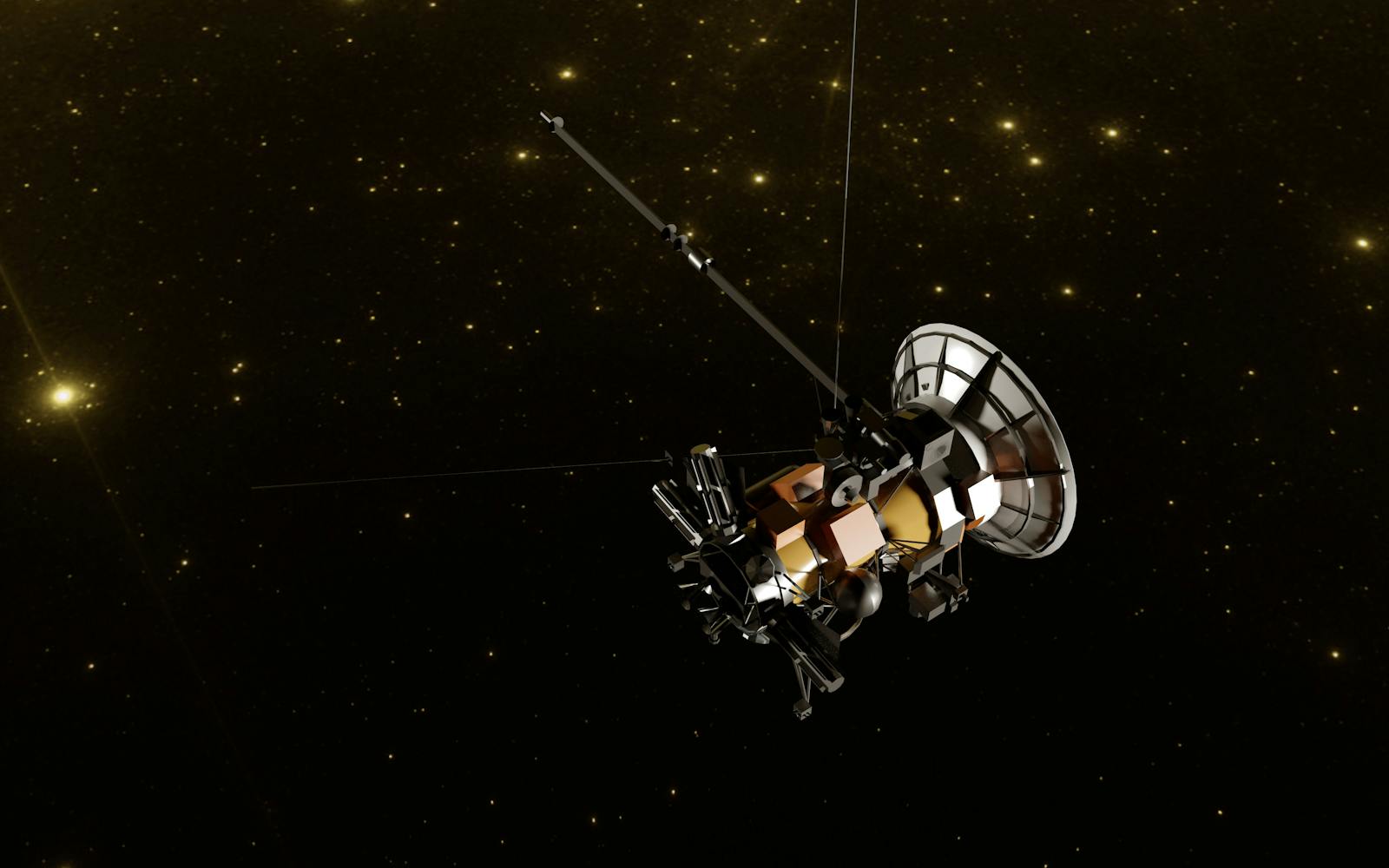
Voyager 1 was launched from Cape Canaveral on September 5, 1977. The spacecraft was, at the time of launch, designed for a five-year mission to fly past Jupiter and Saturn and return scientific data about the outer planets. It completed the mission. It then continued going. Forty-nine years after launch, it is now more than 15 billion miles from Earth, traveling at about 38,000 miles per hour relative to the Sun, in a direction no other human-made object has ever taken. A radio signal from Voyager 1 takes about 23 hours to reach Earth.
The conversation between Earth and Voyager 1 has been continuous, with occasional interruptions, since launch. It is the longest continuous conversation ever conducted across cosmic distances. It is also, on present evidence of how the spacecraft’s power source is running, going to end sometime around 2030.
The power source, and what is happening to it
Voyager 1 is powered by a radioisotope thermoelectric generator, abbreviated RTG. The RTG is the reason the conversation has been able to continue for nearly half a century. The device works by capturing the heat produced by the radioactive decay of plutonium-238 and converting that heat into electricity. The plutonium fuel has a half-life of 87.7 years, which means the device produces useful power for far longer than any chemical battery or solar panel could in the conditions Voyager 1 has been operating in. Solar panels would, at the spacecraft’s current distance from the Sun, produce essentially no useful power. The RTG has been the only available solution.
The problem is that the RTG, despite its longevity, is losing power. NASA’s own documentation of the system describes the loss rate directly: the RTG loses about four watts of available power each year, as the plutonium fuel slowly decays and the thermoelectric components themselves gradually degrade. Four watts per year is small in absolute terms. Across nearly fifty years of operation, it is considerable.
The RTG produced about 470 watts at launch in 1977. It produces somewhere under 270 watts now. The remaining power is enough to maintain the spacecraft’s basic operations and to keep two of its scientific instruments running. It is not, on the trajectory of its continued decline, going to be enough much longer.
What is still operating, and what has already been shut off
Voyager 1 launched with ten scientific instruments. The instruments included cameras, spectrometers, particle detectors, and other devices for studying the planets and the space between them. NASA has, across the decades since launch, been gradually turning the instruments off as power has declined. The first was shut off in 1980. The shutting-off has continued at irregular intervals ever since.
The most recent shutdown occurred on April 17, 2026. ScienceDaily’s coverage of the decision describes what was turned off. The instrument was the Low-Energy Charged Particle detector, designated LECP, which had been measuring ions, electrons, and radiation intensity in the space surrounding the probe. The LECP was the eighth of the original ten instruments to be deactivated. Two remain operational: the Plasma Wave Subsystem and the magnetometer.
The two remaining instruments are not going to stay operational indefinitely. NASA has been clear that available power will, sometime in the late 2020s or early 2030s, fall below the threshold required to operate any scientific instrument at all. At that point, the spacecraft will continue to maintain basic operational systems for some additional period, but the scientific mission, in any meaningful sense, will be over.
What NASA is doing to extend the mission
The honest acknowledgment is that the engineers managing Voyager 1 have been, across the entire history of the mission, far more creative about extending the spacecraft’s operational life than anyone at NASA in 1977 had any reason to expect. The five-year mission has become a fifty-year one. The extensions have involved a series of small operational adjustments that have allowed the spacecraft to continue producing scientific data long after the original mission parameters had ended.
The current effort is called the “Big Bang Project.” Universe Today’s coverage of the project describes the approach. The team is working to optimize how the various powered devices on both Voyager 1 and Voyager 2 consume their available energy, with the goal of pushing the mission into the mid-2030s. The optimization involves swapping out higher-power-consuming components for lower-power alternatives where possible, and adjusting the operational schedule of the remaining instruments to minimize cumulative power draw.
The Big Bang Project will be tested first on Voyager 2, which is closer to Earth and accordingly easier to communicate with. Tests are scheduled for May and June 2026. If the implementation succeeds on Voyager 2, the same approach will be applied to Voyager 1 no earlier than July. If everything works, the LECP that was just shut down could in principle be reactivated, and the scientific mission could continue into the mid-2030s rather than ending in 2030.
The success of the project is not guaranteed. The spacecraft was built during the Ford administration. The hardware is approaching its fiftieth year of continuous operation in conditions that would have destroyed almost any other device. The components are increasingly vulnerable to unexpected failures that the engineers will not, by virtue of the 23-hour communication delay, be able to respond to in real time.
What the end will look like
The end of the conversation will not be a single dramatic event. It will be the slow gradual fading of the spacecraft’s operations as available power continues to decline.
The science instruments will be shut off, one by one, in the same pattern that has been operating for forty-five years. Non-essential systems will be deactivated. The heaters that keep the fuel lines from freezing will, at some point, become impossible to maintain. CNN’s reporting on the mission notes that Voyager project manager Suzy Dodd has been explicit about what that would mean. If propellant lines freeze on either probe and the antennae point elsewhere as a result, “we would lose the mission because we could no longer get a signal to the spacecraft.”
At some point, available power will fall below the threshold required to operate the radio transmitter. The spacecraft will then go silent. The silence will not be the result of any specific failure. It will be the slow consequence of the plutonium fuel having decayed to the point where insufficient heat remains to produce the electricity the transmitter requires. The spacecraft will continue traveling outward, into interstellar space, for far longer than anyone currently alive will be around to track. BBC Sky at Night Magazine notes that NASA estimates Voyager 1 will pass within 1.7 light-years of the faint red dwarf star Gliese 445 around the year 40,272. The silence will be permanent only with respect to the conversation. The spacecraft itself will continue.
The end of Voyager 1’s transmissions will mark the end of the longest continuous conversation any human civilization has ever conducted with anything beyond the immediate vicinity of its home planet. The conversation has been going on for nearly fifty years. It has involved thousands of scientists and engineers across multiple generations. It will, sometime around 2030, simply end.
Final words
Voyager 1 is currently more than 15 billion miles from Earth, traveling outward at about 38,000 miles per hour, in a direction that will eventually take it past various nearby stars over the coming hundreds of thousands of years. Its plutonium-powered radioisotope thermoelectric generator is losing about four watts of power each year. Two of the original ten scientific instruments are still operating. The remaining ones will be shut off across the coming years. The mission will, sometime around 2030 or shortly thereafter, come to an end.
NASA’s Big Bang Project is attempting to push the mission into the mid-2030s by optimizing how the remaining power is consumed. The project may or may not succeed. The engineering accomplishment of having kept the spacecraft operating for nearly fifty years, against the original five-year mission parameters, is not in any meaningful doubt regardless of what the Big Bang Project produces. It has been one of the more substantial pieces of sustained scientific work the wider civilization has conducted across the contemporary period.
What is going to end, sometime around 2030, is not just the operational life of a single spacecraft. What is going to end is the longest continuous conversation human civilization has ever conducted across cosmic distances. The ending will be quiet. It will be the slow consequence of the decay of a small piece of radioactive material that has, across nearly fifty years, been doing the work of allowing the conversation to continue. The conversation has been something genuinely unprecedented in human history, and it is worth taking seriously while it still exists, before the silence arrives and the taking has to be done in retrospect.
