
In May 1964, a chart recorder at Bell Telephone Laboratories registered more microwave power from the sky than Arno Penzias and Robert Wilson could explain. The discrepancy was small, equivalent to only a few degrees above absolute zero, but their instrument had been built precisely enough that the excess could not be ignored.
The familiar version of what followed is a story about pigeons, persistence and a fortunate telephone call. All three belong in it. Yet the discovery of the cosmic microwave background was less a sudden revelation than a year-long process of measurement, elimination and cautious interpretation. Wilson’s 1978 Nobel lecture provides a particularly detailed account of what the two radio astronomers actually did.
An antenna built to reject the ground
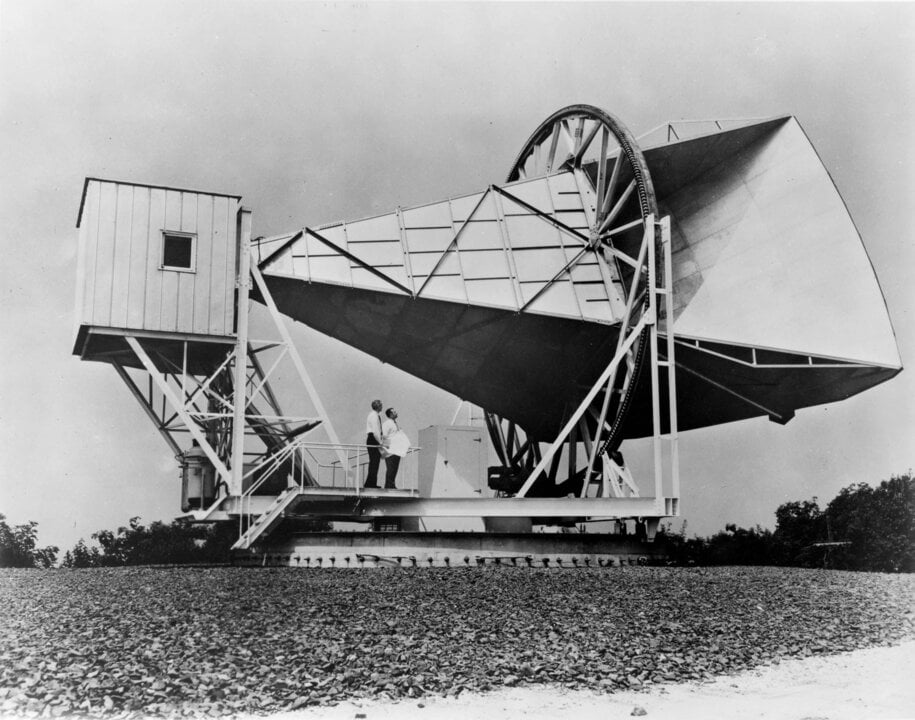
The 20-foot horn reflector at Crawford Hill in Holmdel, New Jersey, had not been designed to investigate the beginning of the universe. Bell Labs built it in 1960 to receive radio signals bounced from NASA’s Echo balloon satellite. By 1963 it was no longer needed for that work, and Penzias and Wilson began adapting it for radio astronomy.
Its unusual shape was central to the discovery. The large flared horn shielded the receiver from microwave radiation emitted by the warm ground. Wilson later calculated that the antenna’s response behind it was less than one three-thousandth of what an equally sensitive receiver exposed in all directions would collect. It could therefore make unusually clean absolute measurements of weak radio emission from the sky.
The receiver was also compared with a carefully characterised reference source cooled by liquid helium. That calibration system allowed the pair to account for noise generated by the receiver itself. They intended to measure the brightness of known astronomical sources and eventually the faint radio halo of the Milky Way. Before that work could proceed, however, they had to understand why their antenna seemed warmer than expected.
The hiss survived every local explanation
The unexplained signal was not audible sound coming directly from the horn. It was excess microwave power displayed by the radiometer, readily described as the equivalent of a faint radio hiss. When all known contributions were subtracted, Penzias and Wilson were left with an antenna temperature of roughly 3.5 kelvin.
They tested the obvious possibilities. Measurements of the atmosphere did not supply enough noise. Pointing towards New York City did not reveal a hidden source of human-made interference. Emission from the Milky Way and discrete radio sources should have varied with direction, whereas the unexplained component was present wherever the antenna looked. It also lacked seasonal variation.
That left the instrument. The horn’s narrow throat was examined, its components were checked for losses, and attention turned to the joints between its riveted aluminium sheets. As Wilson recalled, the pair had no simple way to calculate how much those joints might contribute. They later covered them with aluminium tape, effectively testing the loose-joint explanation. The result was only a minor reduction.
Then there were the pigeons. A pair had been roosting in the horn and had coated part of its interior with droppings. Penzias and Wilson removed the birds and cleaned the antenna. The signal fell slightly but did not disappear. In Wilson’s account, the thorough cleaning, taped rivets and disassembly of the throat came in the spring of 1965, after other planned measurements had been completed. By then, almost a year had passed.
The elapsed time ruled out still more possibilities. A source within the Solar System should have shifted position relative to the antenna. Radiation associated with charged particles left in the Van Allen belts by a 1962 high-altitude nuclear test should have diminished. The residual stayed remarkably constant.
The missing link was a call to MIT
The title’s reference to a Princeton physicist captures the eventual connection but compresses its route. Penzias first mentioned the unexplained noise to Bernard Burke at the Massachusetts Institute of Technology. Burke had heard about theoretical work by P. James Peebles in Robert Dicke’s group at Princeton and directed Penzias towards it.
Penzias then telephoned Dicke. The Princeton group sent Peebles’ preprint and soon visited Bell Labs to inspect the apparatus and discuss the measurements. Dicke, Peebles, Peter Roll and David Wilkinson were already preparing an instrument to search for relic thermal radiation from an early hot phase of the universe. The Bell Labs signal was close to what they hoped to detect.
The two groups divided the result cleanly. Penzias and Wilson reported the observation in “A Measurement of Excess Antenna Temperature at 4080 Mc/s”. Their short paper described an isotropic, unpolarised signal without seasonal variation and avoided committing to a cosmological origin. The adjacent Princeton paper, “Cosmic Black-Body Radiation”, set out the early-universe interpretation.
This was not simply a theorist telling two experimenters what they had found. The Bell Labs team supplied a careful measurement that had survived extensive attempts to disprove it. The Princeton team recognised its cosmological meaning and connected it to a physical model. Each paper did something the other did not.
What “oldest light” means
The cosmic microwave background is commonly called the oldest light in the universe, but it is not light emitted at the instant of the Big Bang. The early universe was a hot, opaque plasma in which photons repeatedly scattered from charged particles. Only after it expanded and cooled enough for electrons and nuclei to form neutral atoms could radiation travel freely.
That transition occurred about 380,000 years after the universe began. Expansion has since stretched the radiation’s wavelengths into the microwave part of the spectrum and cooled its black-body temperature to about 2.7 kelvin. As NASA’s account of the COBE mission explains, later spacecraft separated foreground emission and mapped tiny temperature variations in this ancient radiation.
Penzias and Wilson’s horn could not make such a map. It measured the background at one frequency, 4.080 gigahertz, and found that the excess was nearly the same in all observed directions. Subsequent measurements across other wavelengths established the distinctive black-body spectrum. COBE later measured that spectrum with far greater precision, while COBE, WMAP and Planck mapped fluctuations that record the seeds of later cosmic structure.
A discovery made by refusing to discard noise
The result helped turn the hot Big Bang from a contested cosmological model into the standard account of the universe’s early history. Penzias and Wilson shared half of the 1978 Nobel Prize in Physics for the discovery.
The pigeons remain memorable because they make the story human, but the decisive work was less picturesque. It consisted of calibration, accounting, repeated measurements and the refusal to label an inconvenient residual as instrument error without evidence. The signal became cosmology only after the mundane explanations had been taken seriously and tested.