
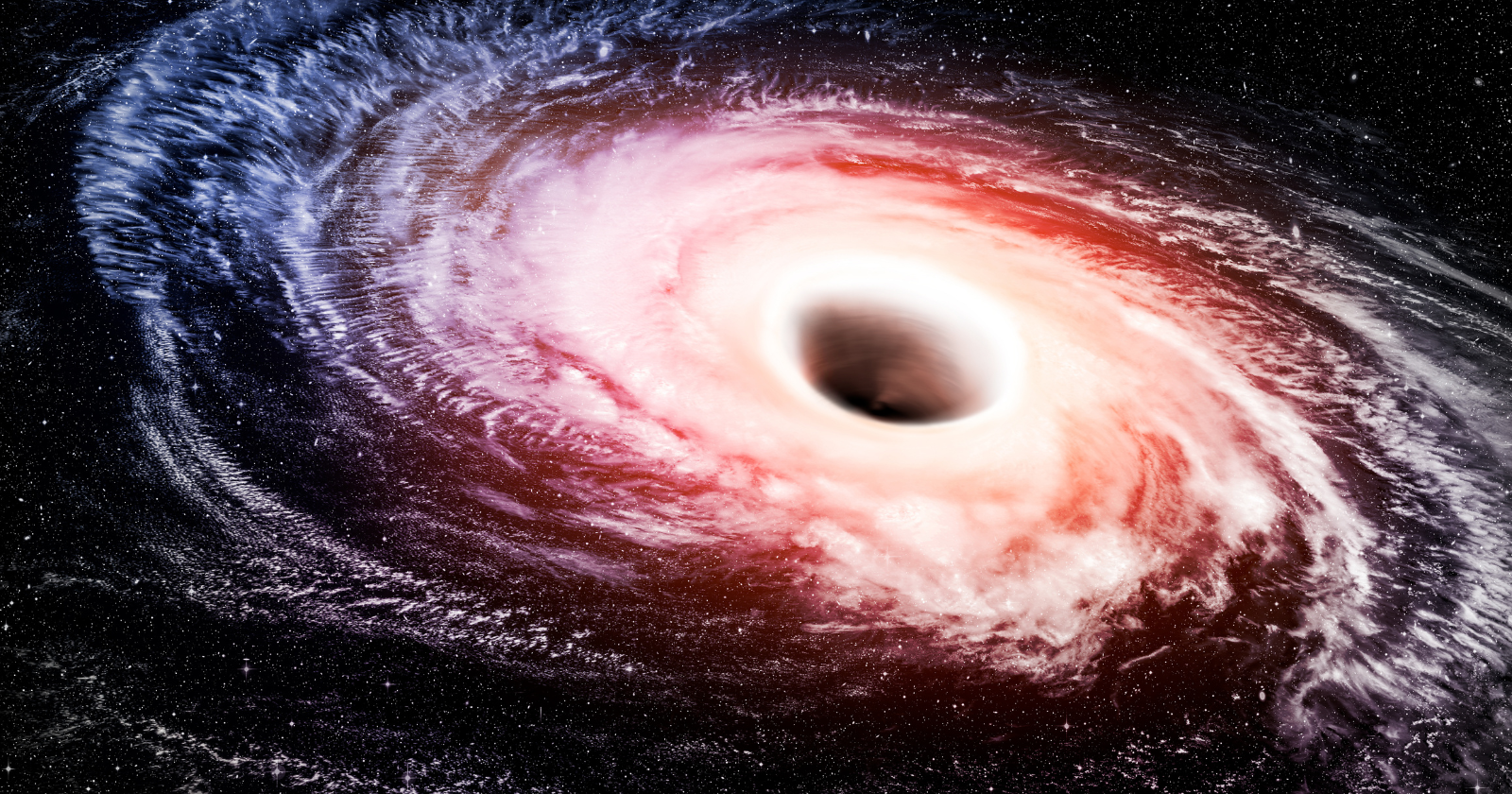
It comes from a study led by Marius Cautun of the Institute for Computational Cosmology at Durham University, published in Monthly Notices of the Royal Astronomical Society. The study modelled the Large Magellanic Cloud, the largest of the Milky Way’s satellite galaxies, falling inward and merging with our own. One consequence the simulations point to is that the Milky Way’s central black hole, currently subsisting on very little, would be fed a large supply of fresh gas.
This is one study built on cosmological simulations, not a settled prediction of the Milky Way’s future. The finding is worth taking seriously, but it should not be read as the final word. What follows is what the paper actually argues, and where the uncertainty sits.
Why the black hole is quiet now
At the centre of the Milky Way is Sagittarius A*, a black hole of about four million solar masses. By the standards of black holes at the centres of galaxies, it is modest in size, and at present it is barely doing anything. It flares from time to time as small amounts of material fall in, but it is not the brilliant, energetic object that the centres of some other galaxies are.
A black hole is not luminous in itself. What produces the dramatic output of an active galactic nucleus is matter falling toward the black hole, heating as it crowds into a dense disc, and radiating fiercely before it crosses the point of no return. A black hole shines only when it is being fed. Sagittarius A* is quiet because, for now, very little gas is reaching it. The reservoir is low, not the appetite.
What the collision would deliver
The Large Magellanic Cloud is visible from the southern hemisphere as a smudge of light. It is a substantial galaxy in its own right, with something like a tenth of the Milky Way’s mass once dark matter is counted, and it carries a large quantity of gas.
For a long time the Large Magellanic Cloud was assumed to be either in a stable long orbit or merely passing by. The Cautun study, drawing on revised and higher estimates of its mass, argues instead that it is losing orbital energy to the surrounding dark matter and will spiral inward. The paper’s central estimate is that it will merge with the Milky Way in about 2.4 billion years, with an uncertainty of roughly plus 1.2 and minus 0.8 billion years. “Roughly two billion years from now” sits comfortably inside that range.
A merger of that kind does not deliver gas tidily. It disturbs the orbits of gas and stars across the inner galaxy, and some of that gas loses the angular momentum that currently keeps it circling at a safe distance. Gas that loses angular momentum falls inward. The study’s argument is that this disturbance would route a fresh supply toward the galactic centre, within reach of Sagittarius A*. According to the paper, the black hole could grow by up to a factor of eight as it consumes that material. A black hole that is fed becomes a black hole that shines, and on this picture Sagittarius A* would brighten into something closer to an active nucleus than the quiet object it is today.
What this does not mean
An awakened galactic centre sounds alarming, and it is worth being plain about scale and distance before the picture runs away.
The Solar System sits roughly 26,000 light years from the galactic centre. An active Sagittarius A* would be a remarkable thing to observe, and its radiation and outflows would matter a great deal in the inner galaxy, but this is not a forecast of the Earth being engulfed or sterilised. The event is also placed billions of years in the future, on a timescale over which the Sun’s own evolution is the more immediate concern for any life on Earth. This is a statement about the long-term behaviour of the galaxy, not a hazard with a countdown.
It is also worth keeping this collision separate from the more familiar one. The predicted merger with the much larger Andromeda galaxy is usually placed around four to five billion years from now, though recent work has reopened how likely a direct collision is. The Large Magellanic Cloud merger, on the Cautun study’s reckoning, would come first. The two are different events on different timescales, and the Large Magellanic Cloud is the smaller, nearer one.
How firm the prediction is
The result rests on simulations, and simulations depend on their inputs. The most important input here is the mass of the Large Magellanic Cloud, including its dark matter halo, which cannot be weighed directly and has been revised upward in recent years. The conclusion that the galaxy will spiral in, rather than orbit or escape, depends on that heavier mass being correct. The timing carries its stated error bars for good reason.
The downstream steps add their own uncertainty. How much gas actually reaches Sagittarius A*, how efficiently it is consumed, and how bright the result becomes are all modelled quantities, not measured ones. The “up to a factor of eight” growth is an upper estimate from the simulations, not a guaranteed outcome.
What the study establishes is narrower than the headline, and still worth stating clearly: on current best estimates of its mass, the Large Magellanic Cloud is most likely on an inward path, and a merger of that kind is the sort of event that can feed a dormant galactic black hole. The open question is how much the mass estimates will shift as measurements improve, because the date, and whether the picture holds at all, moves with them.
