
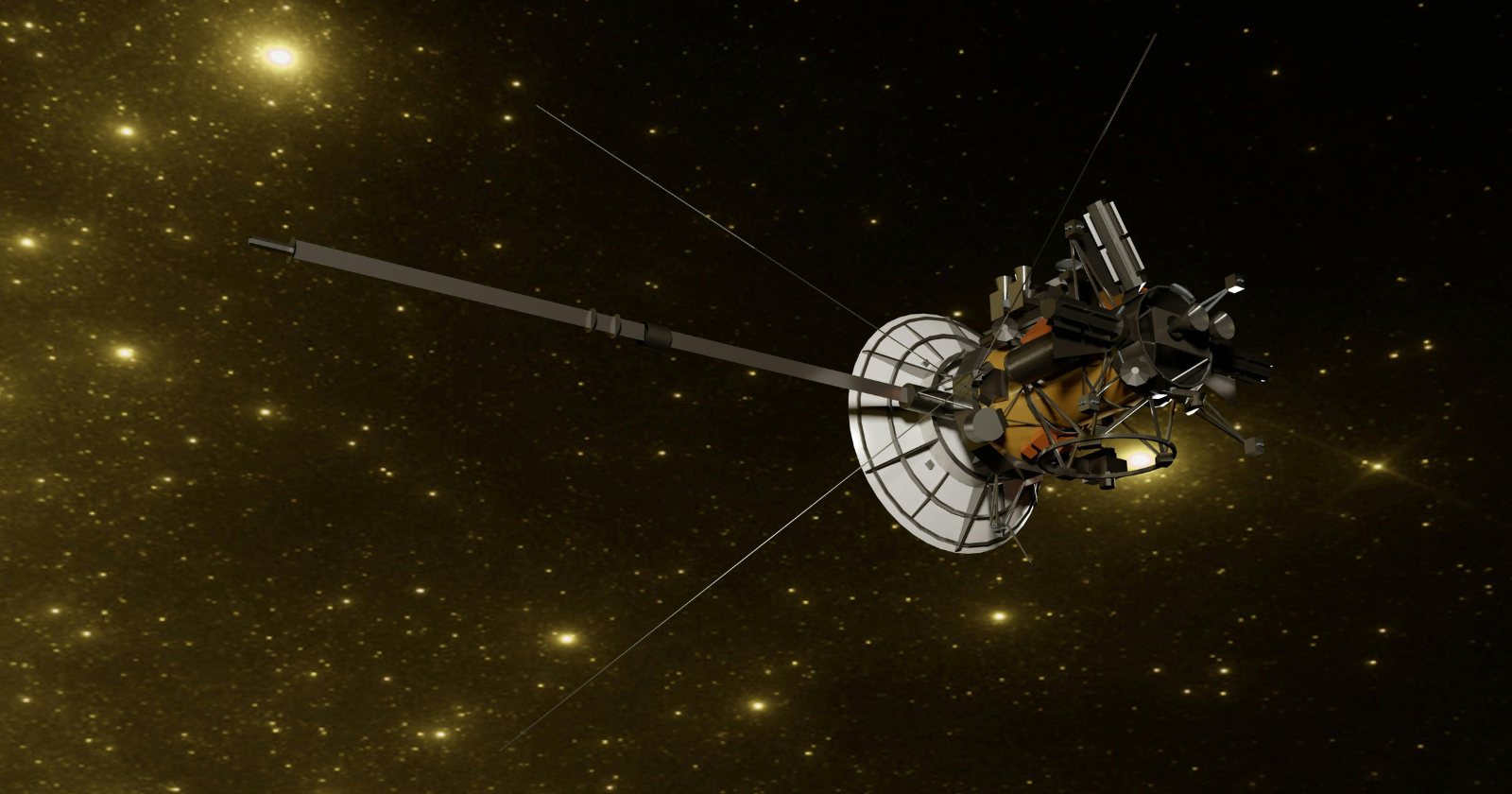
Navigators tracking NASA’s Pioneer 10 and Pioneer 11 spacecraft could see something in the data they could not fully account for. Both probes, by then far beyond their planetary encounters, appeared to be experiencing a tiny sunward acceleration. In practical terms, they were not receding quite as fast as the models predicted, and no known push on the craft accounted for the difference. In June 2012, a team led by Slava Turyshev at NASA’s Jet Propulsion Laboratory published a paper in Physical Review Letters arguing that the force was the probes’ own heat, radiating away unevenly.
The effect was tiny. It was also persistent enough, and consistent enough, to keep physicists arguing about it for years.
What the navigators saw
Pioneer 10 and Pioneer 11 launched in 1972 and 1973, the first spacecraft to cross the asteroid belt and return close-range data from Jupiter and, in Pioneer 11’s case, Saturn. After those encounters, both continued outward on escape trajectories from the solar system.
In the early 1980s, as the probes moved out toward Saturn’s distance and beyond, navigators noticed that the Doppler signal coming back from each craft did not quite match the predicted trajectory. The mismatch corresponded to a small extra deceleration, pointed roughly back toward the Sun. The figure usually cited was around 8.74 x 10^-10 metres per second squared, far too small to matter for the mission itself, but too steady to dismiss as noise.
Because the deceleration was directed sunward, and because it appeared on two separate spacecraft of similar design, it was hard to attribute to a simple tracking error. It became known as the Pioneer anomaly.
Why it drew so much attention
An unexplained sunward force on a spacecraft is, in principle, the kind of thing that could point to new physics. Over the years, proposed explanations ranged from the conventional to the speculative: leftover propellant venting from the craft, drag from interplanetary dust, errors in the tracking model, or modifications to gravity itself at large distances.
That last category is what gave the anomaly its reputation. If the force could not be explained by anything on or near the spacecraft, one possibility raised was that gravity itself behaved slightly differently than expected far from the Sun. That idea was never the leading explanation among most of the physicists working on the problem, but it was enough to keep the anomaly in view well beyond the navigation community.
Recovering the data
Settling the question required data that had nearly been lost. The Pioneers had flown in an era of punch cards and magnetic tape, and the relevant records were scattered across NASA archives in formats that were no longer easy to read.
Beginning in 2004, Turyshev and colleagues set out to recover them, with support that later included the Planetary Society. The effort pulled together both the Doppler tracking data and the telemetry, the housekeeping data describing power use and temperatures aboard each craft. By some accounts the recovered material ran to tens of gigabytes, and one of the tape machines needed to read it was retrieved shortly before being discarded.
The extended record changed the picture in one important way. With a longer span of tracking data, the anomalous acceleration was not constant. It was slowly decreasing over time.
The thermal explanation
A decaying force pointed toward an ordinary cause. The Pioneers were powered by radioisotope thermoelectric generators, and their instruments dissipated heat as they ran. A spacecraft that radiates heat more strongly from one side than the other feels a small push in the opposite direction, the same principle, in the description Turyshev gave in JPL’s announcement of the result, as the faint backward pressure of light from a car’s headlights.
Using the recovered telemetry as input, the team built a detailed finite-element thermal model of each spacecraft, then calculated the recoil force from the uneven emission of that heat. The 2012 paper reported that the magnitude, the direction, and the gradual decline of the modelled thermal force all matched the observed anomaly. As the radioisotope generators cooled over the years and the instruments drew less power, the recoil force weakened, which accounted for the decay the longer dataset had revealed. The paper concluded that once the thermal recoil force was properly accounted for, no anomalous acceleration remained.
How settled the result is
The thermal explanation is not the conclusion of one group working alone. Independent teams, including researchers in Portugal and at the ZARM centre in Germany, had built their own thermal models and reached broadly similar conclusions, and the Turyshev paper is generally regarded as the most detailed of these analyses. A small number of researchers, among them John Anderson, who had been involved in characterising the anomaly in the first place, continued to explore non-thermal accounts.
The wider lesson is a quieter one than the new-physics framing that the anomaly sometimes attracted. A persistent, unexplained signal turned out to be the spacecraft measuring an effect of their own engineering, visible only because the tracking was precise enough to detect a force that small. For navigators planning future deep-space missions, the practical result is that thermal recoil is now something to be modelled in advance rather than discovered later in the residuals.
