
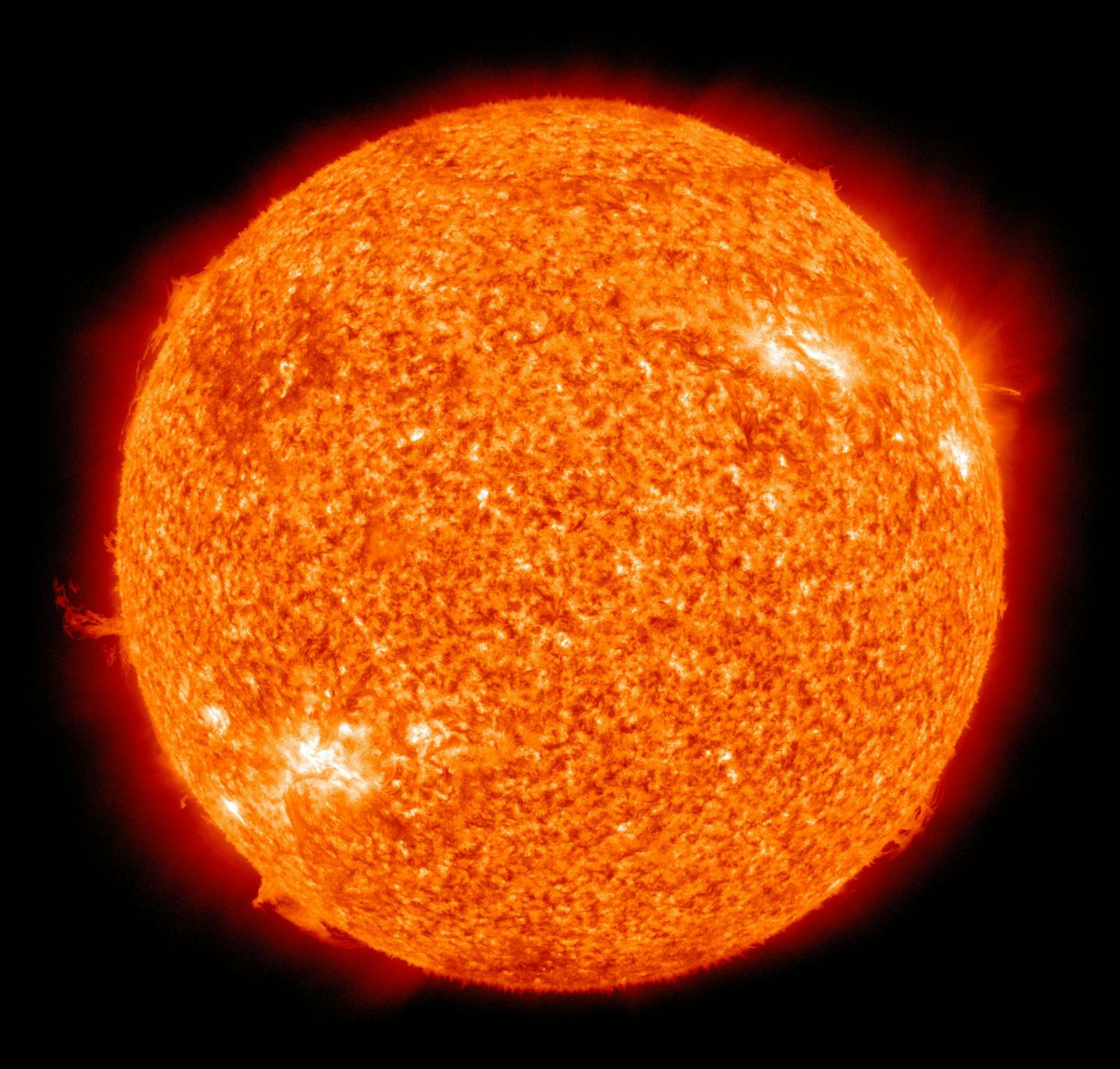
On the front of the Parker Solar Probe, a slab of carbon foam four and a half inches thick is glowing at around 2,500 degrees Fahrenheit. Less than a meter behind it, the science instruments sit at roughly room temperature, taking measurements as if they were in a laboratory in Maryland.
That gap, between a face hot enough to soften steel and a payload bay cool enough to touch, is the central trick of the entire mission. It is also the reason a probe to the Sun’s corona, an idea first proposed in 1958, took sixty years to fly.
Sixty years waiting for a material
The concept was proposed the same year NASA was founded. In October 1958, the National Academy of Sciences Space Studies Board issued an interim report from a committee chaired by University of Chicago physicist John Simpson, recommending a spacecraft that would fly inside the orbit of Mercury and sample the particles and fields near the Sun directly. The mission editorial in Space Science Reviews traces the lineage of every subsequent solar probe proposal back to that one document.
Nothing in the materials catalog could survive the conditions. Decade after decade the mission was sketched out, costed, and shelved. Trajectories that used Jupiter for a gravity assist required a nuclear power source, since solar panels are nearly useless that far out. A redesign in the mid-2000s switched the plan to seven Venus flybys instead, which kept the spacecraft close enough to the Sun to run on photovoltaics but pushed the engineering problem onto the heat shield.
The carbon-carbon composite with a carbon foam core that eventually made the mission possible did not exist as a flight-rated material until engineers at Johns Hopkins Applied Physics Laboratory and Carbon-Carbon Advanced Technologies developed it specifically for this spacecraft. The engineering effort behind the shield spanned two decades.
The Thermal Protection System is a sandwich. Two sheets of carbon-carbon composite, each less than a tenth of an inch thick, enclose a core of carbon foam that is roughly 97 percent air. The whole assembly is about 4.5 inches thick and eight feet across, roughly the depth of a hardback book and the diameter of a small car. NASA’s installation page notes the entire shield weighs only about 160 pounds.
On one side: a glowing red disk hot enough to forge steel. On the other: electronics running at the temperature of a comfortable office, around 85 degrees Fahrenheit. The Sun-facing face is coated with a bright white aluminum-oxide ceramic, layered over a tungsten film thinner than a human hair to keep the carbon from darkening the coating. The point of the white face is to throw photons back into space as fast as they arrive.
The physics is counterintuitive. Most people assume the corona, where temperatures reach a few million degrees, would melt anything that flew through it. But temperature and heat are not the same thing. The corona is extraordinarily hot, but it is also extraordinarily thin. There are very few particles per cubic centimeter to actually deposit energy into the shield.
The dominant heat load on Parker is not the plasma it flies through. It is sunlight, photons hitting the front face, and the shield is engineered to radiate that energy back out into space as fast as it arrives. Lava from a volcanic eruption is cooler than the shield face but would destroy the spacecraft instantly, because the dense rock carries enormously more energy per unit volume than the thin coronal plasma.
Instruments that ride in the shade
Behind the shield sit four instrument suites, each specialized for a different aspect of the near-Sun environment. NASA’s instrument page describes them in detail.
FIELDS, led by Stuart Bale at the University of California, Berkeley, measures electric and magnetic fields. Several of its antennas stick out beyond the heat shield into direct sunlight, where they reach temperatures around 2,500 degrees Fahrenheit and must stay mechanically sound at temperatures that would destroy ordinary metals. The Berkeley Space Sciences Laboratory has been publishing FIELDS results since the first three encounters, including the discovery of switchbacks: sharp, reversed kinks in the solar magnetic field that close-up data revealed are everywhere in the young solar wind.
SWEAP, led by Justin Kasper from the University of Michigan, includes a Faraday cup that also has to peek over the heat shield to catch particles, its grids glowing red while taking measurements. WISPR, the only camera on board, points sideways and uses the heat shield itself as a sunshade. ISʘIS, led from Princeton by David McComas, watches energetic particles and can identify individual ion species, including the helium isotopes that reveal which mechanism accelerated the particles in the first place.
The four suites were built across roughly a dozen institutions and arrived at Johns Hopkins APL for integration in 2017. The spacecraft launched on a Delta IV Heavy from Cape Canaveral on August 12, 2018.
The speed the shield made possible
The shield is what lets Parker move at 430,000 miles per hour through the Sun’s corona, a speed that would carry it across the continental United States in about twenty seconds. Parker holds the speed record for any human-made object, full stop. Nothing built on Earth has ever moved faster. The probe reached its top velocity during a close pass on December 24, 2024, when it swept within 3.8 million miles of the solar surface, a distance the Johns Hopkins Applied Physics Laboratory describes as the closest any spacecraft has ever come to a star.
The speed is not a stunt. It is the only way the spacecraft survives. Parker spends as little time as possible in the worst of the heat. The closest portion of each orbit lasts a matter of hours, and the probe whips through it before the shield can fully equalize with its surroundings. Slower would mean longer exposure, and longer exposure would mean failure.
The speed also lets the instruments take a kind of snapshot of structures that are themselves moving and evolving. Coronal mass ejections travel outward at over a million miles per hour. To sample one near its origin point, the spacecraft has to move at a comparable pace or the structure will simply pass it by.
The spacecraft used seven Venus flybys to bleed off orbital energy and tighten its loops around the Sun, with the final gravity assist coming on November 6, 2024, when it passed within 240 miles of the planet’s surface. It “touched” the solar atmosphere for the first time during its eighth flyby on April 28, 2021, when it crossed the Alfvén critical surface roughly 8.1 million miles above the photosphere. Al Jazeera covered the record-breaking December 2024 pass as the beacon tone confirmed survival.
Parker has now observed the Alfvén surface, the boundary where the corona stops behaving like an atmosphere bound to the Sun and starts streaming outward as solar wind, and found it jagged rather than smooth, with spikes and valleys instead of a clean spherical shell. It has tracked unusual solar wind phenomena in recent orbits, including footage of magnetized material looping back toward the Sun rather than escaping outward, the kind of detail that only this close can resolve.
This is why five years and counting at this velocity matters. Each orbit produces a slightly different slice of the corona under slightly different solar conditions, and the mission is now well past its planned baseline. The spacecraft has completed twenty-six close approaches as of December 2025, and NASA has put the question of further extension under formal review.
What happens next
The Sun is moving past solar maximum and toward minimum, which means the corona Parker flies through over the next few years will look different from the one it sampled in 2024. Fewer flares, fewer ejections, but also a chance to map the quieter solar wind structure that dominates between storms.
Somewhere in the next set of orbits, the spacecraft will encounter a coronal mass ejection at its source. The instruments behind the shield will register a wash of particles, a spike in magnetic field strength, and a moment of plasma that has never been sampled this close to where it was born.
Eugene Parker, the University of Chicago physicist whose 1958 paper predicted the solar wind in the first place, lived to see the probe named after him launch in 2018. He died in 2022, four years before the spacecraft’s closest approach. The first NASA mission named for a living person became, in the end, a mission named for someone whose theory it confirmed.
The shield will glow a little brighter. The electronics behind it will stay at room temperature. And the data will arrive on Earth a few days later, having traveled at light speed across the same gap the spacecraft itself spent six years closing.
