
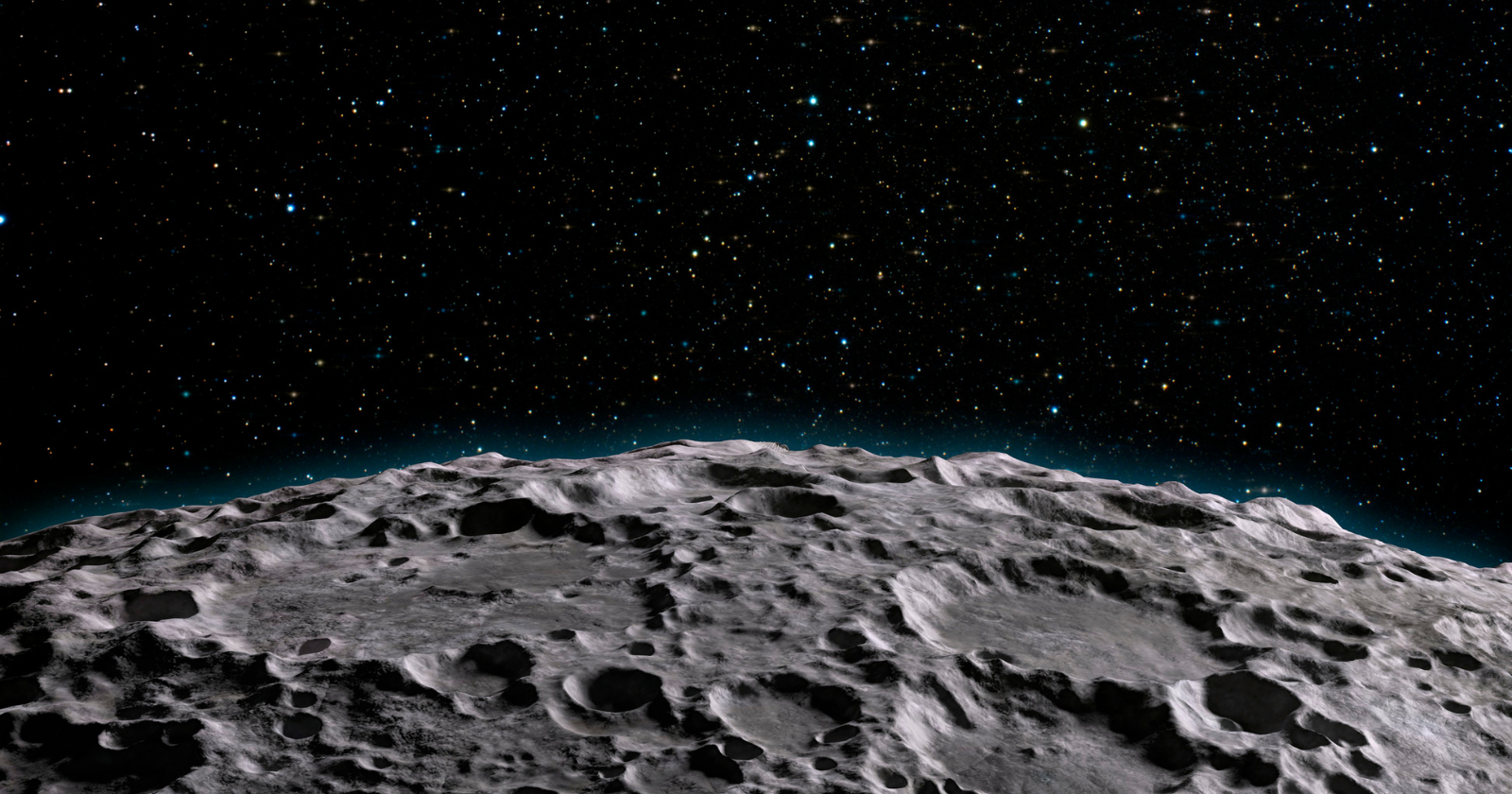
On 17 November 1970, a Soviet unmanned mission called Luna 17 touched down on the Sea of Rains, a wide basalt plain on the near side of the Moon. The lander carried a remote-controlled rover, Lunokhod 1, the first robotic vehicle to operate on the surface of another world. It was one of the standout engineering achievements of the Soviet lunar program: eight wheels, a hinged solar lid that closed at night to trap heat, television cameras for the controllers on Earth, instruments for analysing the lunar surface, and, bolted to its body, a French-built laser retroreflector designed for the kind of precision lunar ranging the Apollo missions had already shown to be scientifically valuable. The rover worked for nearly eleven months. It covered about 10.5 kilometres of lunar terrain, sent back thousands of television images and hundreds of high-resolution panoramas, and sampled and analysed the soil at five hundred separate sites. It was an enormous scientific success. Lunokhod 1 fell silent on 14 September 1971, soon after the start of the lunar night. When the Sun returned, Soviet controllers tried to re-establish contact and failed. The mission was formally ended on 4 October 1971. The rover was finished. What had not ended was the laser retroreflector bolted to its back. The retroreflector was a passive device. It needed no power, no communication and no input from Earth. It simply sat on the lunar surface where the rover had left it, in whatever orientation the rover had last taken before going dark. It was still available to anyone who could find it. For nearly forty years, nobody could.
What the retroreflector was, and why it mattered
It is worth being precise about the device, because it tends to get described in vaguer terms than the physics deserves. A laser retroreflector is an arrangement of precisely angled mirrors that sends any incoming light straight back along the path it arrived on, whatever angle it came in at. The principle is the same one behind the small reflective panels on bicycle wheels that catch a car’s headlights at night. The application is far more demanding. The retroreflector on Lunokhod 1 was designed to let ground-based observatories fire a laser pulse at the lunar surface, catch the pulse bouncing back off the reflector, and time the round trip precisely enough to calculate the Earth-Moon distance to within a few centimetres. Those measurements have mattered for decades. Since the Apollo missions first established the technique, they have underpinned precision tests of Einstein’s general theory of relativity, measurements of the Moon’s slow recession from Earth, and a range of geophysical and astronomical research that depends on knowing the Earth-Moon distance with great accuracy. Lunokhod 1’s retroreflector was meant to operate as one of five laser-ranging targets spread across the Moon. The other four were the three Apollo retroreflectors and the reflector on Lunokhod 2, deployed in 1973. The Apollo reflectors had been in continuous use since the early 1970s, and Lunokhod 2’s reflector since 1973. Lunokhod 1’s had received only a handful of range measurements in the three months after it landed, and those, according to the published research, were never published and remain unavailable. So the reflector was effectively lost. Scientists could not point their lasers at it with any useful precision. The rover’s last known coordinates were vague enough that the search area ran to several kilometres in any direction. According to the published paper by the Apache Point Observatory team, a positional uncertainty of a few kilometres opens up a vast search space, and detecting a reflector under those conditions was extremely unlikely.
What changed in March 2010
The breakthrough came from a different mission entirely. In March 2010, NASA’s Lunar Reconnaissance Orbiter, which had been mapping the Moon in unprecedented detail since 2009, photographed the area where Lunokhod 1 was thought to have come to rest. Working through the imagery, the Lunar Reconnaissance Orbiter Camera team identified the rover. The images showed the vehicle on the surface, its tracks still visible in the regolith, leading right up to its final position. That identification mattered. It cut the positional uncertainty from several kilometres to roughly 100 metres, and that was enough to make laser ranging practical for the first time since 1971. The Apache Point Observatory Lunar Laser-ranging Operation, known as APOLLO, sits at Apache Point in New Mexico and is led by Tom Murphy of the University of California San Diego. The team had been ranging the other lunar reflectors for several years and was ready to attempt Lunokhod 1 as soon as its position was tight enough. According to the Space.com reporting on the rediscovery, they made the attempt on 22 April 2010, less than a month after the orbiter’s imagery became available.
What happened when the laser pulse arrived
The result was far more dramatic than anyone had expected. The reflector answered, and it answered with a signal so strong the team’s first thought was that their equipment was faulty. Murphy’s published comments on the moment are worth quoting directly. “We shined a laser on Lunokhod 1’s position, and we were stunned by the power of the reflection,” he said. “Lunokhod 1 is talking to us loudly and clearly.” The signal strength was remarkable. Lunokhod 2’s reflector, in continuous use since 1973 and ranged by the APOLLO team for years, returned about 750 photons on its best signal. Lunokhod 1, on its first attempt after nearly forty years of silence, returned about 2,000 photons, four to five times stronger than its more recently deployed twin. The explanation was orientation. Lunokhod 1 had come to rest facing Earth almost head-on. It had also weathered far better than expected. Judging by the dust accumulation observed on the nearby Apollo reflectors, the scientific community had assumed Lunokhod 1 would be significantly degraded by lunar surface weathering. It was not. The reflector was in close to the same condition as the day the rover fell silent in 1971. Forty years of silence had done nothing to the device’s ability to do its job.
What the rediscovery accomplished
The rediscovery was more than a historical footnote. The reflector immediately became one of the most valuable laser-ranging targets in the network. Its value came from two things. The first was that unexpected signal strength, which let the APOLLO team take measurements at considerably higher precision than the other reflectors allowed. The second was its location: Lunokhod 1 sits further from the other reflectors than any of them sit from each other, and a wider spread of targets across the lunar surface improves the accuracy of the measurements the technique supports. In the years since, the reflector has been folded into routine lunar ranging operations, contributing to ongoing tests of general relativity, precision tracking of the Moon’s orbital evolution, and the other work that depends on knowing the Earth-Moon distance to millimetre accuracy.
What forty years of silence didn’t change
Lunokhod 1 fell silent in September 1971 after a successful mission of nearly eleven months. At the time, the rover was considered finished and the reflector on its back considered lost. For decades the scientific community treated the device as historical hardware, unlikely ever to be used again. What that view missed was a simple fact about the design. The reflector needed no power, no signal and no maintenance to keep working. It only needed to be found precisely enough to aim a laser at. The finding took thirty-nine years and depended on a generation of lunar imaging that did not exist when the rover went dark. But because the device was still there, and orbital imaging was always going to improve, the rediscovery was close to inevitable. When it finally happened, the reflector answered as though no time had passed. It returned a signal four to five times stronger than its younger twin and became, overnight, one of the most useful instruments in the lunar ranging network. It is still working today, in much the same condition it has held since 1970. Stories like this tend to get filed as minor curiosities. The more accurate reading is that a well-designed passive instrument can quietly outlast the mission that delivered it, and that this kind of patient durability is part of what makes long-baseline science possible at all.
