
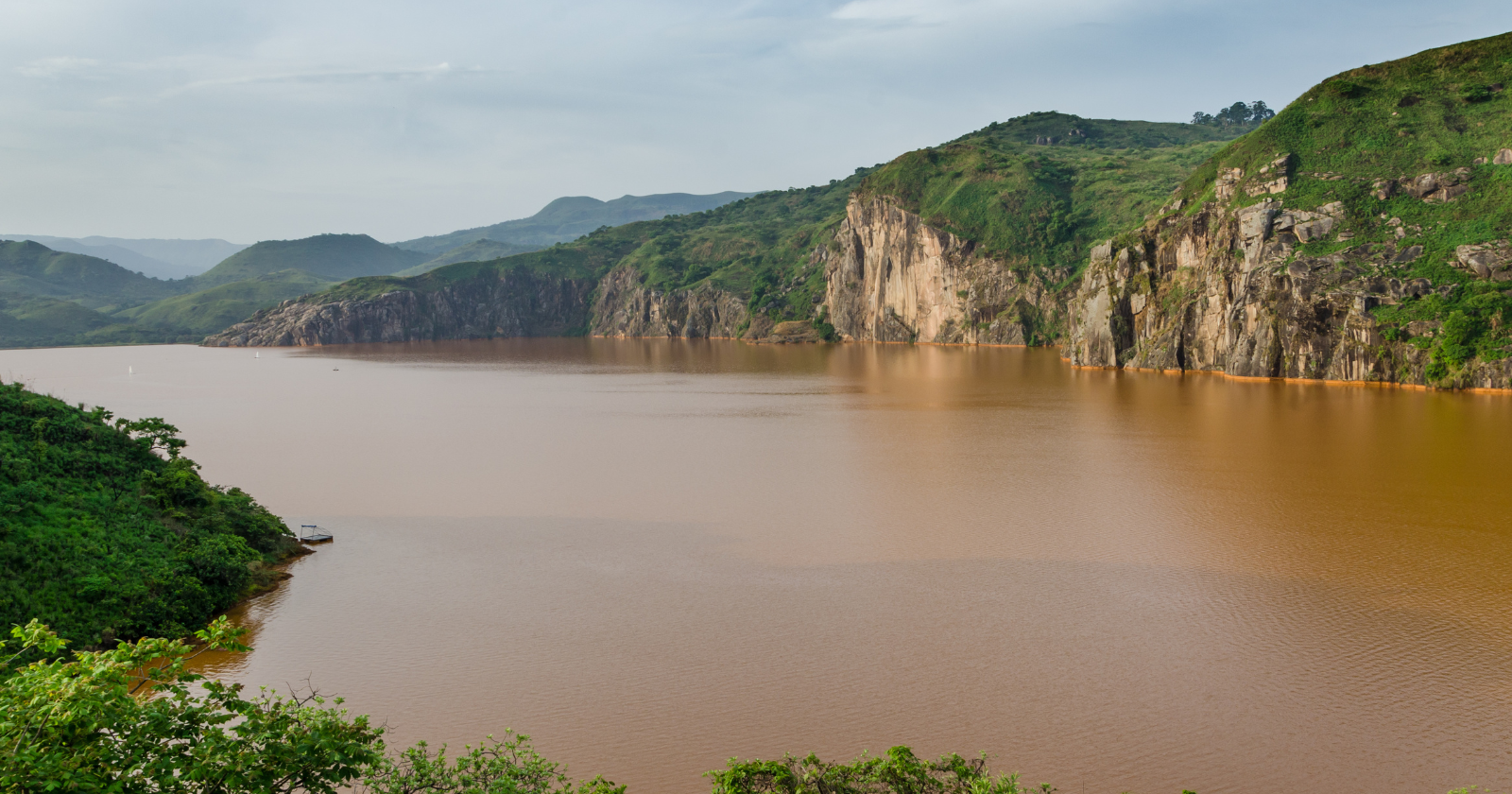
On the evening of 21 August 1986, in a remote part of northwestern Cameroon, the surface of a small crater lake known as Lake Nyos exhibited a brief disturbance. A fountain of water and foam rose, by later reconstruction, approximately a hundred metres above the lake. The disturbance lasted for a short period and subsided. The lake returned to stillness.
What had happened, in those few minutes, was that approximately 100,000 to 300,000 tons of carbon dioxide that had been dissolved under pressure in the deeper layers of the lake came out of solution and rose to the surface. The gas, as documented in the 1987 paper by Kling and colleagues in Science, was roughly 1.5 times denser than air at the temperature it emerged and did not dissipate upward. It flowed downhill, at speeds estimated at close to 100 kilometres per hour, into the river valleys north of the lake. By morning, 1,746 people and approximately 3,500 livestock had died of asphyxiation in the towns of Cha, Nyos, and Subum, in a band of land extending roughly 25 kilometres from the lake. The villages most affected lost virtually their entire populations.
The mechanism is called a limnic eruption. It is, in our reading of the literature, one of the more under-discussed natural hazards on the planet. Only three lakes on Earth are known to be capable of producing it. The largest of those three, Lake Kivu on the border between Rwanda and the Democratic Republic of the Congo, holds approximately 300 cubic kilometres of dissolved carbon dioxide and 60 cubic kilometres of dissolved methane, sits beneath a permanent population of roughly two million people, and has not erupted in recorded history.
How the cloud formed
The mechanism that produced the Lake Nyos disaster is not, in itself, mysterious. Magmatic carbon dioxide percolates through fractures in the rock beneath the lake from a dormant volcano below. The gas dissolves into the deep lake water under pressure. Because the lake has a stable density stratification, with cold, dense, mineral-rich water at depth and warmer, fresher water at the surface, the deep water does not mix with the surface water in the seasonal turnover that affects most temperate lakes. The CO₂ accumulates, year after year, in the lower layer.
The lake can carry a substantial dissolved load before the carbon dioxide approaches the saturation point at which it begins to come out of solution. The trigger for the 1986 event is contested. The leading candidates are a landslide into the lake, a minor earthquake, or an internal density shift produced by cold rainwater entering the lake surface. Whatever the trigger, the result was that a small volume of deep water rose to a depth at which its pressure dropped enough for the dissolved CO₂ to form bubbles. The rising bubbles entrained more deep water, which in turn became supersaturated as it rose. The reaction cascaded.
The engineering response
The 1986 disaster, and the smaller eruption at the nearby Lake Monoun in 1984 which killed 37 people, prompted what is now a long-running international engineering effort to remove the dissolved gas from the two lakes before it can rise to the saturation point again.
The technique was proposed independently by Klaus Tietze in Germany and by a French team led by Adelin Villevieille in 1987. The concept is straightforward in principle. A pipe is lowered into the lake to a depth of roughly 200 metres. A small initial pumping action is used to draw deep, gas-saturated water into the pipe. As the water rises through the pipe, the pressure decreases, the dissolved CO₂ begins to come out of solution, and the resulting two-phase mixture of water and gas becomes less dense than the surrounding lake water. The process becomes self-sustaining: the water continues to rise without further pumping, the gas separates at the surface, and the depleted water returns to the lake at a shallower depth.
The initial design used metal pipes and was prohibitively expensive. The breakthrough came with the use of high-density polyethylene, whose density is close to that of water, allowing the pipes to be installed without the heavy infrastructure metal piping had required. Michel Halbwachs and Jean-Christophe Sabroux, the French scientists who led the engineering team, documented the programme’s thirty-year arc in a 2020 paper in the Journal of African Earth Sciences. The first operational pipe at Lake Nyos was commissioned on 30 January 2001 and produced a fifty-metre-high fountain at the surface. Two additional pipes were added in 2011. Monoun received pipes between 2003 and 2006 and had, by 2011, been degassed to safe levels, with more than 90 per cent of the maximum CO₂ inventory removed.
The Nyos degassing is ongoing. The Halbwachs et al. 2020 paper reports that approximately 33 per cent of the maximum CO₂ inventory has been removed as of the period it covers, with natural recharge from the magma below continuing throughout. The paper concludes that a single degassing pipe, continuously operated, is now sufficient to balance the natural recharge rate indefinitely. The two Cameroonian lakes that produced the disasters of the 1980s are, in engineering terms, under active management.
The lake that has not yet erupted
The third lake is a different problem.
Lake Kivu, on the border between Rwanda and the Democratic Republic of the Congo, has a surface area approximately 1,500 times that of Lake Nyos and a maximum depth of 485 metres. It contains, in its deep stratified layer, the 300 cubic kilometres of dissolved CO₂ and 60 cubic kilometres of dissolved methane already mentioned. The methane is biological in origin, produced by anaerobic bacteria decomposing organic material in the lake’s sediments. The CO₂ is partly magmatic, partly produced by bacterial conversion of organic carbon. Both gases are held in solution by the pressure of the overlying water.
The lakeshore population is, by current estimates, approximately two million people.
The Congolese city of Goma sits directly on the lake’s northern shore. The Rwandan city of Gisenyi is across the border on the same shoreline. Estimates of the immediate lakeshore population have shifted upward over the past two decades as the region’s cities have grown, with the Halbwachs group’s recent work referring to the surrounding inhabited area as a population of up to 2.5 million when broader catchment communities are included.
Sediment cores from Lake Kivu indicate that the lake has, in geological history, undergone events that disturbed its deep-water structure on long but regular intervals. A 2005 paper by Martin Schmid, Michel Halbwachs and Alfred Wüest in Geochemistry, Geophysics, Geosystems, working from the Eawag Swiss research institute, established that the residence time of gases in the deep water of Lake Kivu is on the order of 800 to 1,000 years, which corresponds roughly to the recurrence interval of past overturn events recorded in the sediment record. The 2005 Schmid paper interpreted this pattern as evidence that current methane production rates were increasing and that the gas concentrations might approach saturation within the current century. Subsequent work has revised that interpretation.
A commercial project called KivuWatt, operating on the Rwandan side of the lake since 2015, extracts methane from depth, separates it from the carbon dioxide, burns the methane for electricity generation, and re-injects the CO₂ at a controlled depth designed to preserve the lake’s stratification. The project both generates electricity and slowly reduces the total dissolved gas load. The scale of the operation is, however, small relative to the dissolved gas inventory. Even at full planned capacity, the project would take many decades to substantially affect the saturation level.
The question of whether Lake Kivu’s gas load is increasing toward an eruption threshold or whether it has reached a stable steady state has moved in the more recent literature toward a more reassuring position. A 2020 paper in PLOS ONE by a team led by Fabian Bärenbold at Eawag, using multiple independent measurement techniques during a 2018 intercomparison campaign, concluded that methane and CO₂ concentrations are currently close to steady state and have not been increasing at the rate the 2005 Schmid paper had estimated. A 2026 modelling study in Environmental Science: Processes & Impacts by Hadi Saboorian-Jooybari and Hassan Hassanzadeh at the University of Calgary’s Schulich School of Engineering sets out the orders-of-magnitude scale of the potential threat directly, observing that Lake Kivu is approximately three thousand times larger than Lake Nyos and holds two to four orders of magnitude more dissolved CO₂. Their numerical simulations of the lake’s hydrodynamics over the next five hundred years, however, conclude that the simulations “effectively address common concerns” about overturn-triggered or supersaturation-triggered gas bursts, given the lake’s current density stratification.
What we keep coming back to, in our reading, is how narrow the engineering response has been. Two of the three known limnic-eruption lakes have been actively managed for two decades by a small French-led international team using a technique that costs comparatively little and works. The third is being slowly addressed by a commercial project whose primary purpose is electricity generation rather than hazard reduction, while the recent published literature has moved toward the view that its current gas inventory is more stable than the older work had implied.
The structural facts remain. A freshwater lake in central Africa, large enough to contain three hundred cubic kilometres of dissolved carbon dioxide, sits beneath approximately two million people. The mechanism that produced the Lake Nyos disaster is geologically capable of operating on it. Whether the current monitoring and extraction arrangements are sufficient to prevent that mechanism from being triggered is a question the literature has begun to answer with greater confidence in the past five years than it had in the previous decade, and the more recent answer is more reassuring than the earlier one.
What happened at Lake Nyos in 1986 is one of the more concentrated natural-hazard events of the twentieth century. The mechanism that produced it has been understood, engineered around, and is no longer a serious risk at the lake where it first emerged. The same mechanism, operating on a much larger scale beneath a much larger population, is currently being addressed through methane extraction for energy revenue and monitored by an international research community whose recent modelling work has come down on the side of stability rather than imminent risk.
