
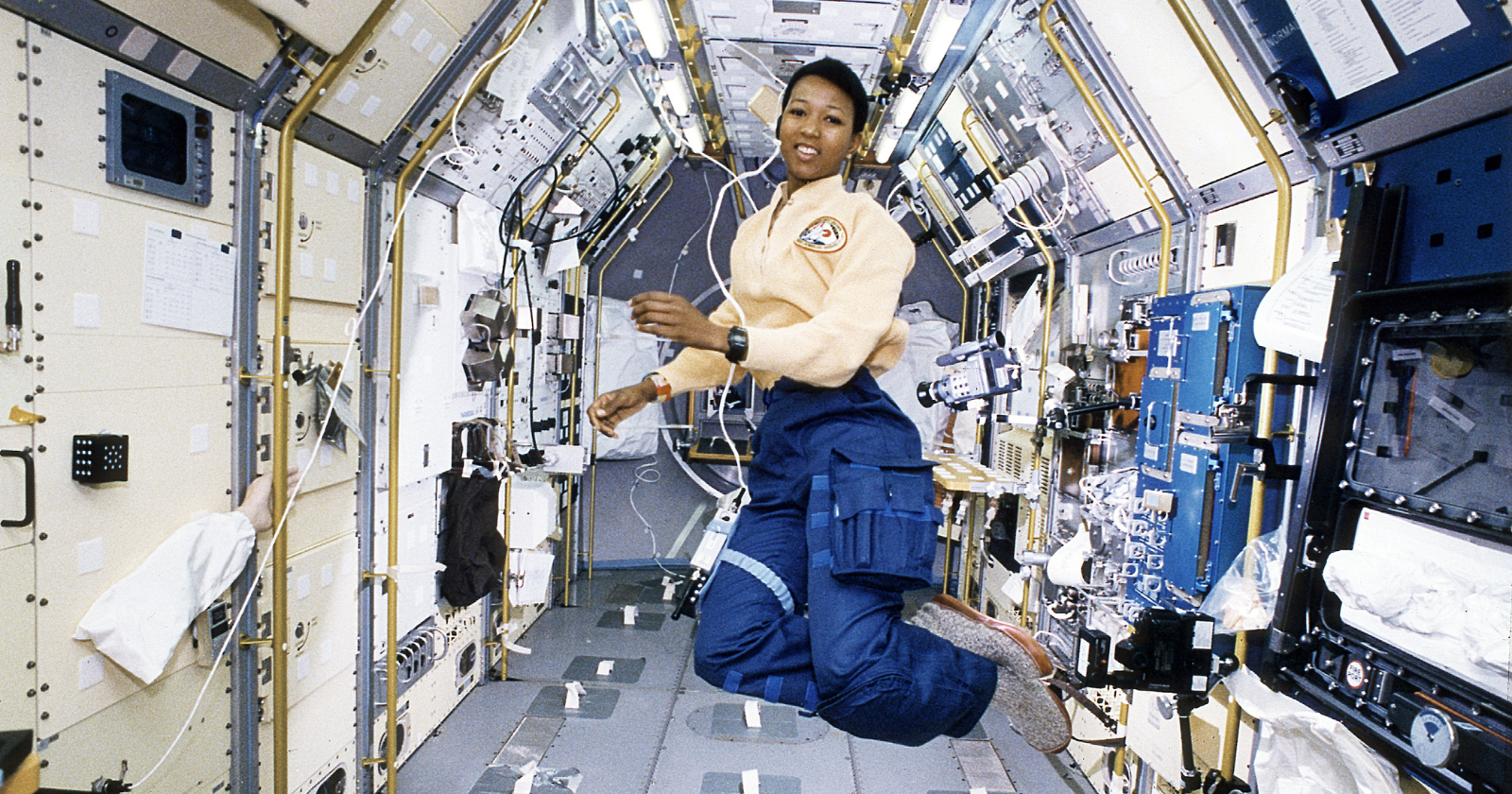
Astronauts who spend months on the International Space Station come back to Earth slightly taller than when they left. The effect is real and measured, not an illusion or an anecdote. NASA’s figure, tied to its Spinal Ultrasound investigation, is that an astronaut can gain up to about 3 per cent of their height in orbit, which for a person around 1.8 metres tall works out to roughly 5 centimetres.
It does not last. Within days to weeks of returning, the gain is gone and the astronaut is back to their normal height. The change is a temporary response to being in orbit, not a permanent one.
What is happening to the spine
The change happens in the spine, and the general cause is straightforward. On Earth, body weight presses down through the spinal column all day. The vertebrae, and the soft discs between them, are under constant compression from gravity. That load is part of why a person is measurably a little shorter in the evening than first thing in the morning, after a day upright.
In orbit, that load is removed. An astronaut on the ISS is in continuous free fall, and the spine is no longer being compressed by body weight. Freed of that compression, the spine lengthens. The result is the height gain.
That much is agreed. The detail of exactly how the spine lengthens is less settled than the popular version of the story suggests, and the difference is worth setting out.
Two possible mechanisms
The familiar explanation is the intervertebral discs. These are the soft, fluid-rich pads between the vertebrae. The idea is that, with the compressive load gone, the discs take on fluid and expand, pushing the vertebrae apart and lengthening the spine. It is a clean story, and it may be part of what happens.
But it is not clearly the main thing. In 2016, a team led by Douglas Chang at the University of California, San Diego, published a study in the journal Spine that used MRI scans of six astronauts before and after long ISS missions. The scans did not show the disc swelling the familiar explanation predicts. Chang’s team suggested instead that the lengthening comes mainly from the spine’s natural curvature relaxing. A spine on Earth holds a set of gentle curves. Without gravity loading it, those curves straighten out somewhat, and a straighter spine is a slightly longer one.
So there are two candidate mechanisms, disc expansion and the straightening of the spine’s curves, and the evidence does not yet cleanly settle which matters more. The honest version is that the height gain is well documented and its precise cause inside the spine is still being worked out.
The part that is not harmless
The height gain on its own is trivial, and temporary. But it is a visible sign of changes in the spine that are not trivial, and that is the part worth taking seriously.
Back pain is common in orbit, with multiple studies reporting it in a large share of astronauts. And the Chang study found something more specific. The lean muscle that supports the spine, the paraspinal muscle, atrophied during the missions. The study found the lean portion of that muscle dropping from about 86 per cent of its cross-sectional area before flight to about 72 per cent immediately after, and only partly recovering when the astronauts were scanned again weeks later.
There is also a raised injury risk after return. Research has indicated that astronauts face a higher rate of herniated disc in the period after spaceflight than the general population. The spine spends months in a lengthened, differently loaded, less muscularly supported state, and then has to readapt, fairly abruptly, to full gravity. That readaptation is where the injury risk sits.
This is why the height change is studied at all. It is not studied because anyone is concerned about astronauts being briefly taller. It is studied because the lengthening is the easily measured outward sign of spinal changes that produce real pain and real injury risk, and that have to be managed.
Why it matters beyond the ISS
The countermeasures are, broadly, exercise. The Chang team suggested that core-strengthening work, and approaches used for back pain on Earth, including yoga, might help maintain the muscles that support the spine. Confirming which specific measures work, and how well, is still in progress.
The practical stakes rise with mission length. A flight to Mars would keep a crew in reduced gravity far longer than an ISS rotation, which makes the spinal changes a genuine design and medical consideration rather than a curiosity. It also has plain engineering consequences: as the researchers have noted, if crew members are measurably taller and shaped differently in flight, that affects the sizing of spacesuits, seats, and the spaces they have to fit into.
The temporary few centimetres, in other words, are the easy part to notice and the least important part in themselves. What they mark is a spine doing months of work in conditions it was never built for, and the real subject is what that does to it.
