
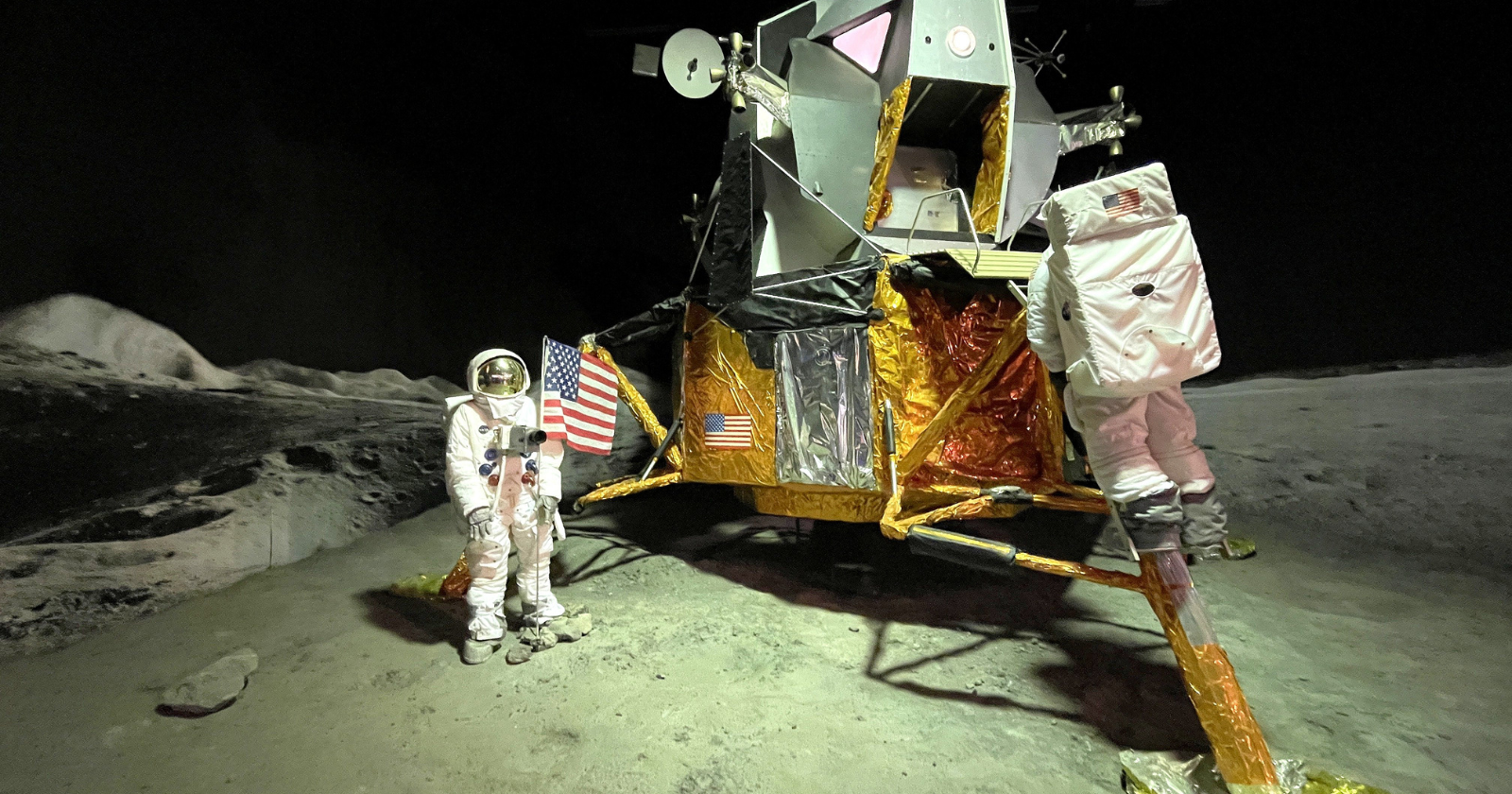
A few hours after the lunar module Eagle touched down on the Sea of Tranquility on July 20, 1969, before Neil Armstrong opened the hatch and climbed down the ladder into history, something quiet happened inside the cramped cabin that most people watching the broadcast never knew about.
Buzz Aldrin reached for a small kit he had carried with him from Earth. Inside it was a tiny silver chalice, a vial of wine, and a wafer of communion bread.
And there, on the surface of the Moon, an estimated 240,000 miles from the nearest church, he took Communion.
It was the first religious ceremony ever performed on another world. It was almost certainly the first food eaten and the first liquid poured anywhere off the Earth. And for years, hardly anyone knew it had happened, because NASA — nervous about a lawsuit — had quietly asked him to keep it off the live broadcast.
A plan made long before launch
Aldrin wasn’t acting on impulse. He was an elder at Webster Presbyterian Church, a congregation just outside Houston so closely tied to the space program that it became informally known as “the church of the astronauts.”
In the months before Apollo 11, Aldrin began thinking about how to mark the enormity of what the mission represented. He settled on Communion — a ceremony, as he later put it, of gratitude and hope. He arranged it in advance with his pastor, who prepared a small home-Communion kit of the kind used to bring the sacrament to people too ill to attend church.
He also cleared it with NASA. The kit was carried aboard with the agency’s knowledge. A few minutes were even built into the mission timeline for it. This was not a secret act of rebellion. It was a planned, approved part of the most scrutinised expedition in human history.
What NASA did not want was for the rest of the world to watch it happen.
The lawsuit hanging over everything
Six months earlier, on Christmas Eve 1968, the crew of Apollo 8 had become the first humans to orbit the Moon. During a live broadcast watched by one of the largest audiences in history to that point, the three astronauts took turns reading from the Book of Genesis.
For most viewers, it was a moving moment. For Madalyn Murray O’Hair — the founder of American Atheists, a woman once dubbed “the most hated woman in America” — it was a constitutional violation. The astronauts were government employees. The broadcast, she argued, amounted to the state endorsing religion. She sued NASA.
Her lawsuit was, legally, weak. It would eventually be dismissed for lack of jurisdiction. But by July 1969 it was still active, still working its way through the courts, and NASA was thoroughly rattled by it.
So when Aldrin prepared to take Communion on the Moon, NASA’s instructions were careful. He could perform the ceremony. He could carry the kit. But he was asked not to broadcast it, and to keep his words to the listening world general rather than overtly religious.
Aldrin agreed, reluctantly.
What actually happened in the cabin
Just before the ceremony, Aldrin radioed a brief message to Earth — one carefully kept non-denominational, exactly as NASA had requested.
“I would like to request a few moments of silence,” he said, “and to invite each person listening in, wherever and whomever they may be, to pause for a moment and contemplate the events of the past few hours, and to give thanks in his or her own way.”
Then he switched off the broadcast.
Inside the lunar module, Aldrin read a short passage of scripture he had written on a small card — a line from the Gospel of John: “I am the vine, you are the branches.” He poured the wine into the little chalice.
And here the Moon itself did something he never forgot.
In the one-sixth gravity of the lunar surface, the wine did not behave the way it would on Earth. It poured slowly, and instead of settling flat, it curled gently and climbed up the inside curve of the cup, moving with a slow grace that no liquid on Earth ever does. Aldrin watched it. He described it for years afterward as one of the small, strange beauties of the whole mission — the very first wine ever poured on another world, curling upward in the silence.
He ate the wafer. He drank the wine. And then, with the ceremony complete, the two astronauts turned their attention back to the work of preparing to walk on the Moon.
Why it stayed quiet
Aldrin had wanted to share the moment with the world. He believed, at the time, that it belonged to everyone watching.
NASA’s caution kept it private. The communion went unannounced during the mission, and the wider story only emerged gradually afterward — Aldrin referred to it within months, and wrote about it more fully in later years, including in his memoir Magnificent Desolation.
He had mixed feelings about it for the rest of his life. Not about his faith, which never wavered, but about whether a private religious act had been the right way to mark a moment that belonged to all of humanity, believers and non-believers alike. In later years he reflected that the Moon landing represented far more than the beliefs of one man, and that perhaps a more universal gesture would have been better.
But the ceremony itself, he never regretted.
A small ritual on a vast frontier
There is something quietly extraordinary about the image. Two men in a tiny metal cabin, sitting on the surface of another world, about to do something no humans had ever done. And one of them pausing, first, to perform one of the oldest and smallest rituals his species had — a sip of wine, a piece of bread, a few words read off a handwritten card.
The wine curled up the side of the cup in a way it never could have on Earth. It was the first meal on the Moon. And almost nobody knew.
More than half a century later, Webster Presbyterian Church still marks the anniversary every July. They call it Lunar Communion Sunday. They still have the chalice.
