
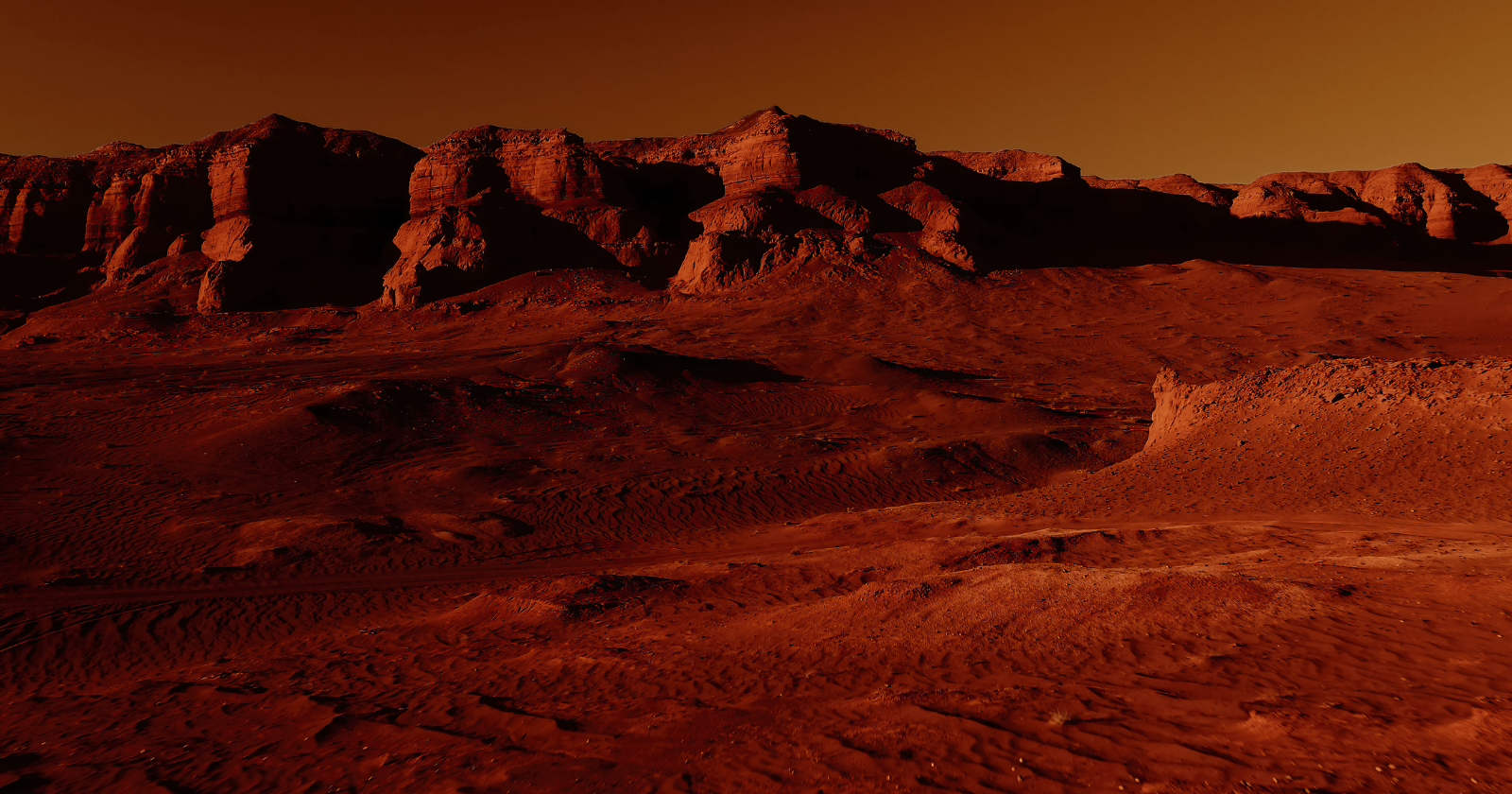
Olympus Mons is a volcano on Mars, in the Tharsis region of the planet’s western hemisphere. It stands roughly 22 kilometres above the surrounding plains, which is about two and a half times the height of Mount Everest measured from sea level. It is the tallest volcano known in the solar system.
Height is only half of what makes it unusual. The other half is width. Olympus Mons is about 600 kilometres across at its base, an area comparable to the US state of Arizona, or large enough to cover much of Italy. It is, very roughly, twenty times wider than it is tall.
That ratio is the key to the whole piece. A mountain on Earth that we think of as tall, Everest, the Matterhorn, is also steep. Olympus Mons is taller than any of them and yet, across most of its surface, barely tilted.
Why the slope is so gentle
Olympus Mons is a shield volcano. The name describes the shape, a broad, low dome resembling a warrior’s shield laid flat, rather than the sharp cone most people picture when they think of a volcano. Shield volcanoes are built by runny, fast-flowing lava that spreads out over long distances before it cools, rather than piling up steeply near the vent. Earth has the same kind of volcano: the Hawaiian islands are shield volcanoes, and Mauna Loa is the closest terrestrial comparison.
The slopes across Olympus Mons are typically only about 2 to 5 degrees, and its average grade is often given at around 5 per cent. That is the figure worth holding onto. Spread across hundreds of kilometres, the volcano rises as a vast, gentle incline rather than a steep mountain wall. It would still be an uphill walk, but not mountaineering in the Earth sense.
So the prompt for this piece is accurate. A person standing partway up Olympus Mons, on a slope of only a few degrees, hundreds of kilometres wide, would have no clear sense of being on a mountain at all. The summit would be too far away to see, often beyond the horizon. The base would be the same. There would be no peak ahead and no valley behind, just gently sloping ground running out of sight in both directions.
Why Mars could build something this large
A volcano this size could not exist on Earth, and the reasons are worth setting out, because they are specific.
The first is plate tectonics, or rather the lack of it. Earth’s crust is broken into moving plates. A volcano on Earth sits over a hot spot in the mantle, but the plate carrying it keeps moving, so over millions of years the volcano drifts off the hot spot and goes quiet, while a new volcano starts forming beside it. The Hawaiian islands are a chain precisely because of this: a conveyor belt of volcanoes, each carried away from the source before it can grow indefinitely. Mars, as far as the evidence shows, does not have active plate tectonics. Its crust appears to sit still over its hot spots. A Martian volcano can therefore stay parked over its magma supply and keep erupting in the same place for an extremely long time, adding layer on layer.
The second reason is gravity. Surface gravity on Mars is about 38 per cent of Earth’s. A pile of volcanic rock can therefore stand higher on Mars before its own weight begins to flatten it or cause it to collapse.
The third is time. Lava flows on parts of Olympus Mons appear, from the low number of impact craters on them, to be geologically young, with some surfaces estimated at only a few million years old. The volcano has been built and rebuilt over a very long span. It is not certain to be extinct. No eruption has been observed, but the youth of some of its lava means a future eruption cannot be firmly ruled out.
What it would actually be like
Put those facts together and the experience of being on Olympus Mons becomes genuinely strange.
Reaching the summit would involve no technical climbing, no scrambling, no exposure. It would be a very long walk on a slight incline, a horizontal journey of hundreds of kilometres far more than a vertical one. The difficulty would be distance and endurance, not steepness.
The volcano is so tall that its summit rises above most of the thin Martian atmosphere. Atmospheric pressure at the top is a small fraction of the already very low pressure at the Martian surface. A walker ascending Olympus Mons would be leaving most of an already sparse atmosphere behind them.
And the edges are the one place the gentleness breaks. The main body of the volcano ends, in many places, not in a gradual run-out but in a steep outward-facing cliff, an escarpment several kilometres high in places, ringing the volcano like a wall. The strangeness of Olympus Mons is contained in that contrast. The thing is so wide and so gently sloped that its own bulk is hard to perceive from its surface, and then it stops, at its rim, in a cliff taller than almost any single rock face on Earth.
It earns the title of tallest volcano in the solar system. What the prompt captures, correctly, is that the title would be nearly impossible to feel while standing on it. A superlative that large, spread over an area that wide, stops registering as a mountain at all.
