
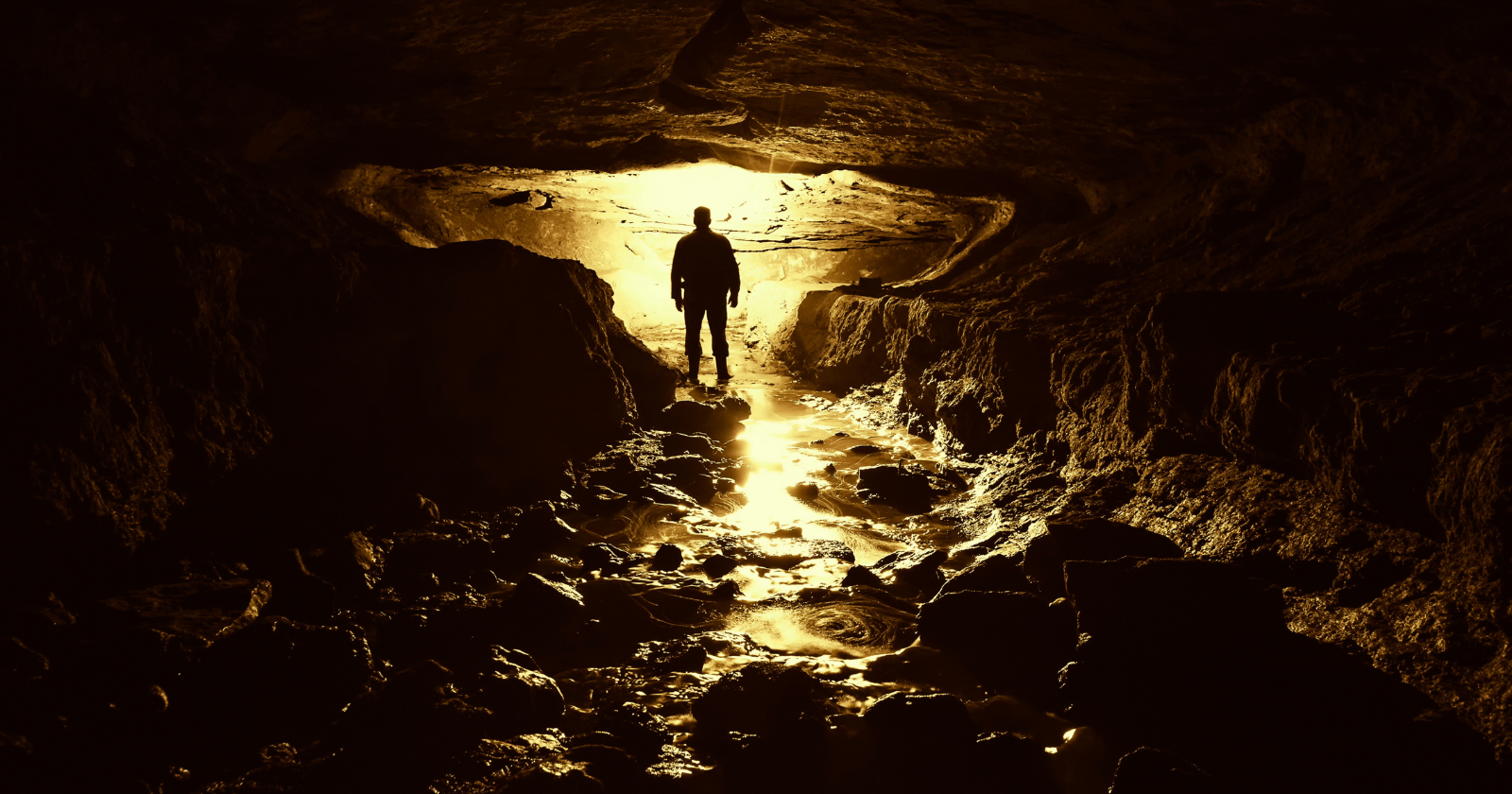
A young Frenchman was hauled out of a cave shaft in the Ligurian Alps on 14 September 1962, dark goggles shielding his eyes from the light.
He insisted, the whole time, that it was still August.
Michel Siffre was 23 and a geologist by training. He had climbed down on 16 July to study an underground glacier and came back up as the accidental founder of a scientific field. When his support team told him the two months were up, he did not believe them. By his own count, the date was the twentieth of August.
How the experiment actually worked
No watch. No calendar. No daylight, and nothing but a single bulb for light. Siffre ran a one-way telephone line to a team stationed at the cave mouth. He called them whenever he woke, ate or prepared to sleep, and they were forbidden from calling him, as he explained decades later to Joshua Foer in Cabinet magazine. Nobody was permitted to mention a date.
Physically, it was brutal. Humidity sat at 98 per cent. The tent sat hard against the ice, his feet never dried, and his core temperature sank to 34 degrees Celsius. His reading material was Plato.
Counting to 120
How do you measure a minute with no watch? Siffre invented a test. Every time he phoned the surface, he took his pulse, then counted aloud from one to 120 at what felt to him like one digit per second.
Two minutes of real time. Five minutes on the watches at the surface.
His internal metronome was running at well under half the speed of the clocks above him, and it stayed that way for the duration. Stretch an error that size across nine weeks and the missing twenty-five days stop looking like sloppy bookkeeping.
Why anyone paid for this
Money followed quickly, and not from universities. NASA paid for mathematical analysis of the 1962 data, Siffre said, and the French army later funded him heavily because it wanted to know whether a soldier could double his waking hours. France had also just begun a nuclear submarine programme, with nobody at headquarters sure how to roster crews who would not see daylight for months.
Why the days stopped stacking up
“It’s entirely black. It’s like one long day,” Siffre told Foer, decades later. The cause, he said, was memory. With no sunrise, no commute, no weekend and no fixed mealtimes, one day left no mark to separate it from the next.
Anyone who spent 2020 in a small flat has a diluted version of this on file. Ian Phillips, who studies time perception at Johns Hopkins University, has described how lockdown pulled people’s sense of duration in both directions at once, dragging for some and evaporating for others, largely because the usual markers went missing.
What one man in a cave could and could not prove
Siffre also found that his own sleep-wake cycle ran to about 24 hours and 30 minutes, just past a standard day. Volunteers he sent down later drifted further still, into cycles of roughly 48 hours: about 36 hours awake, then 12 to 14 hours of sleep. Siffre said he had no theory for that second pattern.
His own figure held up reasonably well. What did not hold up was the wider assumption, built on decades of loosely controlled isolation studies, that the human clock runs closer to 25 hours on average. Work published in Science in 1999, led by Charles Czeisler at Harvard, put the intrinsic period of the human body clock at an average of 24.18 hours once light exposure was tightly controlled. Earlier subjects in dim caves and bunkers, the authors argued, had been exposed to enough light to skew their results, nudging their own rhythms without noticing. One paper does not settle a field, and Siffre’s 48-hour cycles are still on the books. What the 1962 descent established was that an internal clock exists at all, independent of the sun. Measuring its length properly took tighter controls and another thirty-seven years.
Fifteen people, forty days, ten missing
They came out blinking, in protective glasses, on 24 April 2021: fifteen volunteers who had just spent forty days inside the Lombrives cave in the French Pyrenees, on a project called Deep Time, run by the Human Adaptation Institute. In coverage by the Associated Press carried by PBS NewsHour, project director Christian Clot said most of the group believed they had gone underground about thirty days earlier. Ten days unaccounted for, in a group of fifteen, at 10 degrees Celsius and 100 per cent humidity, wired to sensors the entire time.
Siffre kept going back down anyway. In November 1999, aged 60, he took foie gras and champagne into the Clamouse cave in southern France to see the millennium in properly, and, per the Boston Globe’s account of his life, toasted it four days late.
He emerged after 76 days, on 14 February 2000, still convinced it was the 5th.
