
In April 2026, engineers at NASA’s Jet Propulsion Laboratory switched off another instrument on Voyager 1 — the Low-energy Charged Particles experiment, which had been running, with few interruptions, since the spacecraft launched in 1977.
The reason was unromantic: Voyager 1 is running out of power. Both Voyagers lose about four watts each year, and after nearly half a century of decay in their plutonium generators, the mission has spent years rehearsing the order in which their instruments will go dark. “While shutting down a science instrument is not anybody’s preference, it is the best option available,” said Kareem Badaruddin, the mission’s manager at JPL.
It is, in other words, a slow and managed silence. The Voyagers will keep transmitting for a while longer — Badaruddin notes that two instruments are still “sending back data from a region of space no other human-made craft has ever explored.” But the day is coming, perhaps in the 2030s, when both radios will go quiet for good and the two craft will continue on their trajectories without us. What remains, after that, is the record.
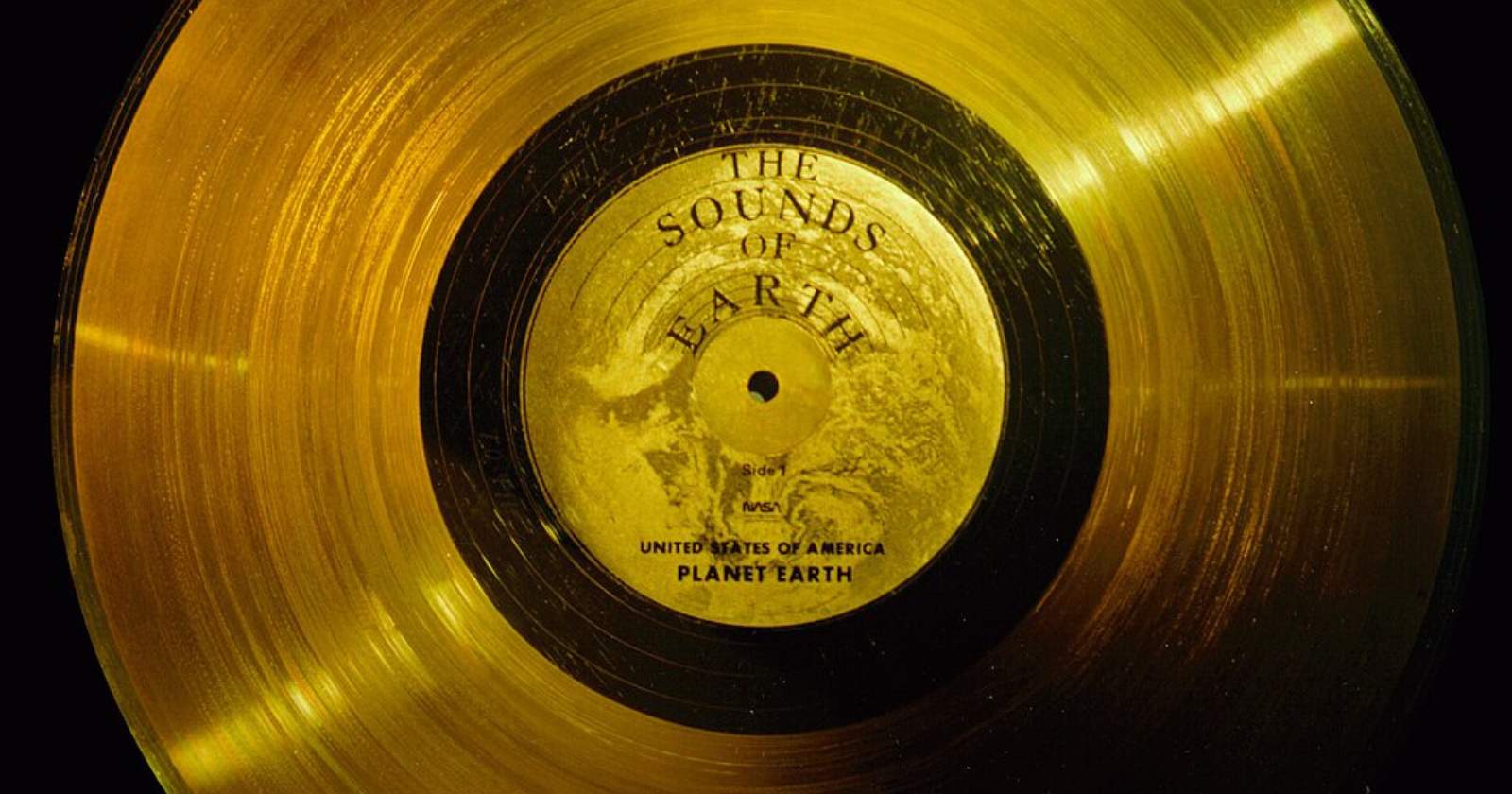
The Voyager Golden Record is the part of the mission designed not for the next decade but for geological time. NASA describes it as a “12-inch gold-plated copper disk containing sounds and images selected to portray the diversity of life and culture on Earth”. The contents were assembled in 1977 by a committee chaired by Carl Sagan of Cornell University: 115 encoded images, a 90-minute selection of music— and, importantly, spoken greetings in fifty-five languages.
The list is striking less for what it sums to than for what it leaves out. Fifty-five is a small number. The greetings begin with Akkadian — spoken in Sumer about six thousand years ago — and end with Wu, a modern Chinese dialect. In between sit Sumerian, Hittite, Latin and dozens of living tongues. The selection is loosely organized by age and reach, not by population: a Bronze Age language and a dialect spoken today in Shanghai are given the same number of seconds. The principle, evidently, was to gesture at the depth of human speech rather than to take a census of it. A neutral observer two thousand years from now would still find the record’s choices a little provincial.
That partial quality is, in some readings, the most truthful thing about the record. It is not humanity’s self-portrait — it is the self-portrait that one committee, in one country, in one summer, could produce. Sagan understood this. His best-known line on the project sits in NASA’s own description of the contents: “The spacecraft will be encountered and the record played only if there are advanced spacefaring civilizations in interstellar space. But the launching of this bottle into the cosmic ocean says something very hopeful about life on this planet.” Notice what he is and is not claiming. He is not claiming that anyone will hear the record. He is claiming that the act of sending it tells us something about ourselves.
This is the part most worth holding on to. The record is, in practical terms, unlikely to be intercepted. Voyager 1 will not approach another planetary system for around forty thousand years, and the odds that any encounter occurs near a system with the capacity and curiosity to read a 1977 phonograph disc are, by any honest accounting, vanishingly small. The probability calculation is not the point. The greetings exist, regardless of whether they are heard. Fifty-five voices were recorded, pressed into copper, plated in gold and bolted to a spacecraft because a small group of people in 1977 decided that humanity should at least have made the gesture.
And the gesture is durable in a way the spacecraft is not. The two Voyagers will likely fall silent within a decade or so, their power gone and their transmitters dark. The records will keep going — uneroded by atmosphere, undisturbed by life — for a span of time so large that the species that recorded them will probably have changed unrecognizably before the discs do. There is something properly humbling in the contrast: the engineering that makes the greetings audible to us is wearing out within one human lifetime, while the greetings themselves, etched into metal, will likely outlast every institution that helped place them there.
The Voyagers were a planetary-science mission first. The record was an addendum — an experiment in addressing the unknown. It was not a science instrument. It just carries, in fifty-five languages, the fact that someone here once said hello.
