
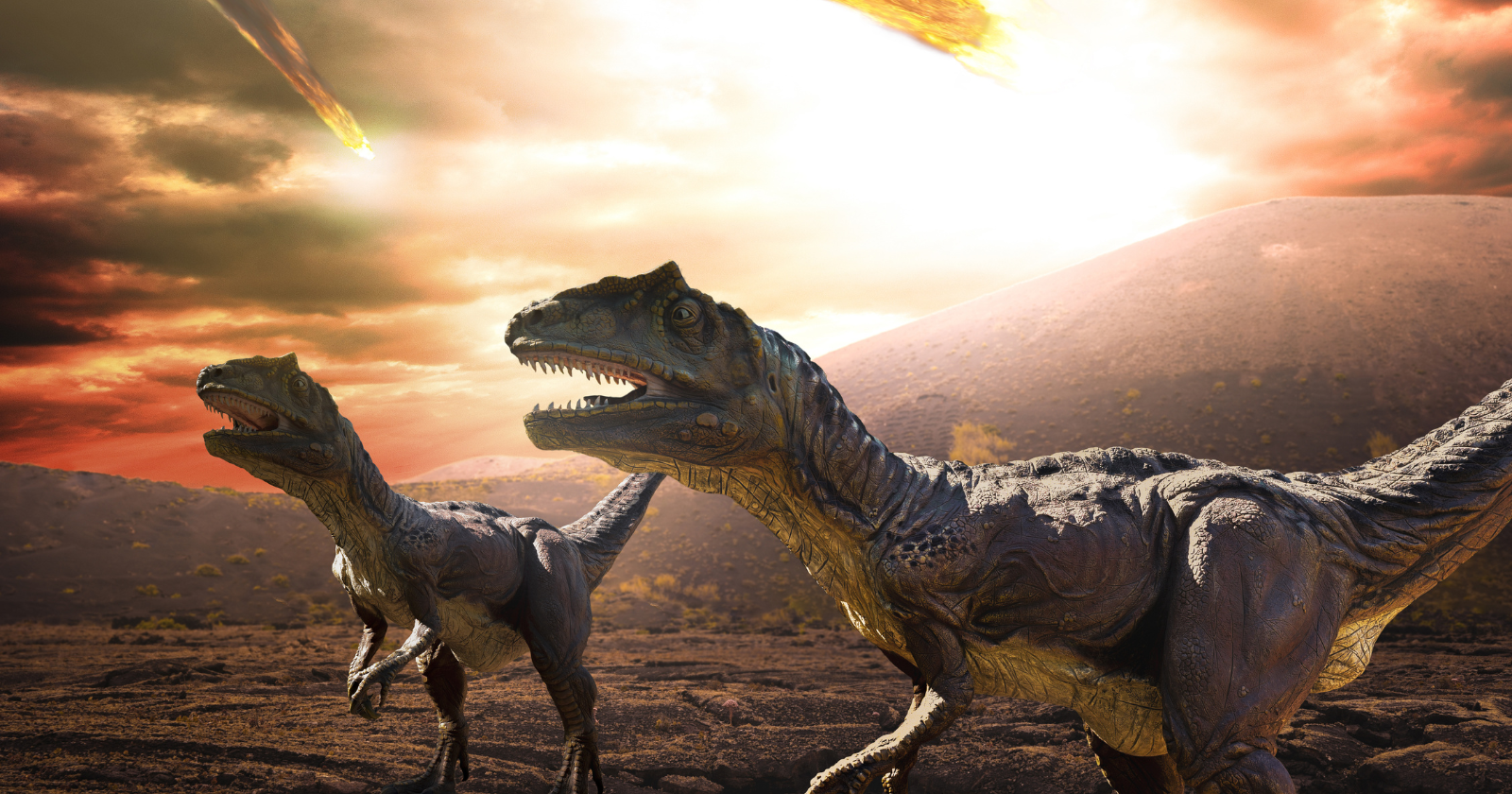
About 66 million years ago, an asteroid roughly 10 to 15 kilometres across struck the shallow sea covering what is now the Yucatan Peninsula in Mexico. It left a crater, named Chicxulub after a nearby town, on the order of 180 kilometres wide. The impact is the event most directly associated with the end-Cretaceous mass extinction, which removed the non-bird dinosaurs and around three-quarters of plant and animal species.
The link between the impact and the extinction was first proposed in 1980 by a team led by the physicist Luis Alvarez and the geologist Walter Alvarez, on the evidence of a worldwide layer of the rare element iridium at the boundary in the rock record. The hypothesis was contested for years. It gained broad acceptance after the buried Chicxulub crater, under about a kilometre of later sediment, was identified in the early 1990s as a structure of the right size and age.
The first hours
The energy released was enormous, equivalent to many millions of the largest nuclear weapons. Among the immediate effects was the ejection of a huge quantity of rock, much of it molten or vaporised, thrown upward and outward at high speed.
A great deal of that material followed ballistic trajectories that carried it out of the atmosphere and then back down across the planet over the following hours. As those countless fragments reentered, friction heated them, and they heated the air around them. The result, in the leading reconstruction, was a global pulse of thermal radiation. The sky itself became, for a period, hot enough to ignite fires across much of the planet’s land surface.
This is the part of the event that matters most for the question of what survived. The first threat was not the long impact winter that followed. It was heat, arriving within hours, from above.
Who that left alive
An animal’s chance of getting through the first hours depended heavily on whether it could get away from the heat. An organism exposed on open ground had little protection from a sky radiating like an oven. An organism underground, underwater, or otherwise sheltered had a great deal.
This is the basis of a long-standing observation in the literature, set out in work by the geophysicist Doug Robertson and colleagues: the survivors were disproportionately animals that were small, and that lived in burrows or in water, or could shelter in them. Size mattered because small animals need less food and can occupy small refuges. Burrowing mattered because a burrow is shelter from exactly the kind of threat the heat pulse posed.
The large, exposed land animals, the non-bird dinosaurs among them, had neither advantage. The groups that came through include many that were small and ground-associated: certain mammals, some birds, amphibians, and others with access to shelter.
Where our own ancestors sit in this
The mammals of the late Cretaceous were mostly small animals, many of them roughly rat-sized or smaller, living in and around the ground rather than dominating the landscape. The lineage that leads to modern mammals, and eventually to humans, runs through animals of this kind. In that broad sense, the idea that small sheltering creatures including our ancestors were among the survivors is accurate.
It is worth being precise about one detail, because the picture has been refined recently. A 2021 study published in Ecology and Evolution found that surviving mammals were mostly non-arboreal, meaning they did not primarily depend on trees. That fits the idea that global forest devastation after the impact favoured ground-dwelling and partly ground-dwelling mammals. But the same study suggested possible exceptions: the ancestors of primates and marsupials may have retained arboreal habits through the event, perhaps because they were flexible enough to cope with the loss of forests.
So the honest version is slightly more layered than “our ancestors were burrowers.” Our deep mammalian ancestry sits among small, ground-associated survivors. Our nearer primate ancestry may not have been burrowing at all. The survivors were varied, and the human line draws on more than one part of that range.
What is solid and what is still debated
The core of this account is well established. The impact happened, the crater is real and dated, the extinction is real, and the association between them is supported by a large body of evidence.
Some details remain under study. The exact balance between the immediate heat pulse and the longer impact winter as causes of the extinction is still discussed. The precise reconstruction of how much ejecta left the atmosphere, and how the reentry heating was distributed across the globe, depends on modelling and is refined as that modelling improves. Whether the impactor was an asteroid or a comet has been argued, with most evidence favouring an asteroid of carbonaceous composition.
What is not seriously in dispute is the shape of the outcome. A large impact, a fast and lethal first few hours, and a filter that fell hardest on large exposed animals and lightest on small sheltered ones. The dinosaurs were on the wrong side of that filter. Many of the small things in burrows, water, or other shelters were not.
