
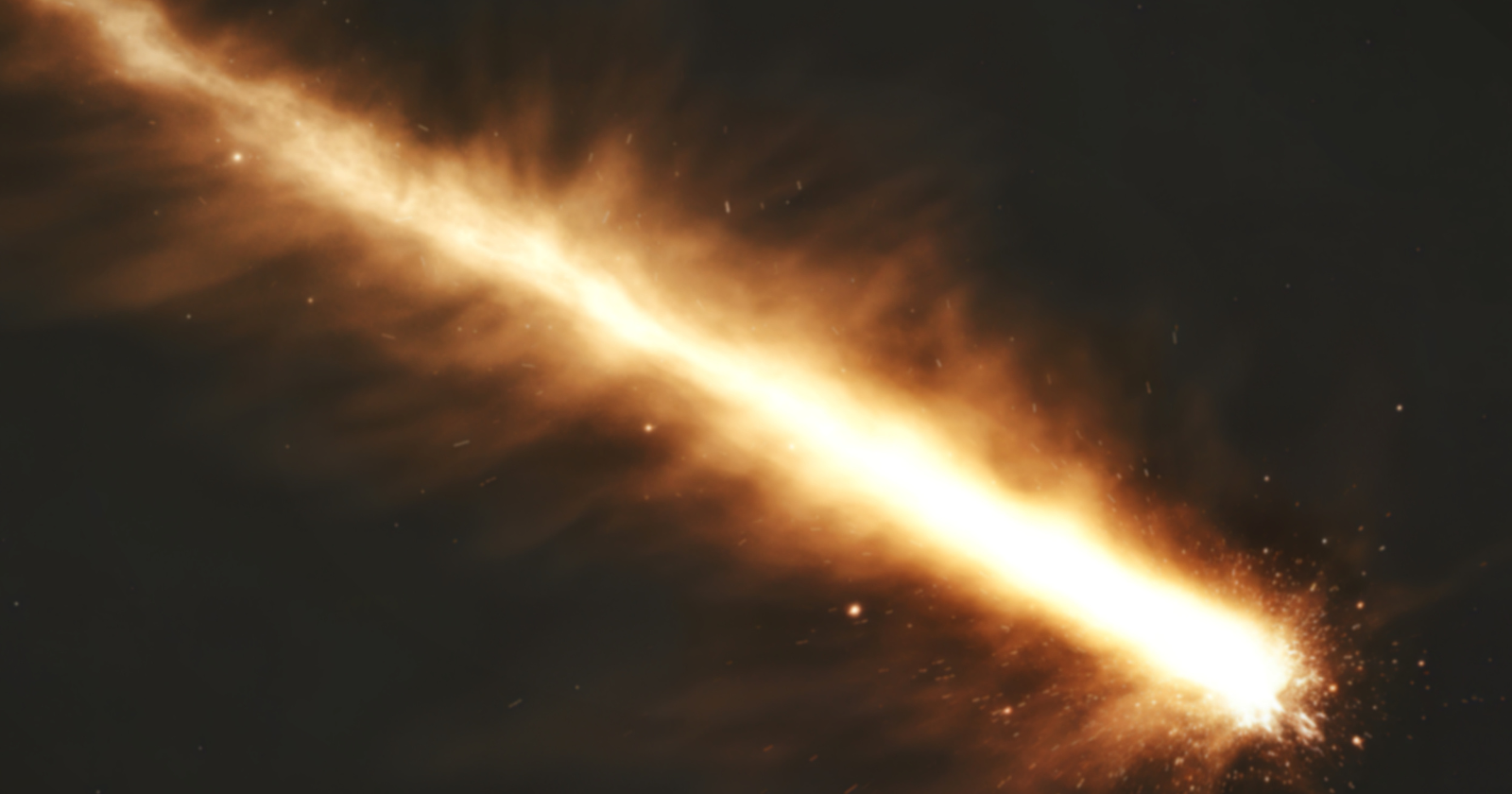
On the morning of 30 June 1908, an object from space exploded above the basin of the Podkamennaya Tunguska River in central Siberia. It flattened roughly 2,150 square kilometres of forest, an area larger than Greater London, and tens of millions of trees were knocked down in a pattern that radiated outward from a single point. It remains the largest cosmic impact event in recorded human history, even though the object appears to have exploded without ever reaching the ground. And there is no crater.
The absence of a crater is the part most often presented as a puzzle. It is better understood as the answer.
What Kulik found, and what he did not
No scientist reached the site for almost two decades. The region was remote, and the years after 1908 in Russia were not ones that lent themselves to expeditions to empty Siberian forest. The first scientific survey was led by the mineralogist Leonid Kulik, who reached the area in 1927 and returned over the following years.
Kulik expected to find a crater and fragments of a fallen meteorite. According to Britannica’s account of the event, he found instead a vast field of felled, splintered trees lying radially for 15 to 30 kilometres, scorched and stripped, with little regrowth two decades on. The epicentre was easy to locate, because every fallen trunk pointed away from it. At that central point Kulik found a marshy bog. He did not find a crater, and he did not find a meteorite.
That result was genuinely unexpected at the time, and it fed decades of more colourful explanations: a crashed spacecraft, a small black hole passing through the Earth, a pocket of antimatter. None of these were ever necessary. The mundane explanation accounts for the evidence, including the missing crater.
Why there is no crater
A crater forms when an object survives its passage through the atmosphere and strikes the ground intact. The Tunguska object did not strike the ground. It came apart in the air.
An incoming asteroid or comet fragment travels at tens of kilometres per second. As it descends into denser air, the pressure on its leading face becomes enormous, and a body that is not a solid block of metal cannot hold together against it. The object fragments and its kinetic energy is released almost at once as an explosion in the atmosphere. This is called an airburst. As the Royal Observatory Greenwich notes, because the Tunguska explosion happened in the air, no impact crater was created, though the event is still classed as an impact event.
The downward-directed blast wave from that explosion is what flattened the forest, and the radial pattern of the fallen trees points back to the point in the sky above which it happened. Estimates put that altitude at roughly 5 to 10 kilometres. The flattened trees are not the wreckage left by something that landed. They are the imprint of a shockwave from something that never did.
What is still genuinely uncertain
Some figures attached to Tunguska are firmer than others, and the energy is one of the softer ones.
There were no instruments at the site. The energy of the explosion has been reconstructed from indirect evidence: the extent of the flattened forest, the seismic waves recorded as far away as Western Europe, and modelling of how airbursts behave. The commonly cited range is around 10 to 15 megatons of TNT, which is several hundred times the energy of the bomb dropped on Hiroshima, but published estimates run wider than that in both directions. “Hundreds of times Hiroshima” is a fair and conservative way to put it. A single precise multiplier is not something the evidence supports.
The nature of the object is also not fully settled. The airburst mechanism is well established. Whether the body was a stony asteroid or a fragment of a comet has been argued for decades, with the balance of recent work tending toward a stony asteroid perhaps 50 to 60 metres across. There is also a long-running and contested claim, advanced by an Italian research team, that a small lake near the epicentre, Lake Cheko, could be a crater left by a surviving fragment. That proposal has not been widely accepted, and other researchers have argued the lake predates 1908. It is worth knowing the claim exists. It is not a reason to retire the sentence “there is no crater.”
Why it still matters
Tunguska is not only a historical curiosity, and this is where the careful version of the story has a practical edge.
For a long time, thinking about impact hazards focused on large objects capable of leaving craters and causing global effects. Those are rare. Objects in the Tunguska size range are far more common, and an airburst from one does not need to hit a city to be destructive. On 15 February 2013, a much smaller object exploded over Chelyabinsk, Russia, roughly 2,400 kilometres west of Tunguska. It injured around 1,500 people, mostly from glass broken by the blast wave. It was a fraction of Tunguska’s scale, and it was still the most damaging meteor event in over a century.
This is why surveys to catalogue near-Earth objects now extend well below the size that would once have drawn attention. The open question Tunguska leaves is not what exploded over Siberia in 1908. It is how completely the population of similar objects has been mapped, and how much warning the next one would give.
