
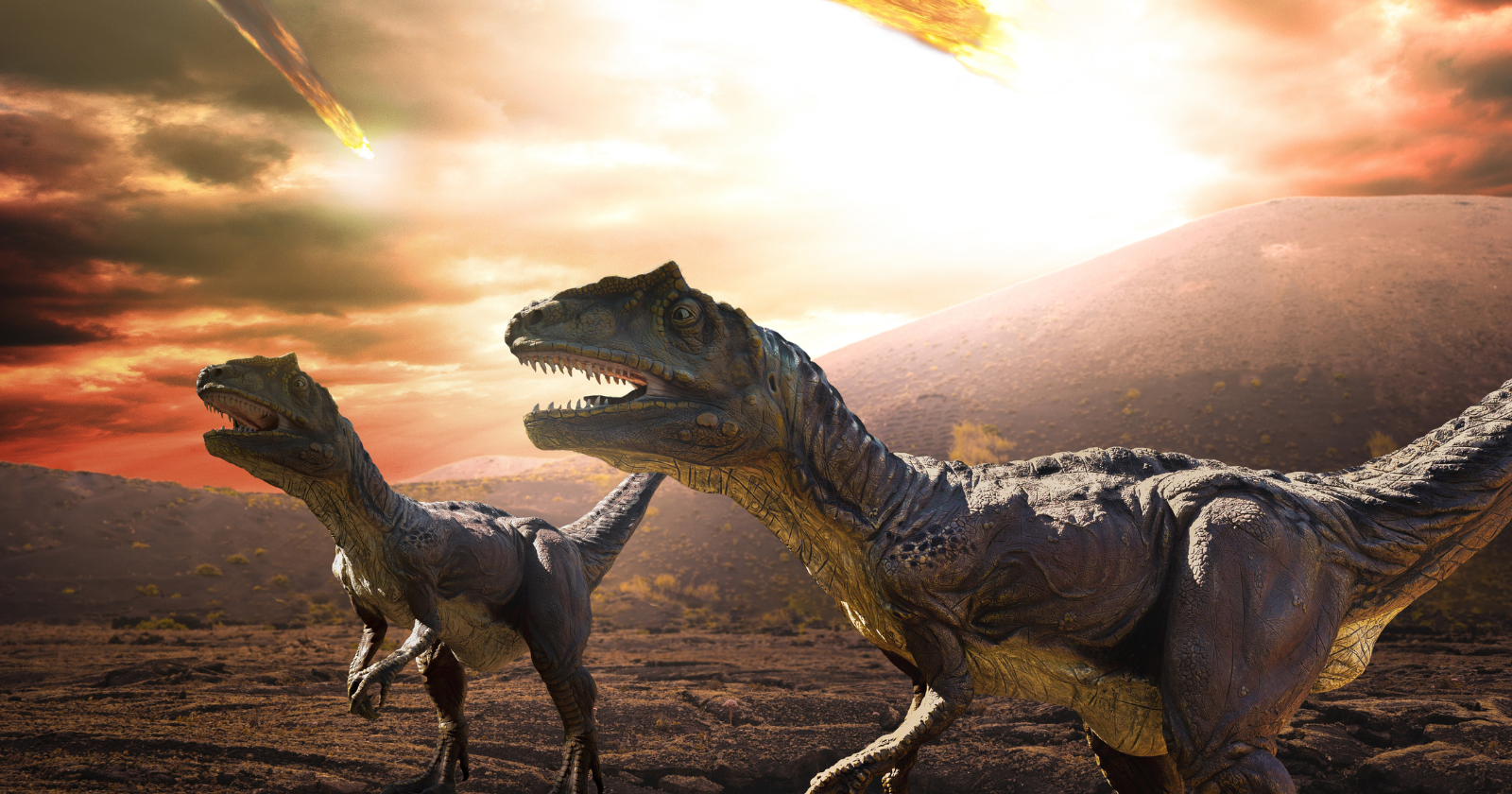
The site is called Tanis, in the Hell Creek Formation of southwestern North Dakota. In 2019, a team led by Robert DePalma described it as a rare snapshot of the first minutes to hours after the Chicxulub asteroid impact 66 million years ago. The most arresting detail was not a dinosaur skeleton. It was fish. Some of them had tiny glassy beads of impact debris lodged in their gills, which suggests they were still alive and breathing as material thrown up by the asteroid was falling out of the sky.
That does not mean every claim about Tanis should be treated as settled. The fish and the surge deposit that buried them are the strongest published evidence. The more spectacular claims, the ones involving dinosaurs, are less fully described in the peer-reviewed literature, and the site itself has become unusually controversial. It is a genuine and unusual find, not a closed case.
What the 2019 paper actually describes
The paper, published in PNAS, describes an “Event Deposit,” a package of jumbled sediment and fossils roughly 1.3 metres thick, capped by the iridium-rich clay layer that marks the Cretaceous-Paleogene boundary worldwide. Inside it: densely packed freshwater fish, burned wood, marine ammonites, and other material, deposited together in a single high-energy event.
The deposit was emplaced, the paper argues, by a surge of water that ran inland up a river channel connected to an arm of the Western Interior Seaway. It carries the physical signatures of a tsunami runup, but the timing does not fit one. A tsunami from Chicxulub, roughly 3,000 kilometres away, would have taken many hours to reach the site. The paper instead attributes the surge to seismic waves from the impact earthquake, estimated at magnitude 10 to 11, arriving in under an hour.
And running through all of it are the spherules: small glassy beads of melted rock, thrown out by the impact and falling back to the ground, found through the deposit and, most importantly, lodged in the gills of the fish and sealed inside amber.
Why the fish gills matter
Spherules on their own do not date a deposit precisely. They can be reworked, washed into younger sediments by later storms or shifts in sea level, and they turn up in layers above and below the boundary at other sites. The Princeton geoscientist Gerta Keller raised exactly this point about Tanis, noting that spherules are easily moved into rock younger than they are.
The gills are what change the picture. According to the PNAS paper, the spherules in the fish are concentrated in the gill rakers, the bony structures fish use to filter water, rather than scattered through the body. The straightforward reading is that the fish inhaled the spherules from the water while still alive, then were buried before the particles could pass through or settle out. The same logic applies to spherules sealed in amber, which fixes them in place at the moment the resin hardened.
This is what links the spherules to the fish, and the fish to a window of minutes to hours. It is the strongest single piece of evidence at the site, and in our reading it is genuinely unusual. A deposit full of loose spherules would be interesting. Spherules caught mid-breath are something closer to a timestamp.
Where the framing runs ahead of the evidence
What that evidence shows is fish dying in North Dakota within about an hour of an impact 3,000 kilometres away. That is not quite the same as the day the dinosaurs died.
The 2019 paper itself contained almost no dinosaur remains. As Smithsonian reported at the time, the dinosaur material in the formal study amounted to little more than a weathered hip bone. The dinosaurs of the popular framing arrive through a separate set of claims, made mostly outside the peer-reviewed literature and notably in a 2022 BBC documentary: an exceptionally preserved leg of the dinosaur Thescelosaurus, a pterosaur embryo still inside its egg, and a piece of Triceratops skin. The team has suggested some of these animals may have died on the day of the impact. These are striking specimens if the descriptions hold. But they have not yet been published and assessed in the detail such claims require, and a detached leg is not an animal killed by the impact, since limbs can be transported and buried well after death. The case that Tanis preserves the last of the non-avian dinosaurs is, for now, not established in the way the surge deposit and the fish are.
Why some researchers remain cautious about the source
Caution about Tanis is partly about the site and partly about how its findings have reached the public. The site first found a wide audience through a long article in The New Yorker in 2019, published days before the PNAS paper. Several researchers objected at the time that the public claims, as Science reported, ran ahead of what the peer-reviewed study supported. DePalma’s standing has also drawn scrutiny, including over his 2015 description of a dinosaur he named Dakotaraptor, parts of which were later disputed. Tanis sits on private land that DePalma leases and controls access to, which makes independent verification harder than at a publicly held site.
The sharpest dispute concerns the season of the impact. In late 2021 and early 2022, two teams working with Tanis fish published almost identical conclusions, that the impact occurred in the Northern Hemisphere spring. DePalma’s group published first; Melanie During and colleagues, who had also worked at the site, published in Nature two months later and alleged that DePalma had fabricated data to publish ahead of her. A University of Manchester investigation, reported by Science in 2023, found that DePalma had not fabricated data, but that poor research practice in the handling and presentation of the isotope data constituted research misconduct. The spring conclusion itself was not invalidated. The dispute is about how the result was produced, not about whether it was right.
What is not in dispute
The controversy can make the whole subject look shakier than it is, so it is worth separating the contested parts from the settled ones.
That an asteroid struck near Chicxulub 66 million years ago, and that this impact was the principal driver of the extinction that ended the age of the non-avian dinosaurs and wiped out roughly three-quarters of species, rests on a broad body of evidence: the buried crater itself, the global iridium layer, and shocked minerals found worldwide at the boundary. None of that depends on Tanis. A long-running minority view gives more weight to Deccan Traps volcanism as a contributing factor, but the impact’s central role is not seriously in question.
Tanis, if the surge-deposit interpretation holds, adds something narrower and harder to obtain: a closely resolved record of the first hour, at one location, on the day itself. That is a real contribution, and it is why the site deserves the ordinary machinery of science applied to it patiently.
The open questions at Tanis are the kind that can be settled. Full peer-reviewed descriptions of the dinosaur material, data released for others to check, and access for researchers outside the team would do more to establish what the site shows than any further documentary footage.
