
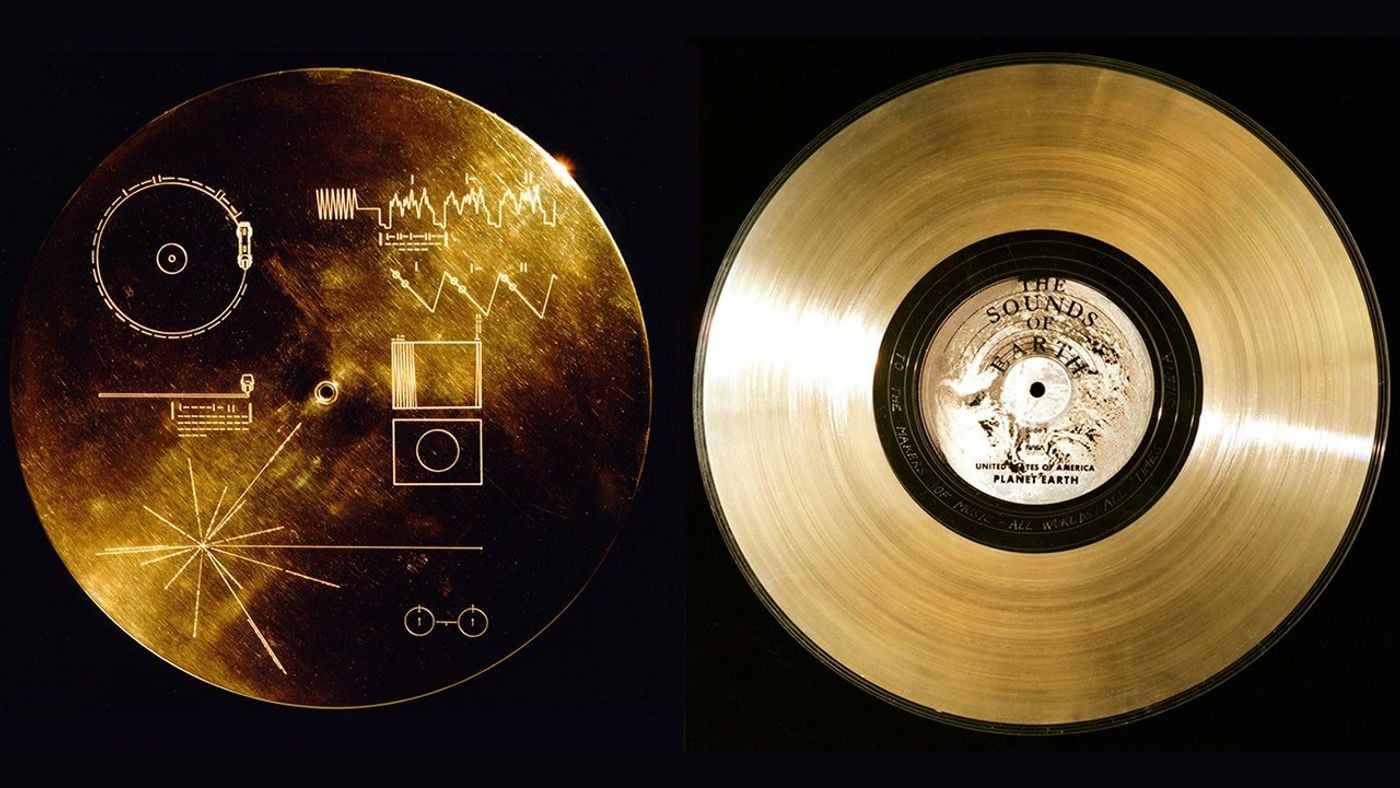
The Voyager Golden Record is usually remembered as a message: music, greetings, natural sounds, images and diagrams sent outward on the two Voyager spacecraft in 1977.
But one of its most careful details was not in the music or the greetings. It was on the cover.
According to NASA’s page on the Golden Record cover, an ultra-pure source of uranium-238 was electroplated onto the protective cover. The amount was tiny, with a radioactivity of about 0.00026 microcuries, but the purpose was ambitious. The uranium was meant to function as a clock.
If a future finder could measure how much uranium-238 remained and how much daughter material had accumulated, they could estimate how long the record had been travelling since it left Earth.
A clock without gears
The basic idea is radiometric dating reduced to a physical note on an artifact. Uranium-238 decays at a known rate. NASA describes the uranium on the cover as decaying steadily into daughter isotopes, with half the uranium-238 gone after about 4.51 billion years. Modern references often give the half-life as about 4.47 billion years, but the larger point is unchanged: this is a very slow clock.
That slowness was the point. A clock measured in years, centuries or even thousands of years would be poorly matched to a spacecraft expected to drift between stars. A uranium-238 clock has a timescale closer to planets than to people.
The Voyager spacecraft are already far beyond their original planetary mission. NASA’s Voyager mission page now describes the twin probes as continuing their extended journey after exploring the outer planets, with Voyager 1 and Voyager 2 both beyond the heliosphere. The Golden Records aboard them are not being actively transmitted. They are physical objects, bolted to machines that will continue coasting long after their power systems fall silent.
For that kind of message, the designers needed a way to communicate time without relying on the human calendar. The year 1977 means something only to a civilisation that knows Earth’s calendar system. Radioactive decay does not need that context.
The cover was also an instruction sheet
The uranium marker was only one part of the cover’s larger job. NASA’s overview of the Golden Record describes the record as a 12-inch gold-plated copper disk containing sounds and images selected to portray life and culture on Earth. But the cover had to do a more technical job: explain how to play it.
The record could not assume English, familiar units, or any shared cultural reference. So the cover uses physical constants and diagrams.
One symbol shows the hydrogen atom and defines a basic unit of time from a transition of neutral hydrogen. Another diagram shows the record and stylus, with binary notation giving the time for one rotation. Other markings explain how to reconstruct the images encoded on the record and include a circular calibration image so that the proportions can be checked.
The lower-left part of the cover contains a pulsar map, an idea related to the earlier Pioneer plaques. It uses the relative periods and directions of pulsars to indicate where the Sun is and to help establish the era in which the spacecraft was launched.
The uranium clock adds a second route to the same question. It is not there to tell a story about Earth. It is there to let the material itself date the message.
Why redundancy mattered
NASA says the uranium measurement was intended as a check on the epoch indicated by the pulsar map. That redundancy is a small but revealing engineering choice.
A future civilisation might not identify every pulsar. The pulsar data might be read imperfectly. The cover might be damaged. The finder might understand radioactive decay more readily than the map, or the reverse. The record’s designers did not have the luxury of assuming a shared interpretive culture, so they built in several physical references rather than one.
That is what makes the Golden Record different from a symbolic gesture alone. It was symbolic, of course. It carried music, spoken greetings and images selected under Carl Sagan’s leadership to represent something of Earth. NASA’s Golden Record contents page still lists the greetings, sounds, music and images chosen for the two spacecraft. But the cover treated the whole artifact as a technical communication problem.
It had to answer several questions before the record could say anything: what is this object, how does it rotate, how should the information be decoded, where did it come from, and when was it made?
The uranium sample was the answer to that last question.
A message built for deep time
The Golden Record is sometimes described as if it were meant to be found soon. It was not. The Voyager trajectories do not take them to known nearby civilisations, and even their future close stellar passages are close only on astronomical scales.
Timothy Ferris, who produced the Golden Record, wrote in a 2017 New Yorker account that the records were crafted to last over a billion years. That should not be read as a guarantee that every encoded sound and image will remain perfectly recoverable for that long. Dust impacts, radiation and chance still exist. But it does capture the design horizon: the records were made for durations that make ordinary historical time almost disappear.
That scale helps explain the uranium-238 choice. It is not a clock for a mission operations team. It is not a clock for the first few centuries. It is a clock whose half-life is comparable with the age of Earth itself.
It also changes the emotional texture of the record. The contents say, roughly, here is something of who we were. The cover says, more quietly, here is how to understand the message, where it came from, and how long it has been alone.
The date is built into the matter
There is no reason to assume the Golden Record will ever be discovered. Space is large enough that even a well-made artifact can become effectively unreachable. The Voyagers are not probes aimed at an audience. They are spacecraft carrying a message as a possibility, not a delivery plan.
Still, the uranium clock gives that possibility a seriousness that is easy to miss. The record does not merely ask a future finder to play sounds from Earth. It gives them a set of tools for interpreting the object across an enormous gap in time.
That is the quiet precision of the uranium on the cover. The designers did not just send a message into interstellar space. They sent a message with a physical timestamp, one that any sufficiently capable finder could test without knowing a word of any human language.
The Golden Record’s clock has no hands, no face and no ticking mechanism. It is a tiny radioactive reference point fixed to a cover, counting time by decay while Voyager drifts outward. If it is ever found, the record will not have to say when it left. The matter on its surface will have been keeping count.
