
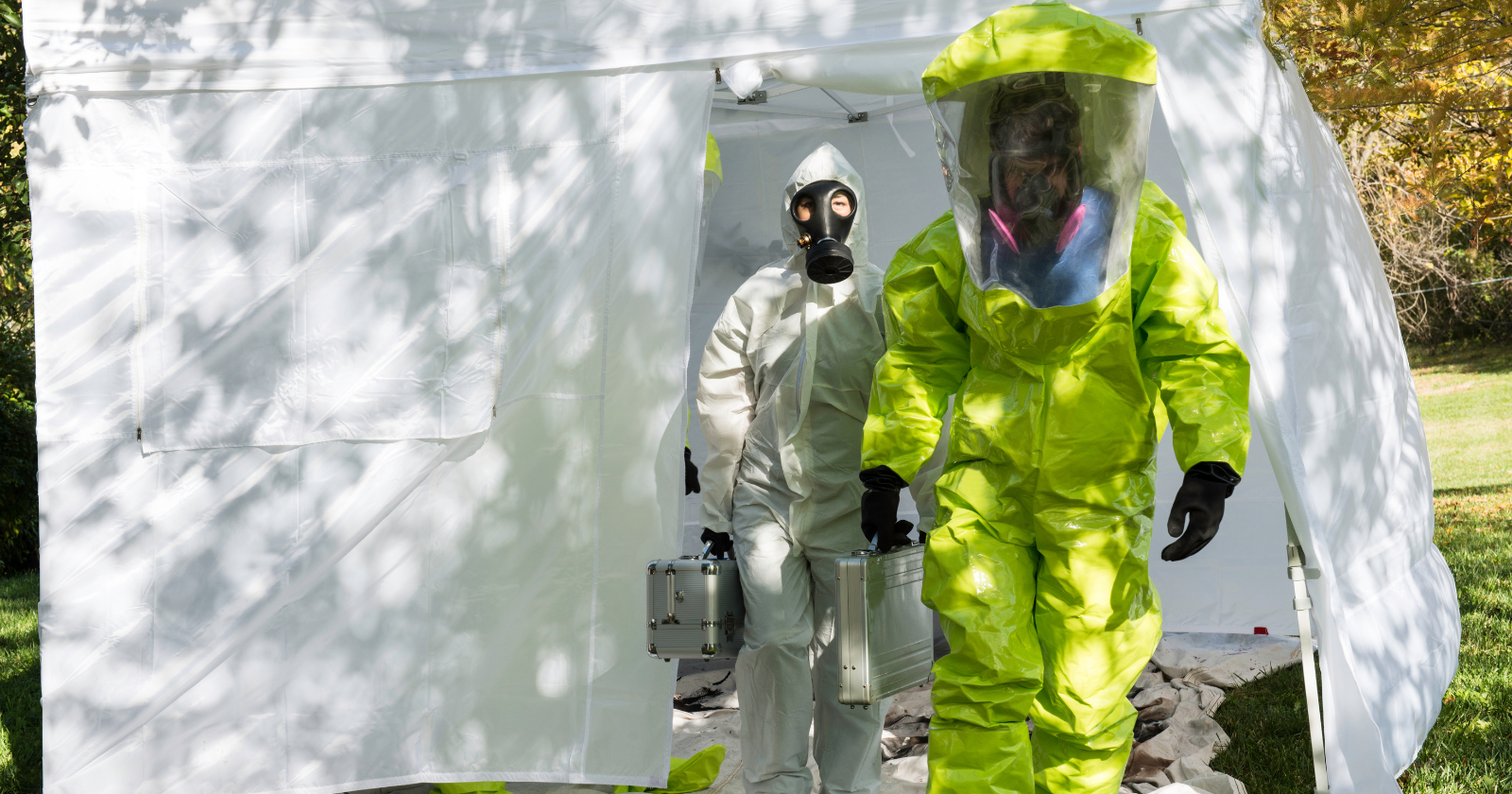
The World Health Organization declared, on May 17, 2026, that the Ebola outbreak currently spreading through the Democratic Republic of Congo and Uganda constitutes a public health emergency of international concern. The declaration came as case counts had already pushed the outbreak past the threshold for becoming the third-largest Ebola outbreak on record, after the 2014-2016 West Africa outbreak and the 2018-2020 DRC outbreak. As of the most recent WHO figures, more than 513 cases have been recorded, with over 130 suspected deaths. The strain responsible is the Bundibugyo virus, for which there is no approved vaccine or treatment currently available.
The standard cultural framing of an Ebola outbreak, when one occurs, tends to focus on the immediate medical features. The case counts. The geographic spread. The mortality rate. The various practical questions about whether the outbreak will reach Western countries. The framing is, in some real way, inadequate to what is currently happening. What is currently happening is, on close examination, considerably more interesting and considerably more uncomfortable than the standard framing allows for. The outbreak is, by every available account from the people closest to the response, the result of a particular set of decisions made in Washington across the previous fifteen months, the effects of which have been quietly accumulating in the form of weakened surveillance, diminished response capacity, and the conditions under which the current outbreak was, in some real way, allowed to grow to its current size before being detected.
What the funding cuts actually looked like
It is worth being precise about what the cuts involved, because the wider register has tended to absorb them in vaguer terms than the underlying numbers warrant.
The cuts began in early 2025, when the Trump administration initiated the dismantling of the U.S. Agency for International Development. The numerical record, according to STAT’s analysis of the federal foreign aid data, is that USAID sent approximately $1.2 billion in foreign aid to the DRC in fiscal year 2024. The figure fell to $715 million in fiscal year 2025. In the final three months of 2025, the figure was $67 million. The Department of Health and Human Services, separately, sent nearly $33 million in foreign aid to the DRC in fiscal year 2024. That figure fell to less than $10 million in fiscal year 2025. Total U.S. foreign assistance spending dropped by approximately 57 percent across the same period.
The cuts were not, on close examination, narrowly targeted. The cuts affected, among other things, the USAID teams that had been working on Ebola preparedness and response in central Africa. According to former USAID officials interviewed by CNN, almost everyone on the USAID team that worked on the most recent previous Ebola outbreak in Uganda has been fired. The cancellation of relevant funding, the same official said, meant that “everything stalled while the outbreak continued” during the earlier outbreak in 2025. The team that would, under previous conditions, have been monitoring the situation in 2026 was, in some real way, no longer in place by the time the current outbreak began.
The U.S. exit from the World Health Organization, also undertaken in 2025, added a further disruption. The exit meant that the U.S. government and CDC no longer received information through the WHO’s official reporting channels, although some informal contact has continued. The information flows that had previously allowed for early detection of outbreaks like the current one were, accordingly, degraded.
What “massive surveillance failure” actually means
The most striking single description of what has happened comes from Jeremy Konyndyk, the president of Refugees International and the former leader of USAID’s COVID-19 and disaster relief response work. Konyndyk characterized the current outbreak as “very worrying” and as the apparent result of “a massive surveillance failure.” He noted that it is “really unusual for an Ebola outbreak to get to this scale before being detected.”
The feature this points to is worth attending to. The Ebola response infrastructure that the international community built up across the 2014-2020 period was, by every available measure, calibrated to early detection. Early detection is the feature that determines whether an Ebola outbreak remains a localized event or becomes a regional crisis. The window between when the first case appears and when the outbreak crosses the threshold from controllable to uncontrollable is, on the available epidemiological evidence, somewhere between several weeks and a few months. The window depends on the density of the population, the quality of the local healthcare infrastructure, and the speed with which international support can be mobilized.
The current outbreak, on the available evidence, was not detected during the window. The outbreak had spread to multiple locations in two countries and produced more than 300 cases before the WHO became aware of it. The not-detecting is the surveillance failure. The surveillance failure is, on the available evidence from former officials and current aid workers, the consequence of the dismantling of the surveillance infrastructure across the previous fifteen months.
This is not, on close examination, a partisan claim. The claim is being made by former USAID officials, by global health experts at major research institutions, by aid workers currently on the ground in the affected regions, and by the international press covering the outbreak. The claim is, in some real way, the fact that the people closest to the situation are all converging on, regardless of their political positioning.
What the practical effects on the ground have been
The practical effects on the ground have been documented, on the available evidence, in several specific ways.
The first effect involves the basic supplies that local healthcare workers need to respond to outbreaks. When the previous Ebola outbreak hit Uganda in March 2025, U.S. officials warned at the time that the Trump administration’s actions on foreign assistance, including the termination of USAID grants, was impeding the Ugandan government’s ability to procure lab supplies, diagnostic equipment, and protective gear for medical workers. The impediment continued through the intervening fourteen months, with the result that the current outbreak began under conditions where the local response infrastructure had been progressively degraded rather than maintained.
The second effect involves the surveillance networks that had previously been monitoring the populations at risk. The networks had been funded, in significant part, by USAID grants to local health authorities and international organizations. The grants were, in many cases, cancelled or substantially reduced across 2025. The networks accordingly thinned out. The thinning is what produced the conditions under which the current outbreak could grow to several hundred cases before being detected.
The third effect involves the response capacity that, once the outbreak was detected, would normally be mobilized to contain it. The capacity included, in previous outbreaks, the rapid deployment of USAID Disaster Assistance Response Teams, the mobilization of CDC epidemiologists, and the coordination with WHO of the international response. The capacity has, in 2026, been substantially reduced. The U.S. is no longer a WHO member. The USAID teams have been disbanded. The CDC has experienced staffing cuts that have reduced its ability to deploy personnel to international outbreaks. The response is, accordingly, occurring with considerably less American involvement than any previous Ebola outbreak in the last two decades.
What the wider implications actually are
The implication of all this, on close examination, is uncomfortable. The implication is that the international system for detecting and responding to emerging infectious diseases has been, in some real way, partially disabled, and that the partial disabling has produced visible costs in the form of the current outbreak being larger than it would otherwise have been.
The implication does not, on close examination, depend on any particular position about whether the underlying funding decisions were justified on other grounds. The funding decisions were made for various reasons that the wider political register has been litigating at considerable length. The consequence of the decisions, regardless of how one evaluates the decisions themselves, is what is currently being observed in the form of the outbreak’s size and the timing of its detection. The observation is, by every available account from the people closest to the response, that the consequences have been considerable.
The wider implication, beyond the current outbreak, is that the infrastructure that the international community had built up across decades for responding to disease outbreaks is, in some real way, no longer fully operational. The infrastructure was expensive. The infrastructure was, in some sense, redundant during the periods when no major outbreak was occurring. The infrastructure was also, by every available measure of its track record, calibrated to the rare events that justify its existence. The dismantling of the infrastructure during periods of apparent quiet has produced, in the case of the current outbreak, the demonstration of what the infrastructure had actually been doing all along.
Final words
The third-largest Ebola outbreak on record is currently spreading through the Democratic Republic of Congo and Uganda. The outbreak has, as of mid-May 2026, produced more than 513 reported cases and over 130 suspected deaths. The Bundibugyo strain responsible has no approved vaccine or treatment. The WHO has declared the outbreak a public health emergency of international concern.
The outbreak grew to its current size, on the available evidence from former USAID officials, current aid workers, and global health experts, in part because the international surveillance and response infrastructure that would, under previous conditions, have detected and contained it earlier had been substantially degraded by the dismantling of USAID and related U.S. global health programs across the previous fifteen months. The degradation was real. The degradation produced, in some real way, the conditions under which the current outbreak could grow to several hundred cases before being detected.
The wider cultural register has not, on the available evidence, fully absorbed what this means. The absorption is, in some real way, what the next several months of public discussion is going to be required to do. The infrastructure that the international community had built up for responding to outbreaks like this one was not, by any honest accounting, a luxury. The infrastructure was the condition under which outbreaks of this kind could be contained before they became regional crises. The conditions are, on the available evidence, no longer fully in place. The current outbreak is the first major demonstration of what that absence actually means. There will, in all likelihood, be others.
