
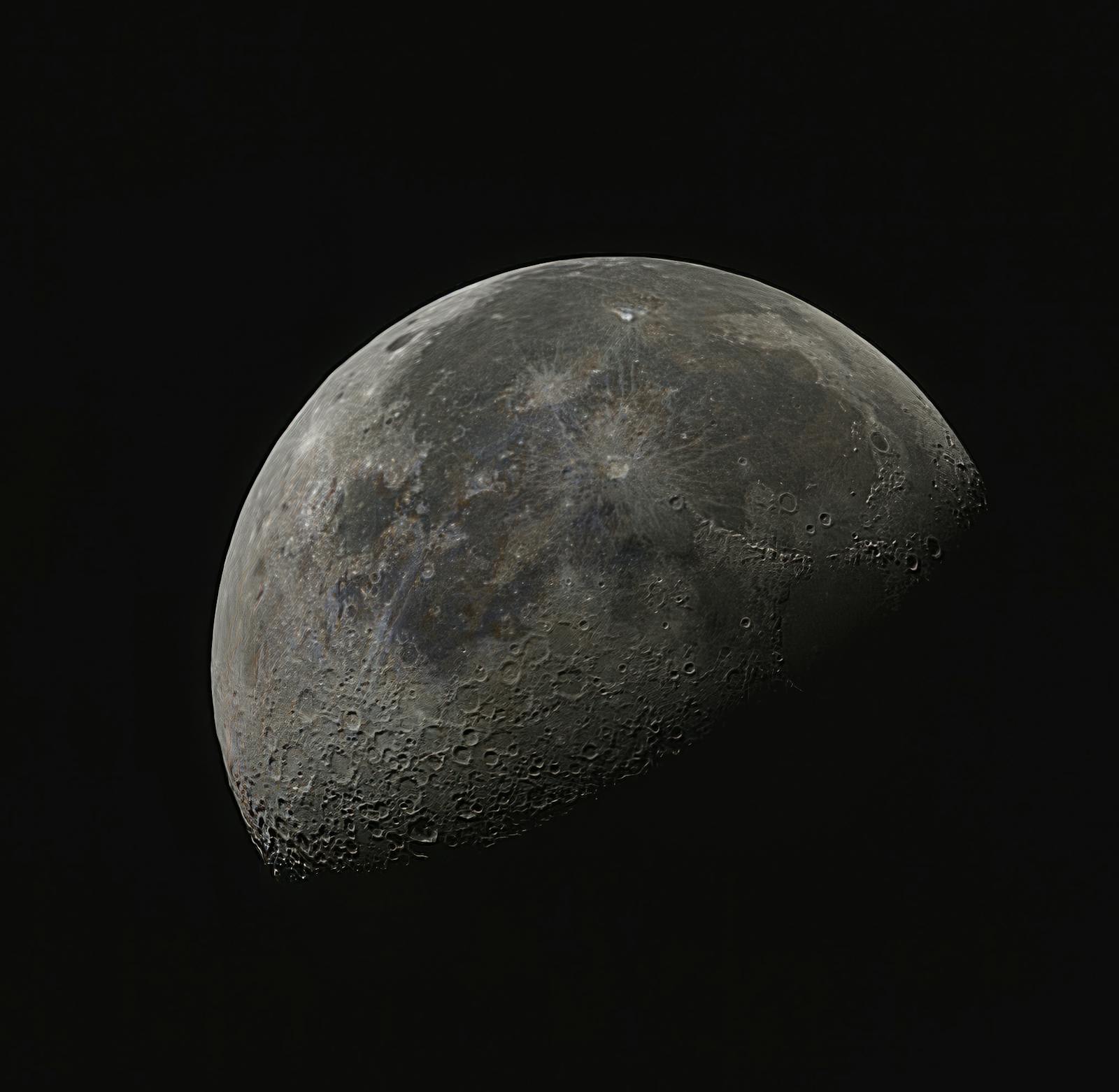
On a quiet night at the Apache Point Observatory in New Mexico, a pulse of green laser light leaves a 3.5-meter telescope, climbs through the atmosphere, and races toward the Moon. About 1.25 seconds later it strikes a panel of fused silica prisms left there by Buzz Aldrin in July 1969. A handful of photons bounce back. By the time they return to Earth, the original beam has spread to roughly 20 kilometers wide, and the telescope catches, on a good night, a single photon every few seconds. That faint echo is enough to measure the distance to the Moon to within a couple of millimeters.
The reflectors have been working for nearly 57 years. They have no power source. They never will.
What the astronauts actually left behind
The Apollo 11 retroreflector is an 18-inch square aluminum panel holding 100 corner-cube prisms made of fused silica. Each prism has the optical trick of sending any incoming light back in exactly the direction it came from, regardless of the angle of incidence. Aldrin set it down on the Sea of Tranquility on July 21, 1969, leveled it with a small bubble indicator, and walked away. Apollo 14 placed a similar panel near Fra Mauro in 1971. Apollo 15 placed a larger array, 300 prisms, near Hadley Rille later that year. Two French-built reflectors also sit on the Soviet Lunokhod 1 and Lunokhod 2 rovers, the latter delivered in 1973.
Five working mirrors. Five fixed points on another world.
The instruments require no electricity, no thermal control, no communication. That is why they have outlasted the powered Apollo science stations on the surface, the ALSEP packages deployed by Apollo 12, 14, 15, 16, and 17, which were shut down by NASA in September 1977 to save mission operations money. As Fox News reported on the 50th anniversary of the experiment, the reflector keeps working because it is, fundamentally, just a very well-made mirror.
How you bounce a laser off the Moon
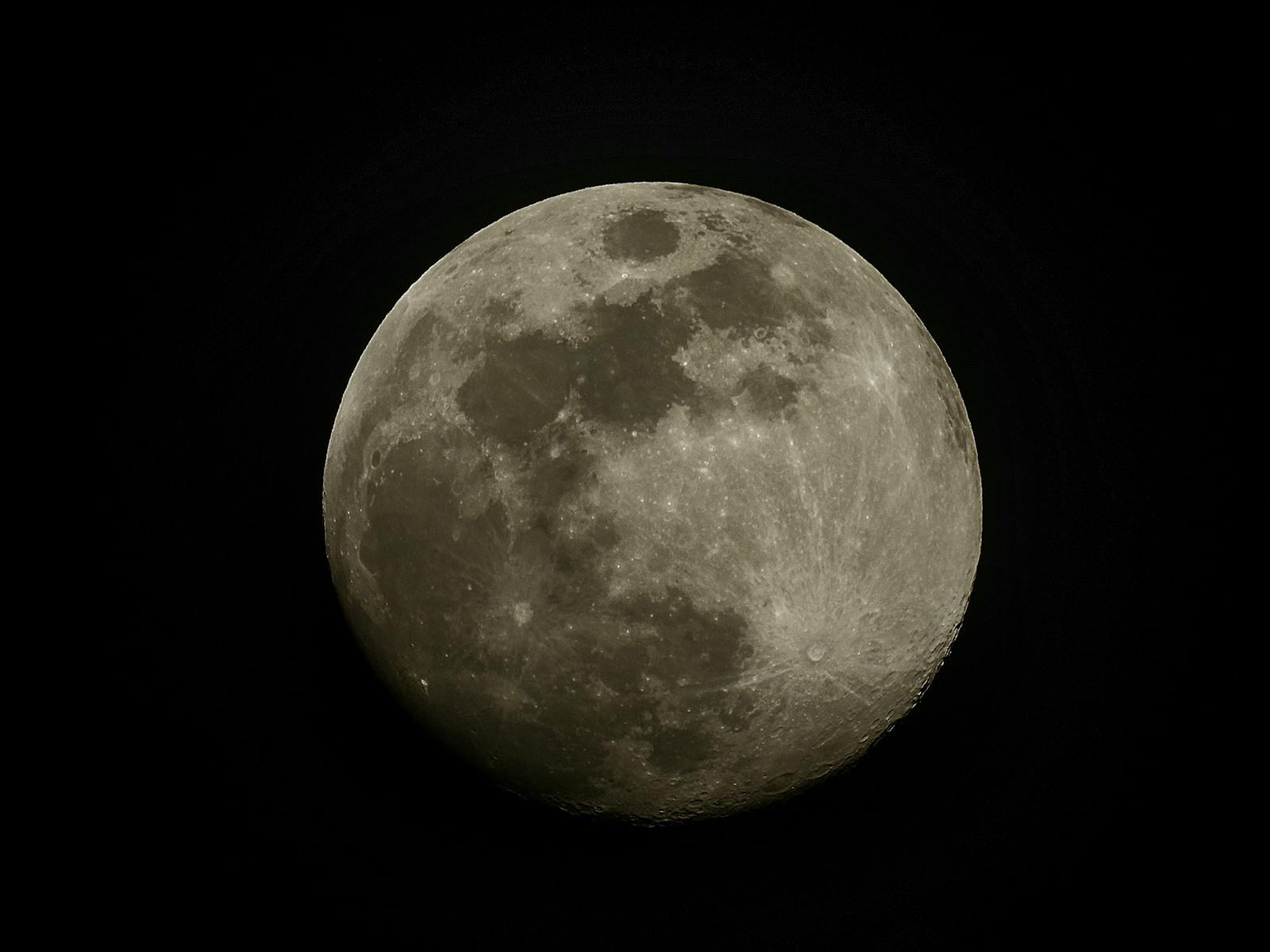
The Moon sits, on average, 384,400 kilometers from Earth, about 30 Earth-diameters away. A laser pulse takes roughly 2.5 seconds to make the round trip. The challenge is not distance. The challenge is light loss.
When a laser leaves an observatory like the McDonald Observatory in Texas or the Apache Point Observatory in New Mexico, atmospheric turbulence and beam divergence spread the photons across several kilometers by the time they reach the lunar surface. Only a tiny fraction of the beam actually strikes the reflector. The corner cubes send those photons back, but on the return trip the beam spreads again. From a starting pulse of roughly 10²⁰ photons, the telescope might catch one. Sometimes two.
To extract a usable signal, observatories fire thousands of pulses over several hours and average the timing. The technique has improved steadily since 1969, partly because lasers have grown more powerful, partly because photon detectors have grown more sensitive, and partly because some stations now range in the infrared, which delivers a more uniform signal across all five reflectors.
The Apache Point Observatory Lunar Laser-ranging Operation, known as APOLLO, has produced a 15-year dataset with median nightly ranging accuracy of 1.7 millimeters, according to a Nature Research Intelligence summary of the field. That is roughly the thickness of a credit card, measured across nearly 400,000 kilometers.
The Moon is leaving, slowly
Half a century of these measurements has produced one of the more poetic facts in modern astronomy. The Moon is drifting away from Earth at 3.8 centimeters per year. Roughly the rate at which fingernails grow.
The cause is tidal friction. Earth’s oceans bulge toward the Moon, but because Earth rotates faster than the Moon orbits, the tidal bulge runs slightly ahead of the lunar position. That misaligned bulge tugs the Moon forward in its orbit, transferring angular momentum from Earth’s spin to the Moon’s path. Earth’s day lengthens by about 1.8 milliseconds per century. The Moon climbs a little higher.
James Williams, a planetary scientist at NASA’s Jet Propulsion Laboratory who has worked on the experiment for decades, has long argued that the data also revealed the Moon has a fluid core, a finding extracted from tiny wobbles in its rotation that show up in the ranging data.
The recession has consequences on a timescale humans rarely think about. The slow retreat means total solar eclipses will eventually become impossible. In roughly 600 million years, the Moon’s apparent disk will be too small to fully cover the Sun. The narrow geometric coincidence that gives Earth its current eclipses is a feature of this particular moment in deep time.
A 57-year experiment in fundamental physics
The reflectors were sold to NASA management as a geodesy experiment. They have turned out to be among the most precise tests of gravity ever conducted.
Lunar laser ranging has confirmed Einstein’s general relativity to extraordinary accuracy. The equivalence principle, the idea that gravitational and inertial mass are the same, has been verified for the Earth-Moon system to better than 4 parts in 10¹⁴. That is two orders of magnitude tighter than earlier limits, according to the Nature Index summary cited above. Newton’s gravitational constant, G, has been shown to vary by less than 1 part in 100 billion between 1969 and 2004. If gravity is changing with time, it is changing more slowly than any other physical constant has been measured to change.
The reflectors also constrain parametrised post-Newtonian parameters, the coefficients physicists use to describe possible deviations from general relativity. Each year of new data tightens the bounds. So far, Einstein keeps holding.
Who runs the experiment
Multiple observatories around the world have participated over the decades. McDonald Observatory in Texas was the workhorse for the first 30 years. The Observatoire de la Côte d’Azur in France contributed long European datasets and pioneered infrared ranging at the Grasse station. The Apache Point installation in New Mexico became the precision standard in the 2000s. Lick Observatory in California fired the first successful return signal off the Apollo 11 reflector on August 1, 1969, weeks after the astronauts left, using its 120-inch Shane Telescope. UC Santa Cruz documented the Lick observation in a 2019 story commemorating the 50th anniversary with a bronze plaque in the lobby of the Shane Telescope Dome.
The lineage of the instrument runs back to Princeton in the late 1950s, when graduate student James Faller, working in Robert Dicke’s gravity group, wrote a short paper proposing a corner reflector on the Moon and handed it to Dicke with a note asking whether the idea made sense. It did. Town Topics recounted the origin story in 2019, including the Princeton gravity group’s broader role in the development of relativistic tests that, decades later, would underpin modern GPS. Without those general-relativistic corrections, GPS positions would drift by about 10 kilometers per day.
The strange durability of a passive mirror
The corner cubes are made of fused silica, a glass that is essentially immune to ultraviolet damage. The lunar surface has no atmosphere, no rain, no wind, no liquid water, no biology. The only environmental threats are micrometeorite impacts and the slow accumulation of dust kicked up by those impacts. Over 57 years, the reflectivity of the Apollo 11 panel has degraded, but only modestly. Modern observations show the older panels return roughly 10 times fewer photons than they did in 1969, likely because of dust accumulation and thermal distortion of individual prisms during the lunar day.
The Apollo 15 array, the largest of the three, still produces the strongest signal. It is the workhorse of modern lunar laser ranging.
Even degraded, the reflectors are useful. The challenge has shifted from detecting a return signal to modeling every centimeter-scale effect that might bias the measurement. Researchers now have to account for the center-of-mass offset of each prism, the thermal expansion of the aluminum panel during a lunar day, and the lunar libration that subtly changes which prisms in the array are facing Earth at any given moment.
New mirrors for a new era
The next generation of lunar reflectors is already on the surface. NASA’s Next Generation Lunar Retroreflector, a single large corner cube about 10 centimeters across, is designed to outperform the original Apollo arrays by eliminating the array-averaging problem entirely. The first unit, NGLR-1, was delivered to Mare Crisium in March 2025 aboard Firefly Aerospace’s Blue Ghost 1 lander, and European and US laser stations successfully ranged to it within days of landing.
More are coming. Astrolab’s FLIP rover, scheduled to launch from Kennedy Space Center later this year on Astrobotic’s Griffin-1 lander, will carry a Laser Retroreflector Array from NASA Goddard to the lunar south pole as part of NASA’s Commercial Lunar Payload Services program, Florida Today reported. Other CLPS landers are also emplacing retroreflector packages, expanding the geometric baseline of the ranging network for the first time since 1973.
Differential Lunar Laser Ranging, where multiple ground stations record the same lunar return signal simultaneously, promises another order of magnitude improvement in measurements of the Moon’s interior structure. Simulation studies suggest that even five years of DLLR data, added to the existing 57-year archive, could sharpen estimates of lunar orientation and core properties by a factor of 100.
An experiment that outlives its institutions
The political context around the reflectors keeps shifting. The agency that placed them, NASA, is now navigating budget proposals that would terminate dozens of science missions while preparing to return crews to the Moon. The Soviet partner that built two of the five reflectors no longer exists. The French institutions that designed the Lunokhod mirrors are now part of European frameworks that have themselves been targeted in proposed partnership cancellations.
The mirrors keep working. They do not require funding cycles or international agreements or operating budgets. They sit on the regolith, three of them within a few hundred kilometers of each other, two more on the tracks of dead Soviet rovers, waiting for a photon.
The Apollo 11 panel was deployed about 18 meters from the Eagle’s descent stage, which still stands on the Sea of Tranquility. The footprints Aldrin made walking the reflector to its final position are still there. The lunar surface preserves what is left on it. The reflector will outlast the observatories that aim at it. It will outlast the institutions that built it. On a timescale of millions of years, dust and impacts will eventually dim the prisms below usefulness. But for now, every clear night, somewhere on Earth, a green pulse leaves a telescope, climbs 384,400 kilometers, and comes back with a number.
The Moon is 3.8 centimeters farther away than it was last year. The mirror that proves it has been sitting there since the summer the first commercial Boeing 747 entered service.
