
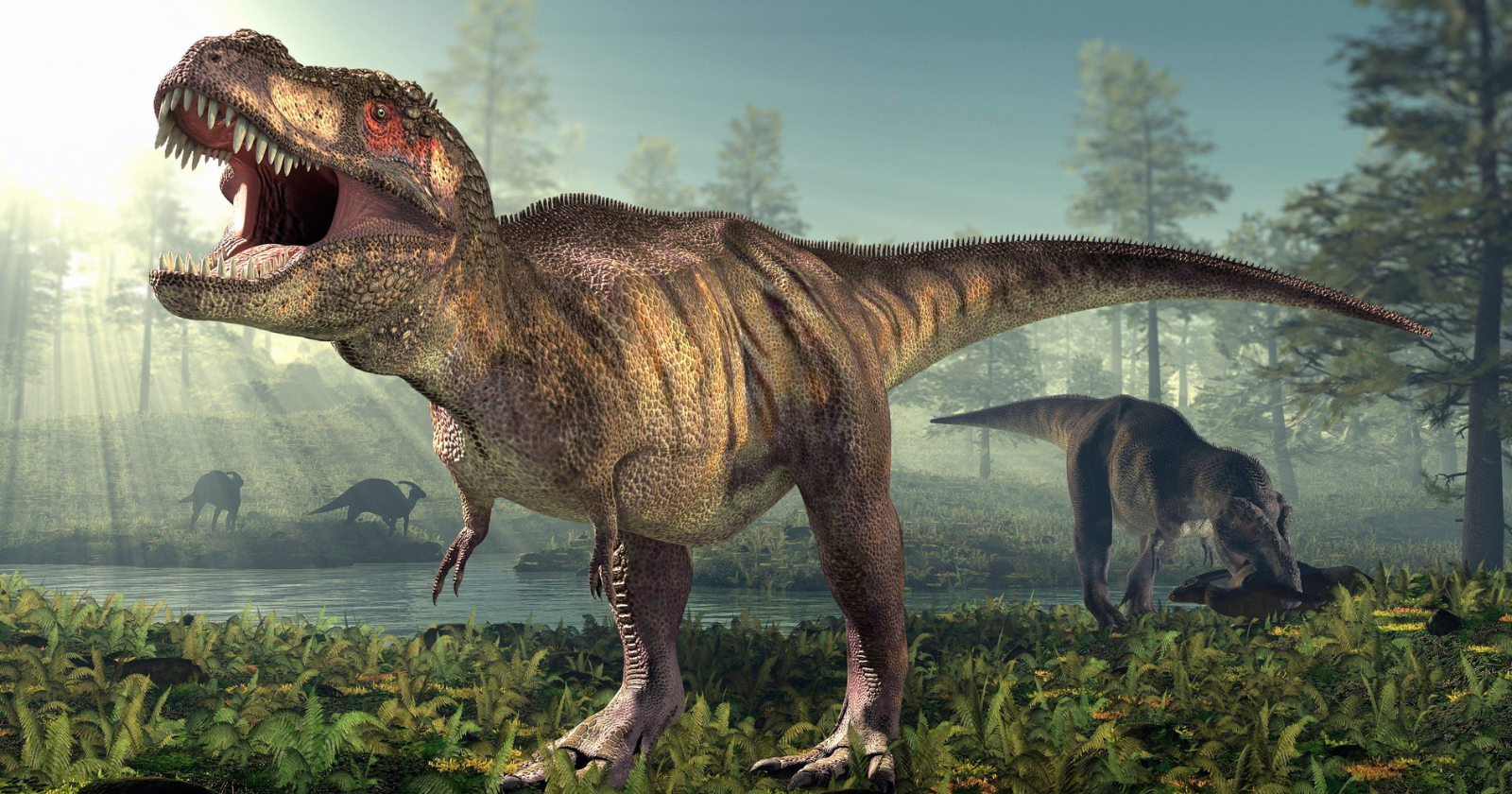
The standard cultural framing of Tyrannosaurus rex’s famously tiny arms has, for over a century, treated them as one of the small jokes evolution has played on an otherwise terrifying animal. The skull is enormous. The teeth are the size of bananas. The body is the size of a city bus. The arms, by contrast, are about the size of a human adult’s, dangling from the front of an animal that weighed eight tons. The disproportion is, in some real way, what every child who has ever encountered T. rex in a museum has registered as the dinosaur’s most absurd feature.
The standard scientific framing has tended to treat the arms as a byproduct of the animal’s enormous size. The body got bigger across evolutionary time. The arms, by design, did not keep pace. The arms therefore appear small relative to the rest of the animal because the rest of the animal had been getting larger faster than the arms were. The framing has been intuitive, plausible, and, on the available new evidence, almost certainly wrong.
A new study published on May 19, 2026, in Proceedings of the Royal Society B has examined the question across the wider population of carnivorous dinosaurs and identified, on close examination, a different explanation. The arms did not shrink because the body grew. The arms shrank because the jaws got more powerful, and the more powerful the jaws became, the less the arms had to do.
What the study actually examined
The research, led by Charlie Roger Scherer of UCL Earth Sciences along with Elizabeth Steell at Cambridge and Paul Upchurch at UCL, analyzed data from 82 species of theropods, the broader group of two-legged, mostly carnivorous dinosaurs that includes T. rex along with most of the other large meat-eating dinosaurs that the wider cultural register recognizes. The Cambridge documentation of the study describes the methodology as a comparative analysis of forelimb length, skull robustness, and body size across the full taxonomic spread of the group.
The researchers developed a new way to quantify skull robustness, based on factors including how tightly the bones of the head were connected, the dimensions of the skull, and bite force. On this measure, T. rex scored highest of all 82 species analyzed. Tyrannotitan, a South American theropod nearly as massive as T. rex that lived more than 30 million years earlier in the Early Cretaceous, came in second. The robust-skull category, on the team’s measure, included T. rex along with several other genuinely terrifying-looking animals from across the wider theropod family.
The finding emerged when the team compared forelimb length to skull robustness rather than to body size. The correlation between short arms and robust skulls was stronger than the correlation between short arms and large body size. The implication was that the arms had not, in fact, been shrinking as a byproduct of body growth. The arms had been shrinking specifically in association with the development of more powerful skulls and jaws.
The five groups in which the pattern repeated
The study identified five distinct theropod groups in which the forelimb shortening pattern appeared independently. The groups were tyrannosaurids, which include T. rex; abelisaurids, which include Carnotaurus and its relatives; carcharodontosaurids, which include Tyrannotitan and Giganotosaurus; megalosaurids, an older group of large theropods; and ceratosaurids, an even older group.
The feature worth attending to is that these five groups were not, in evolutionary terms, closely related to each other. The groups represent independent lineages of large theropods that, across tens of millions of years of evolutionary time, separately converged on the same combination of features. The combination was robust skull plus reduced forelimbs. The same combination, evolved independently five times, by separate lineages of giant predators, in separate parts of the world, across separate periods of geological history.
The repeated independent evolution of the same combination is, in evolutionary biology, what is called convergent evolution. The presence of convergent evolution is, on close examination, what gives the study its weight. Any single instance of a feature could be explained by various contingent factors. The repeated independent evolution of the same feature in different lineages is, more accurately, evidence that the feature is doing something important rather than appearing by accident. The five lineages of giant theropods were, by the available evidence, all converging on the same solution to what appears to have been the same underlying problem.
What the underlying problem actually was
The underlying problem, according to the researchers’ interpretation, was that the prey was getting larger. The wider geological record documents that, across the Mesozoic, the plant-eating dinosaurs were getting bigger. The sauropods, in particular, were reaching enormous sizes, with the largest species exceeding 100 feet in length and 60 tons in weight. The ceratopsians, the horned plant-eating dinosaurs that included Triceratops, were also reaching considerable sizes by the late Cretaceous.
The challenge for the large predators, accordingly, was how to attack and subdue increasingly enormous prey. The traditional theropod predatory configuration involved grasping prey with the forelimbs and then using the jaws for the killing bite. The configuration worked well when the prey was small enough to be physically restrained by the predator’s arms. The configuration worked considerably less well when the prey was a 100-foot sauropod weighing 60 tons. Trying to physically restrain such an animal with two human-sized arms was, by every available analysis, not a viable hunting strategy.
The alternative was to abandon the grasping function and rely on the bite. The bite, if it could be made powerful enough to inflict serious damage on a single application, did not require the predator to physically hold the prey at all. The bite could be delivered in a hit-and-run configuration, with the predator using its body weight and jaw strength to inflict catastrophic injuries that the prey could not recover from. The arms, in this configuration, were not needed. The arms, accordingly, were free to shrink.
The shrinking was not, on close examination, a passive process. The arms shrank because maintaining large arms had a metabolic cost, and the cost was no longer being repaid by any functional benefit. The arms became, in some real way, an unnecessary expense for the animal’s metabolism. Natural selection, operating across millions of years, favored the individuals whose arms were smaller, because the smaller arms freed up resources for other uses, including the further development of the increasingly powerful skull that had made the arms redundant in the first place.
Why the skull came first
The lead researcher has been explicit about the sequencing of the evolutionary change. The skull’s development came first. The arm reduction followed. The opposite sequencing, in which the arms shrank first and the skull then had to compensate, would not, on close examination, make evolutionary sense.
Roger Scherer’s summary of the logic is direct. Predators do not, in any evolutionary scenario, give up their attack mechanism without having a backup. An animal whose primary hunting tool was its arms would not, by any available selection pressure, evolve smaller arms unless something else was already taking over the attack function. The something else, in the case of the giant theropods, was the increasingly robust and powerful skull. The skull developed first. The arms shrank after the skull was already doing the work the arms used to do.
The sequencing is important because it implies a particular kind of evolutionary causality that the standard framing of T. rex’s arms has not adequately captured. The arms were not shrinking because of any feature of the arms themselves. The arms were shrinking because the skull had taken over the function, and the arms had become evolutionary surplus.
Final words
The pattern repeated independently in at least five distinct lineages of giant theropods across millions of years of evolutionary history. T. rex was, in some real way, only the most famous example of an evolutionary solution that the wider theropod lineage had been arriving at, separately and repeatedly, across the entire Mesozoic. The tiny arms were not, accordingly, a quirk of T. rex’s particular evolutionary path. The tiny arms were, more accurately, what giant carnivorous dinosaurs evolved when their jaws got powerful enough that their arms no longer mattered. The wider cultural register has, for over a century, been laughing at the wrong feature. The interesting feature, on the available new evidence, was not the smallness of the arms. The interesting feature was the largeness of what made the smallness possible.
