
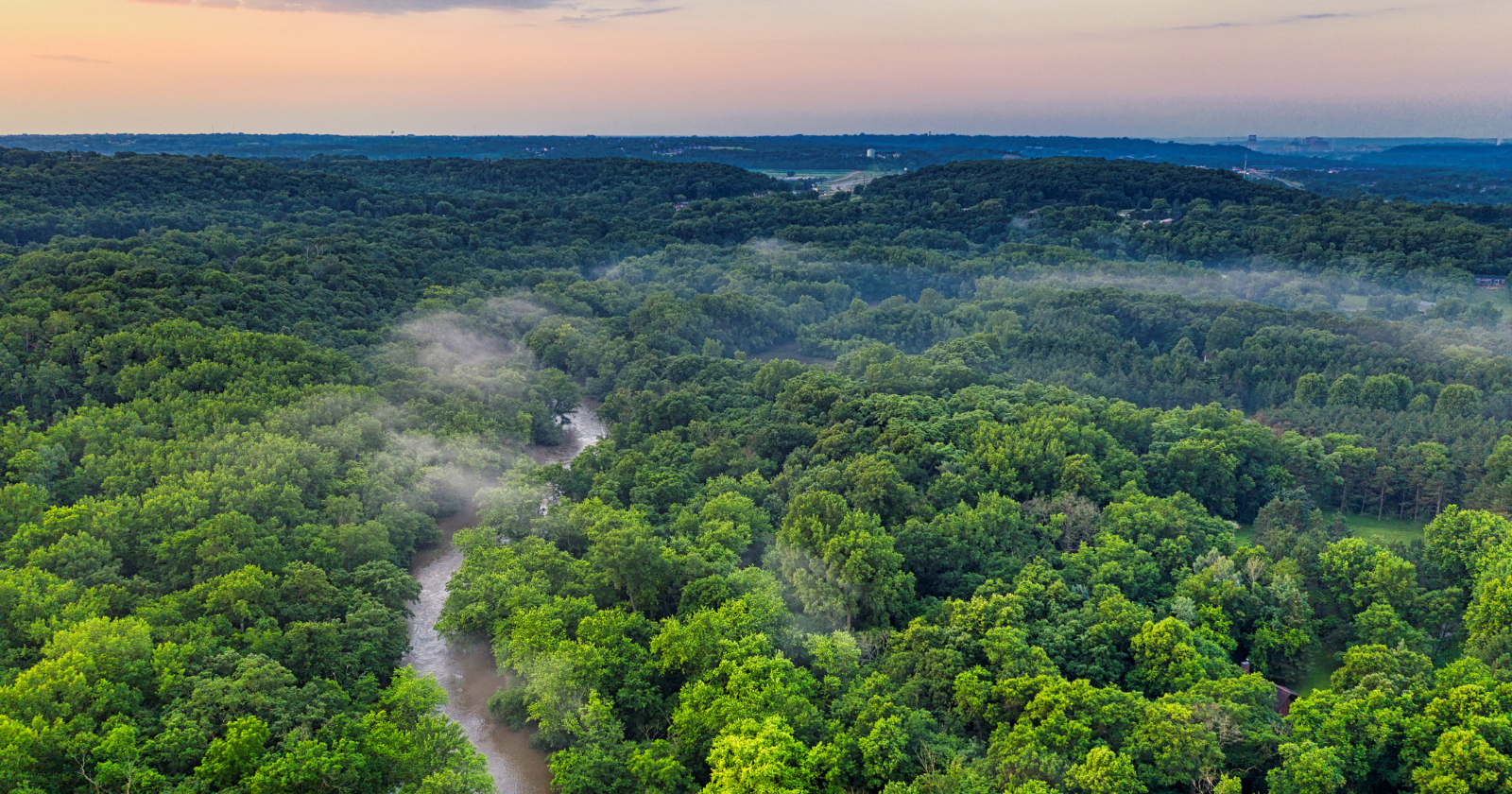
The connection is one of those facts about the planet that nobody designed and almost no one outside the relevant atmospheric science literature knows about. Every year, somewhere between 180 and 200 million tons of fine particulate dust gets picked up from the Sahara Desert by trade winds, lifted into the upper atmosphere, and carried west across the Atlantic Ocean. About 27.7 million tons of that dust settles on the Amazon Basin. Roughly 22,000 tons of it is elemental phosphorus.
That last number is the one that matters.
The phosphorus deposited on the Amazon by Saharan dust each year approximately matches the amount of phosphorus the Amazon loses each year to runoff from its frequent, heavy rainfall. The rainforest’s nutrient balance is not maintained primarily by what falls onto it from above as part of its own water cycle. It is maintained by a long-distance, intercontinental dust transport from an entirely different climate zone, several thousand miles away.
The connection has been mapped only recently. The first multiyear satellite estimate of the trans-Atlantic dust transport was published in 2015 by Hongbin Yu and colleagues at the University of Maryland and NASA’s Goddard Space Flight Center, in Geophysical Research Letters. The paper drew on data from NASA’s Cloud-Aerosol Lidar and Infrared Pathfinder Satellite Observation, or CALIPSO, satellite over the period 2007 to 2013. CALIPSO uses lidar to measure the three-dimensional distribution of aerosols in the atmosphere, which makes it the first instrument capable of resolving dust transport at the scale and altitude profile the team needed.
What the data showed, when they finished the analysis, was the connection in its quantitative form. The Sahara loses 182 million tons of dust a year over its western edge. About 132 million tons of that falls into the Atlantic Ocean. 27.7 million tons reaches the Amazon Basin. A further 24 million tons continues onward to the Caribbean. The numbers vary year to year, with the variation driven primarily by conditions in the Sahel, the strip of semi-arid land along the southern edge of the Sahara. The average is consistent enough across the seven-year measurement period to be treated, in atmospheric-science terms, as an established baseline.
What is in the dust
The reason any of this matters for the Amazon is that the dust is not just dust.
Most of the material picked up by the trade winds is silica and clay minerals, which are not nutritionally useful to a rainforest. A small but consistent fraction of the dust, however, contains phosphorus. This is the nutrient the Amazon needs in particular, because the rainforest’s biological productivity is constrained by phosphorus more than by any other element. The Amazon’s soils are old, deeply weathered, and chronically poor in phosphorus, which gets washed out by the rain at roughly the same rate the dust delivers it in. Phosphorus is essential for plant proteins and photosynthesis. Without an external source, the productivity of the rainforest would decline over time.
The phosphorus in the Saharan dust does not come from sand. It comes from biological sediment. The specific origin point that was most studied in the early years of this research, and that became the canonical answer in the first wave of public coverage, is the Bodélé Depression in northern Chad, an ancient lake bed that was, during the African Humid Period roughly 5,000 to 8,000 years ago, the seabed of a large freshwater lake known as Mega-Lake Chad. When the lake dried out, it left behind layers of diatomite, the fossilised remains of microorganisms, fish and other freshwater life, all unusually rich in phosphorus. The Bodélé Depression is now one of the most active dust sources on Earth, with strong wind channels formed between the Tibesti and Ennedi mountains that lift the diatomite deposits into the atmosphere on a near-daily basis during the dust season.
The contested source
For roughly fifteen years, the popular framing of the Sahara-to-Amazon connection treated the Bodélé Depression as the primary source of the phosphorus reaching the rainforest. The framing came from a 2006 paper by Ilan Koren and colleagues in Environmental Research Letters, titled “The Bodélé Depression: A single spot in the Sahara that provides most of the mineral dust to the Amazon forest.” NASA’s Earth Observatory reproduced the framing in 2007. The Yu 2015 paper, while focused on quantifying the total transport rather than locating its source, also identified the Bodélé as a particularly significant contributor.
In 2020, a different team led by Yan Yu at Princeton’s Geophysical Fluid Dynamics Laboratory, working with Olga Kalashnikova at NASA’s Jet Propulsion Laboratory and several other co-authors, published a paper in Geophysical Research Letters with the unambiguous title “Disproving the Bodélé Depression as the Primary Source of Dust Fertilizing the Amazon Rainforest.” The team used a different satellite instrument, the Multi-angle Imaging SpectroRadiometer (MISR) on NASA’s Terra satellite, combined with a trajectory analysis that accounted explicitly for dry and wet deposition along the dust’s transport pathways. What they found was that the Bodélé Depression’s dust, while abundant at the source, is largely removed from the atmosphere before it crosses the Atlantic, mostly by rainfall in the Inter-Tropical Convergence Zone. The dominant source of the dust that actually reaches the Amazon, on their analysis, is El Djouf, a desert region spanning Mauritania, Mali, and northern Algeria, several thousand kilometres west of Bodélé.
The 2020 paper has not settled the question. A 2018 study by Anne Barkley, Ali Pourmand and colleagues at the University of Miami, working with samples collected in the Caribbean, came down on a similar side, suggesting that western North African sources contribute more than the Bodélé to the dust that completes the transatlantic journey. Other recent work continues to argue for a significant Bodélé contribution. What the literature has converged on is that the Sahara-to-Amazon connection is real, the total numbers are roughly as Yu 2015 established, and the question of which specific part of the Sahara is doing most of the work is genuinely open. The story is still settling.
What the balance actually implies
What the empirical work has not contested, and what the broader implication of the finding is, is that the Amazon’s nutrient balance is maintained, year after year, by an external input from another continent. This is a different kind of ecological dependence than the public conversation about the Amazon usually acknowledges.
The popular framing of the rainforest is of an enclosed, self-sustaining biosphere that humans need to protect from external interference. The empirical picture is more complicated. The forest is interlocked, at the level of the phosphorus cycle that determines its long-term productivity, with a desert thousands of miles away whose dust emissions are themselves driven by atmospheric conditions that have changed substantially over geological time. Mega-Lake Chad disappeared five thousand years ago. The diatomite the lake left behind is, in atmospheric-science terms, finite. The El Djouf region’s emissions depend on regional climate conditions that are themselves shifting. Whether the trans-Atlantic transport will continue at its current rate over the next century is not a question current models can answer with confidence.
This is the part of the story that does not make the news cycle. The Sahara fertilises the Amazon. The fact is true, well-measured, and ecologically consequential. It implies a planetary system that is more connected, and more contingent, than the standard public framing of either ecosystem allows.
What we keep coming back to, in our reading of the literature, is that the science here has been moving for two decades and may not be done moving. The 2006 paper said one thing. The 2015 paper added a second. The 2020 paper revised a third. The broader picture continues to be worked out by atmospheric scientists who are unusually good at telling each other when the latest finding has changed the picture.
The picture they keep arriving at is the same. A specific large desert, on one continent, is keeping a specific large rainforest, on another, alive at the level of its phosphorus budget. Which part of the desert, and by exactly what mechanism, the field is still working out. That a connection exists, at roughly the magnitude the early researchers suggested, is no longer in question.
It is one of the better-documented planetary-scale connections we have, and almost nobody outside the relevant journals knows about it.
