
In 2016, during the dry season when water levels in a communal pond in northeastern Thailand had receded enough to expose its edges, a local resident in Chaiyaphum province noticed a pile of large bones along the bank. The bones were unusually big. They were also, by the look of them, almost certainly old. The resident reported the discovery. Paleontologists were notified. Excavations began.
The excavations took much longer than the standard cultural framing of fossil discoveries tends to suggest. Fieldwork at the site was conducted across multiple seasons between 2016 and 2019, with additional excavation continuing as recently as 2024. The bones, once recovered, had to be cleaned, stabilized, analyzed, compared against the sauropod literature, and put through the rounds of measurement and interpretation that identifying a new species requires. The work took about a decade.
The result, announced on May 14, 2026, in a peer-reviewed paper in Scientific Reports, is the identification of a new species of long-necked dinosaur. The species has been named Nagatitan chaiyaphumensis. It is the largest dinosaur ever discovered in Southeast Asia.
What the animal was
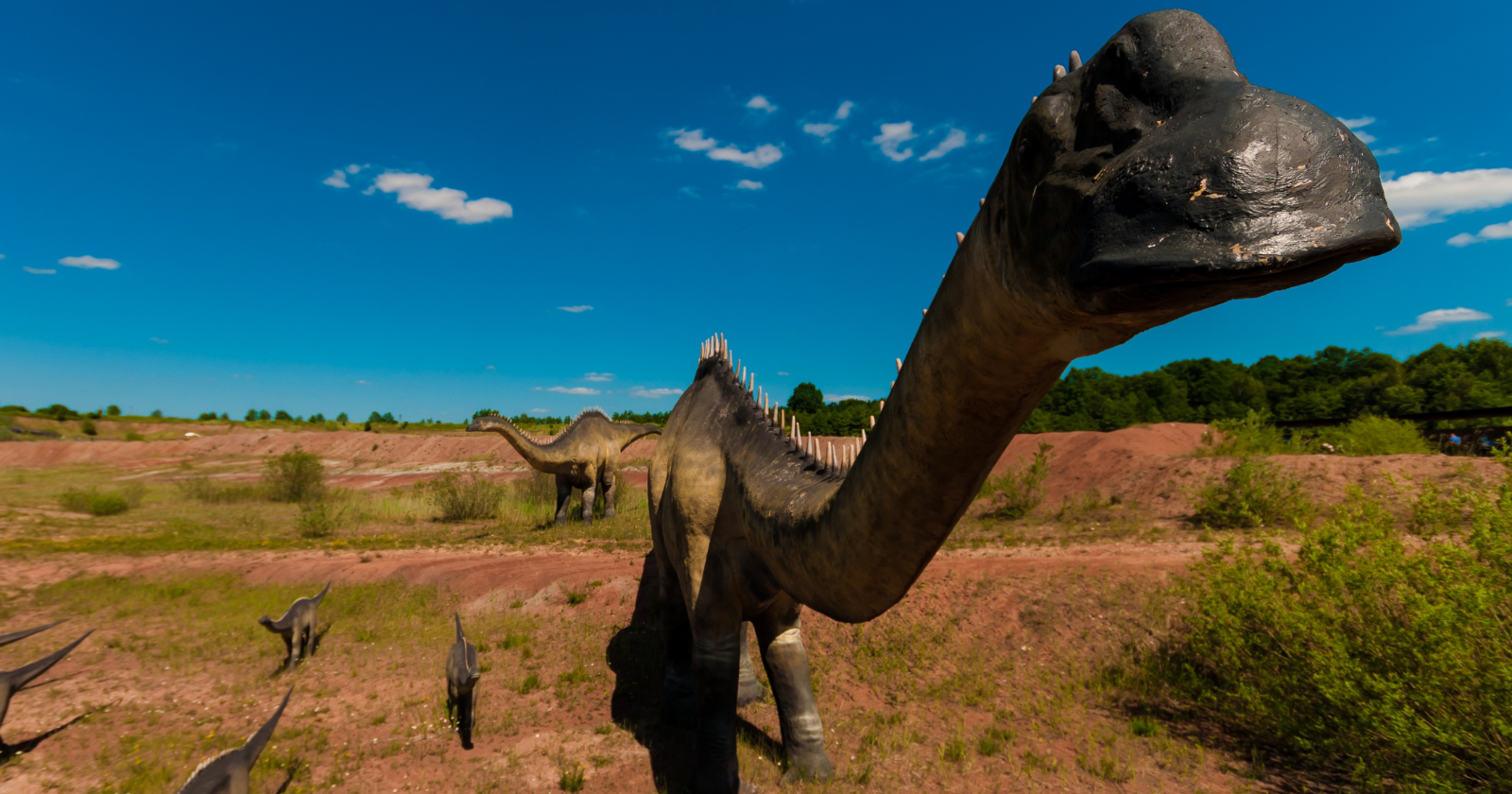
Nagatitan was a sauropod, the broad family of long-necked, long-tailed, plant-eating dinosaurs that includes the more familiar Diplodocus and Brontosaurus. The published analysis places the animal at about 27 meters in length, around 89 feet, and approximately 27 metric tons in weight, equivalent to nine adult Asian elephants. The proportions are almost difficult to picture. The animal would have been about the length of a blue whale and the weight of three or four large African elephants stacked together.
The species belongs to a subgroup of sauropods called Euhelopodidae, a family of long-necked dinosaurs found only in Asia. What distinguishes Nagatitan from the other members of the family is a particular combination of features in its spine, pelvis, and legs. The Sci.News coverage of the find notes that the team identified the species by comparing its anatomy against more than 150 other dinosaur species.
The skeletal material included vertebrae, ribs, pelvic bones, and leg bones. A single front leg bone, the humerus, measured 1.78 meters in length. In an interview with CNN, the lead researcher, Thitiwoot Sethapanichsakul, said that when he first saw the humerus, it was taller than he was, which gave him an immediate physical sense of the scale of the animal. The skull and teeth were not among the recovered material. The researchers have inferred the animal’s feeding preferences from existing knowledge of sauropod biology rather than from direct evidence of its dentition.
What the name means
The name Nagatitan chaiyaphumensis is doing more cultural work than the standard zoological naming convention usually involves.
The first element, “Naga,” refers to a mythological aquatic serpent that appears in Thai and Southeast Asian folklore. The Naga is a powerful and ancient being associated with water, with rivers and lakes, and with the deep mythological substrate of the region. It grounds the dinosaur in the cultural context of where it was found.
The second element, “Titan,” refers to the giants of Greek mythology, the primordial beings who preceded the Olympian gods and whose scale exceeded that of the later divine order. It marks the animal’s exceptional size relative to other dinosaurs known from the region.
The species name, “chaiyaphumensis,” means “from Chaiyaphum,” referring to the Thai province where the fossils were discovered. The convention is standard in zoological taxonomy, but the specific choice honors the local geography in a way that gives the species an enduring connection to the place of its discovery.
Taken together, the name is a careful piece of cultural attention. The ScienceDaily coverage of the announcement notes that the team includes Thai paleontologists working alongside researchers from University College London, Mahasarakham University, Suranaree University of Technology, and Thailand’s Sirindhorn Museum. Nagatitan is both a scientific identification and a small act of acknowledgment to the place that produced the fossils.
Why “the last titan”
What gives the dinosaur its informal nickname, “the last titan,” is the geological context of where it was found. The fossils were recovered from the Khok Kruat Formation, the youngest dinosaur-bearing rock formation in Thailand. The formation dates to the late Early Cretaceous, between 100 and 120 million years ago.
This matters because the rocks laid down in the region after this period are not going to contain large dinosaur remains. The geological history of Southeast Asia in the later Cretaceous involves the region becoming a shallow sea, with the terrestrial habitats that would have supported animals like Nagatitan giving way to marine environments. The dinosaurs that lived in the region after that would have left their remains in conditions that have not, in most cases, been preserved in the way the earlier terrestrial deposits have.
The implication is that Nagatitan may be the last of its kind that the local geological record will yield. As Sethapanichsakul put it in the published announcement, “Younger rocks laid down towards the end of the time of the dinosaurs are unlikely to contain dinosaur remains because the region by then had become a shallow sea. So this may be the last or most recent large sauropod we will find in Southeast Asia.”
There is a particular kind of poignancy here that the headlines have not quite caught. Nagatitan was alive for some period in the Early Cretaceous. By the geological facts of the region, it may have been the last of its kind to leave a fossil record that future humans would be able to recover. It is both a discovery and the marker of a horizon beyond which similar discoveries may not be available.
Where it sits in the global sauropod picture
The wider context is worth attending to, because the headline “biggest dinosaur ever found in Southeast Asia” can mislead about what kind of biggest the animal actually is.
By regional comparison, Nagatitan is exceptional. It is the largest dinosaur ever discovered in Southeast Asia, larger than any of the thirteen previously identified Thai dinosaur species and larger than any of the species identified in neighboring countries. Sethapanichsakul has noted that Nagatitan likely weighed at least 10 tonnes more than Dippy the Diplodocus, the iconic sauropod whose cast skeleton has been a fixture in major natural history museums.
By global comparison, though, Nagatitan is not in the same weight class as the largest sauropods ever discovered. The Smithsonian Magazine coverage notes that the South American sauropod Patagotitan weighed about 60 metric tons, more than twice the weight of Nagatitan. Ruyangosaurus, another large Asian sauropod, came in at around 50 metric tons. Argentinosaurus, by some estimates, may have exceeded 70 metric tons. Nagatitan is large by global standards but not exceptionally so. What is exceptional about it is its regional dominance, not any claim to a global record.
Final words
The detail worth sitting with is the timeline of the discovery itself. The bones were noticed in 2016. The species was identified in 2026. The intervening decade involved fieldwork, laboratory analysis, comparison against the literature, peer review, and the slow patient work that identifying a new species requires. Scientific discoveries tend to get reported as single events. They are, more accurately, the visible endpoints of long processes that the news cycle has no real vocabulary for. Nagatitan is the product of ten years of patient work by a team doing the slow identification that the animal had been waiting roughly 110 million years to receive.
