
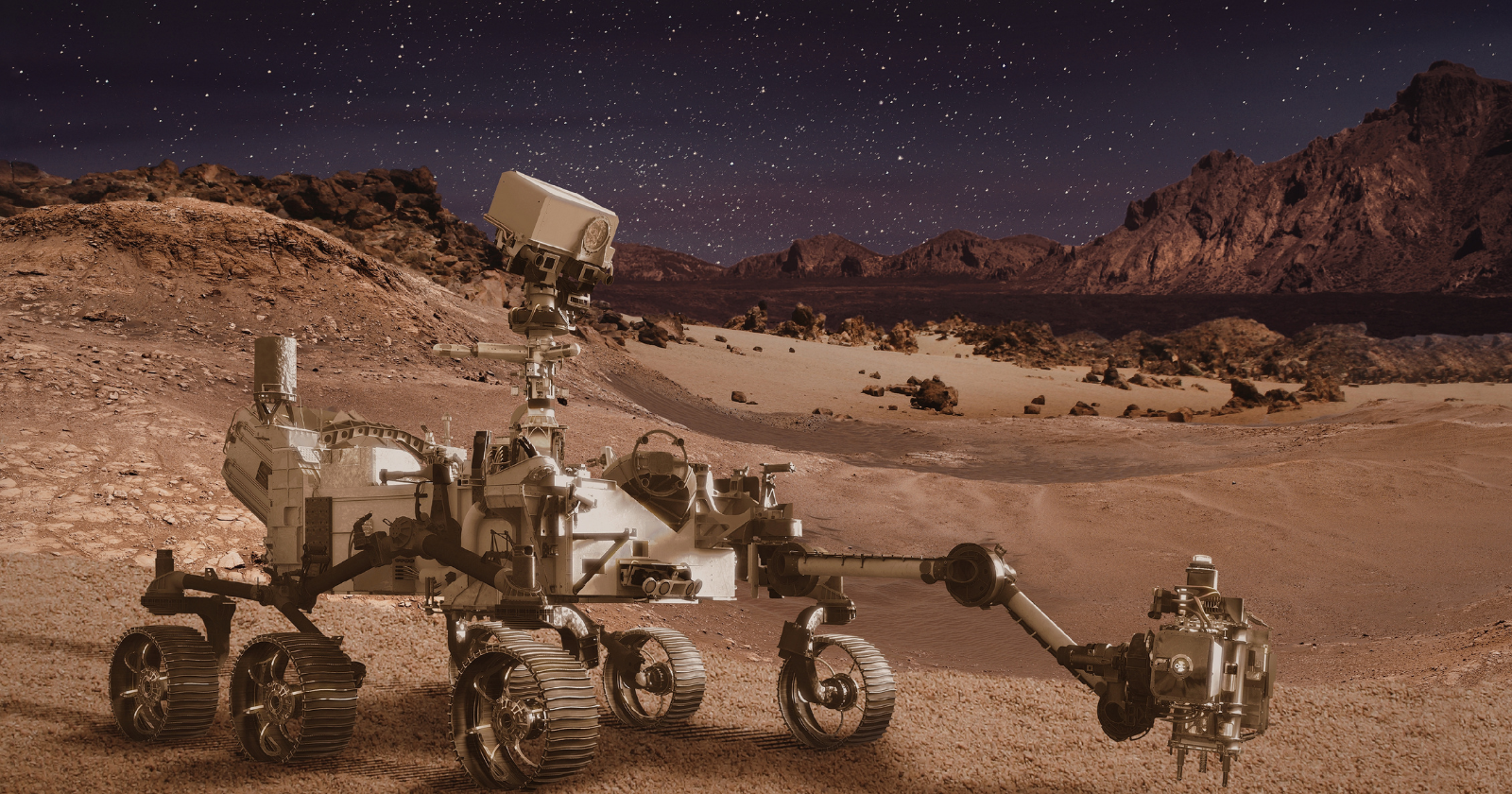
Thirteen years after landing in Gale Crater, NASA’s Curiosity rover has produced what may be its most significant scientific result to date. In a paper published in Nature Communications in April 2026, researchers led by Amy Williams, an astrobiologist and professor of geological sciences at the University of Florida, reported the detection of more than 20 organic molecules in a single Martian rock sample — the most diverse collection ever found on the planet. Seven of the molecules had never been confirmed on Mars before.
The findings have generated substantial coverage, most of it accurate. Some of it has also required the scientists involved to do something that researchers in this field have learned to do carefully: explain, repeatedly and in precise terms, what the discovery does and does not mean.
What was found and how
The experiment at the centre of the April findings used a chemical called tetramethylammonium hydroxide, or TMAH — a solvent capable of breaking apart large organic molecules into smaller fragments that Curiosity’s onboard instruments can then identify. The rover carries only two cups of this chemical. The decision about where to use the first cup was not made lightly.
The chosen sample, drilled from a site the team named Mary Anning 3 — after the 19th-century British paleontologist who spent her career finding fossils others had overlooked — came from the Glen Torridon region of Gale Crater, an ancient clay-rich area that scientists believe once held standing water. The clay minerals there are known to preserve organic material over geological timescales. The sample itself is estimated to be approximately 3.5 billion years old.
“This experiment’s never been run before on another world,” Williams told AFP. The team had two chances to get it right. They used the first one here.
What the TMAH dissolved and released included nitrogen-bearing organic compounds, sulfur-bearing molecules including benzothiophene — previously found in meteorites and asteroids — and a range of carbon-containing structures that, on Earth, are associated with the chemistry of living systems. Among them was a molecule structurally similar to precursors of DNA. The results were verified on Earth by exposing a piece of the Murchison meteorite, a well-studied 4-billion-year-old rock containing organic chemistry, to the same TMAH process. It produced similar breakdown products, including benzothiophene, lending confidence to the Martian readings.
The second cup was subsequently used on a different Martian site featuring what JPL described as weblike boxwork ridges formed by ancient groundwater. Those results are being written up.
The parallel discovery from 2025
The April 2026 findings do not stand alone. In March 2025, a separate analysis of an existing Curiosity sample produced a different but related result. Researchers reported in the Proceedings of the National Academy of Sciences the detection of decane, undecane, and dodecane in a drilled sample from a rock called Cumberland — chains of 10, 11, and 12 carbon atoms respectively, preserved in mudstone from an ancient lakebed estimated at 3.7 billion years old.
These long-chain hydrocarbons are thought to be fragments of fatty acids: molecules that on Earth form cell membranes and serve essential biological functions. They can also be produced by non-biological processes, including hydrothermal chemistry and meteorite delivery. A subsequent analysis, published in early 2026, found that known non-biological processes could not fully account for the quantity of organic material detected in the Cumberland sample. The scientists noted that this did not resolve the question of origin. It narrowed the explanation space.
Taken together, the two sets of findings represent a sustained accumulation of chemical complexity in the Martian geological record. Simple organic molecules have been detected on Mars before. What is new is the scale, structural diversity, and preservation depth of what Curiosity is now finding — and the implication that the planet’s subsurface may contain significantly more complex chemistry than its irradiated surface suggests.
Why the scientists are being careful about what they say next
The consistent thread running through all public statements from the researchers involved is a studied refusal to reach beyond what the data supports.
“We now know that there are big complex organics preserved in the shallow subsurface of Mars,” Williams said, “and that holds a lot of promise for preserving large complex organics that might be diagnostic of life.” The qualifier — might be — is doing deliberate work. The molecules found are consistent with biological origin. They are also consistent with abiotic chemistry. Curiosity’s instruments cannot distinguish between the two.
This is not a limitation of the researchers’ ambition. It is a limitation of in situ analysis on a planet 225 million kilometres away, with instruments designed to fit inside a car-sized rover launched in 2011. The paper states clearly that definitively identifying signs of past life would require returning rock samples to Earth, where laboratory instruments orders of magnitude more powerful than anything a rover can carry could be applied to the question.
That return mission is now in serious jeopardy. In January 2026, the US Congress effectively cancelled the Mars Sample Return programme, which had been designed to retrieve exactly the kind of samples Perseverance has been caching in Jezero Crater for this purpose. The programme had been struggling with cost overestimates and schedule delays for years. The cancellation leaves no currently funded pathway to bring Martian material to Earth for detailed analysis.
The organic molecules Curiosity has found will, for the foreseeable future, remain on Mars. The instruments capable of answering the questions they raise are not going there any time soon.
What preservation means in this context
One of the more technically significant aspects of the April findings is not the identity of the molecules but the fact that they survived at all.
Mars’s surface is bathed in ultraviolet radiation and oxidising chemicals that should, over geological timescales, degrade organic compounds. The expectation among many researchers was that any organics formed or delivered to early Mars would have been destroyed long before Curiosity arrived. Finding a structurally diverse collection of molecules in a 3.5-billion-year-old clay-bearing sample suggests that the planet’s shallow subsurface — even a few centimetres below the surface — can act as an effective preservation environment.
The paper’s authors describe the broad structural variety of organic molecules as evidence that some chemical diversity is preserved in ancient Martian sediments despite more than 3.5 billion years of geological change and radiation exposure. The word despite is precise. The molecules are not there because conditions were protective in any familiar sense. They are there because the clay minerals in this particular location held them in a matrix that radiation and oxidation could not fully reach.
This matters for how future missions are designed. If complex organics survive in near-surface clay sediments over these timescales, the case for drilling deeper — where preservation conditions should be even better — becomes more urgent, not less.
What the findings do and do not establish
What the combined 2025 and 2026 results establish is that Mars, during a period roughly 3.5 to 3.7 billion years ago, when liquid water was present and the planet’s surface was arguably more hospitable than it is now, hosted the chemical conditions in which complex organic molecules formed and were preserved. Whether those molecules were produced by biology, by geology, or by the delivery of extraterrestrial material via meteorites remains an open question.
What they do not establish is the presence of past life. That claim would require ruling out non-biological explanations for the specific molecules detected, in the specific quantities and ratios found, in the specific geological context they occupy. Curiosity cannot do that. The instruments that could are on Earth, waiting for samples that may no longer have a funded pathway to reach them.
Williams put the current state of knowledge in terms that balance its significance against its limits: the findings confirm that Mars was capable of preserving ancient biosignatures. Whether there are biosignatures to preserve is a different question, and one the available data does not yet answer.
That is where the science stands. The molecules are there. Their origin remains open. And the most powerful tools for reading them are, for the time being, pointed in the wrong direction.
