
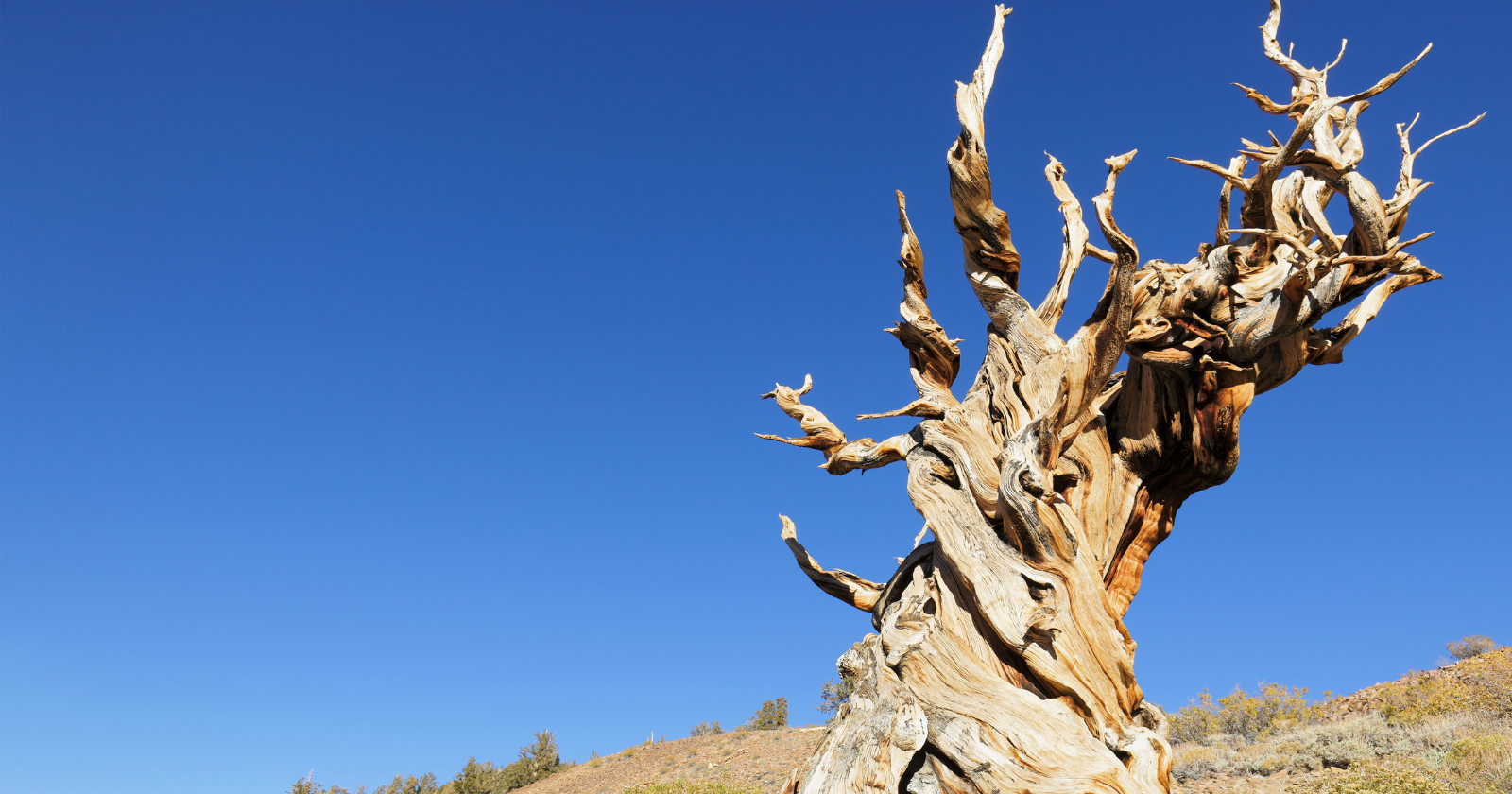
On a windswept slope of the White Mountains in eastern California, somewhere between 9,500 and 9,800 feet above sea level, in a grove of bristlecone pines that has been growing there since before recorded human history, stands a single tree that the United States Forest Service has, for over seventy years, been actively protecting by refusing to disclose its exact location. The tree is called Methuselah. The tree is, by every available measure of confirmed continuous individual life, the oldest non-clonal living thing on Earth.
The age is the part of the story that the wider cultural register has, in some real way, absorbed. The standard cultural framing notes that the tree is older than the Pyramids of Giza, older than written language, older than nearly every cultural artifact that contemporary humans use to anchor their sense of historical depth. The tree was 4,789 years old when sampled in 1957 by the dendrochronologist Edmund Schulman, which means the tree germinated around 2833 BCE. By 2026, it has been growing continuously for approximately 4,857 years. The fact this number is pointing at is that the tree was already a thousand years old when the Egyptians were finishing the Great Pyramid at Giza around 2560 BCE. The tree was already two thousand years old when Homer composed the Iliad. The tree was already three thousand years old when the Roman Empire fell. The tree is, by every available historical reference point, considerably older than the wider cultural register can easily process.
What the tree is, biologically
It is worth being precise about what kind of tree this is, because the species itself is doing something biologically unusual that the cultural register tends to skip past.
Methuselah is a Great Basin bristlecone pine, Pinus longaeva, a species adapted to one of the harshest growing environments any tree has ever colonized. The trees grow on dolomite soils in the White Mountains at elevations between roughly 9,500 and 11,000 feet, in conditions of extreme cold, low water availability, intense ultraviolet radiation, and short growing seasons. The harshness is, on the available evidence, the reason for the longevity. The trees grow extremely slowly, sometimes adding less than a millimeter of trunk diameter per year. The slow growth produces extraordinarily dense, resinous wood that is essentially immune to the fungi, insects, and rot that typically kill trees in less hostile environments. The wider species is, accordingly, capable of living for periods that, in any less extreme environment, would not be biologically achievable.
The bristlecone pine is also unusual in that individual trees do not, in most cases, die all at once. As parts of the root system fail across centuries, the corresponding parts of the tree above ground also die. The result is that most ancient bristlecones consist of a small living strip of bark and growth running up one side of an otherwise skeletal, dead-looking trunk. The visual impression is that of a piece of weathered driftwood from which a single green branch is improbably still growing. The tree is, in some real way, mostly dead, with a small surviving portion that has been continuously alive for thousands of years.
This biological configuration is, on close examination, why the Forest Service is so concerned about visitor disturbance. A small living strip of bark and the few branches still attached to it constitute the entire active life of a tree that has been growing for nearly five thousand years. Damage to that strip, of the kind that an enthusiastic tourist with a knife or a piece of bark-souvenir intent could easily inflict, would not, in most cases, be survivable for the tree. The risk is structural and, on the available evidence, well-founded.
What happened to the previous record holder
The case for the Forest Service’s protective approach was substantially strengthened by what happened to the previous record holder. A bristlecone pine called Prometheus, growing in what is now Great Basin National Park in Nevada, was cut down in 1964 by a graduate student conducting research on Little Ice Age climate dynamics. The student had been having trouble with his coring equipment. With permission from the Forest Service, he and the Forest Service personnel decided to cut the tree down rather than continue the difficult coring process. When the rings were subsequently counted, Prometheus turned out to have been over 4,862 years old at the time of cutting, with an estimated germination date around 2880 BCE. The tree had been, until that moment, the oldest known non-clonal living thing on Earth. The cutting destroyed it.
The cutting of Prometheus is, on every available account, the formative event that produced the Forest Service’s current policy regarding Methuselah. The decision to cut Prometheus had been made on the assumption that the loss of any single tree, even an old one, was a reasonable scientific cost. The realization, after the rings were counted, that the cost had been considerably larger than anyone had anticipated, established the precedent that ancient bristlecones should be protected with considerably more caution than the standard scientific practices of the period had been applying.
Methuselah, accordingly, has been treated since the 1950s as a tree whose continued survival depends on its location remaining unknown to the wider public. The Forest Service has, for over seventy years, refused to disclose the precise location. The 4.5-mile Methuselah Trail, which winds through the Methuselah Grove and past the tree itself, does not mark which of the visible trees is Methuselah. Visitors walk past it without knowing which one it is. This is, on the available evidence, the policy.
What changed in 2021
The protection of Methuselah by the Forest Service was, until recently, reasonably effective at maintaining the secrecy. The visitors who walked the trail were not, in most cases, able to identify which of the gnarled, weathered, mostly-dead-looking trees they were walking past was the famous one. The secrecy was, in some real way, doing its work.
In 2021, the secrecy was substantially compromised. Photographs of the exact tree, taken decades earlier for a National Geographic article, were found and matched against the trees visible from the trail. The identification was disseminated online. The exact location of Methuselah is now, on the available evidence, widely known to anyone with sufficient interest in finding it, despite the Forest Service’s continued official refusal to disclose it.
The Forest Service’s policy has not changed in response to the leak. The official position remains that the location is not disclosed, and the rangers at the Schulman Grove Visitor Center continue to decline to identify the tree. The position is, in some real way, partly symbolic at this point, since the information is available to anyone who searches for it. The position is also, on close examination, still doing some work. The barrier to the casual tourist remains higher than it would be if the tree were officially marked. Most visitors to the grove still do not know which tree is Methuselah. The most enthusiastic and persistent seekers, who would have caused the most damage anyway, are not deterred by the policy, but the median visitor still walks past without recognizing the tree.
What the tree has actually witnessed
The standard register for describing the antiquity of Methuselah tends to reach for historical reference points. The tree was alive when the Egyptians built the pyramids. The tree was alive when the Greeks were inventing democracy. The tree was alive when Christ was born. The tree was alive when Genghis Khan was conquering Eurasia. These are, in some real way, accurate. The accuracy does not, on close examination, fully convey what the tree’s continuous existence across this period actually involves.
What the tree has actually been doing, for the entire period, is growing slowly on a windswept slope at high elevation, accumulating one ring of dense resinous wood per year, with most of the resources of each year going into the maintenance of a small living strip of bark and the few green branches still attached to it. The growing is not, in any meaningful sense, paying attention to the various human events that have been occurring far below and far away. The growing is, more accurately, the continuous biological operation of a particular organism that has, by chance and by the specific properties of its species, managed to keep operating across a period that almost no other individual organism on Earth has managed to span.
The feature this points to is that the tree is, in some real way, a piece of continuous biological time that has been running uninterrupted since before the wider species of which we are members had developed writing. The continuity is what makes the tree remarkable. The continuity is what the Forest Service is, in some real way, protecting. The continuity could, on the available evidence, be ended by a single moment of unprotected access. The not-ending of it is what the secrecy has been calibrated to produce.
Methuselah is still growing. The 2026 ring is, presumably, currently being laid down somewhere in the small living strip of bark. The growing will continue, on the available evidence, for as long as the conditions permit and the human visitors are kept from disturbing it. The tree is, in some real way, the closest thing the wider species has to a living artifact that predates almost all of the rest of our cultural history. The Forest Service’s seventy-year effort to protect it is, by every available measure, a small piece of long-term thinking that has, against considerable pressure, mostly worked.
