

The Siberian taiga, the Amazon basin, and the Australian interior were not in meaningful contact for tens of thousands of years. Aboriginal Australians have been culturally isolated for somewhere between 50,000 and 65,000 years. Amazonian peoples diverged from the Siberian populations that crossed Beringia and developed their ritual specialists in tropical conditions that share almost nothing with the Siberian tundra. And yet the cosmologies that emerged in all three places describe the same basic architecture: a layered universe with an upper world, a middle world, and a lower world, connected by a vertical axis at the centre that ritual specialists travel along during altered states. The standard textbook explanations — diffusion, or a comparative grid imposed by Mircea Eliade in Shamanism: Archaic Techniques of Ecstasy (1964) — strain against that geography.
That convergence is the part worth slowing down on. It is not a claim about identical theology — the entities, the spirits, the moral content, and the social functions vary enormously. The claim is about structural geometry. Three traditions, developed independently, settled on the same spatial map.
The Siberian template and the problem of the original word
The word shaman itself comes from the Tungusic languages of eastern Siberia — specifically the Evenki term šamán, referring to a ritual specialist who enters trance to negotiate with spirits on behalf of the community. The term was brought west and by the 19th century it had been generalised, somewhat carelessly, to cover analogous figures across Eurasia, the Americas, and Oceania. The generalisation is contested for good reason. Calling an Amazonian ayahuasquero or an Aboriginal clever man a shaman risks collapsing distinct social roles into a Siberian template.
But the underlying cosmology that the Siberian word describes turns out to be remarkably portable, and that is the puzzle. Among the Evenki, the Yakut, the Nenets, and the Selkup, the universe is reliably described as three-tiered. There is an upper world of sky spirits and ancestral beings, a middle world where humans live, and a lower world of the dead and of chthonic powers. The tiers are connected by a world tree, a central mountain, or a smoke-hole at the top of the tent — a vertical channel along which the shaman ascends or descends during trance. The work of contemporary Siberian ethnographers including Dima Arzyutov at Ohio State continues to document how these spatial categories organise both ritual practice and everyday land use among Indigenous Siberian communities, including reindeer-herding groups whose cosmology remains active rather than archival.
The axis is the structurally important element. Without it the three worlds would be isolated; with it, they are operationally connected, and the shaman’s social function — to retrieve a lost soul, to negotiate with an offended spirit, to diagnose illness as a disturbance in the upper or lower realm — becomes coherent.

The Amazon arrived at the same diagram
Amazonian cosmologies, documented across dozens of language families with no demonstrable cultural contact with Siberia in the last 10,000 years, describe a structurally identical architecture. The Shipibo-Conibo of the Peruvian Amazon, the Desana of the Vaupés region, the Yanomami along the Venezuela-Brazil border, and the Asháninka of the central Peruvian forest all describe a universe with layered upper realms inhabited by celestial beings, a middle world of human social life, and a lower world or watery underworld inhabited by ancestors, river spirits, and predatory entities. The vertical axis is sometimes a great tree — the lupuna or kapok, which Shipibo cosmology positions at the centre of the world — and sometimes a vine, most famously the Banisteriopsis caapi liana that forms one of the two main ingredients in ayahuasca and is called, in several Amazonian languages, the vine that allows one to climb between worlds.
The ethnographic record on this is dense. Gerardo Reichel-Dolmatoff’s work with the Desana mapped a fully articulated three-tiered cosmos with named layers and specific transit protocols. The cosmology is not decorative; it organises the actual ritual labour. When an Amazonian ritual specialist treats illness, the diagnostic move is to identify which world the disturbance originated in and to travel along the axis to address it. The tradition continues to be carried by communities whose territorial integrity is now under acute pressure — recent research indicates that deforestation rates fall by roughly 83% in areas under Indigenous protection, which means the cosmological systems and the forests that materially embed them have become coupled survival questions rather than separable cultural and ecological ones.
The pressure is not abstract. A 2026 study found that organised crime affects 32% of Indigenous areas across the Amazon basin, and Indigenous federations have appealed to the United Nations to address illegal mining and trafficking rather than respond with militarisation. The ritual specialists who hold the cosmological knowledge are dying or being displaced faster than the knowledge can be documented, and the loss is not recoverable from elsewhere because the system is locally specific even where the broad architecture echoes Siberia.
Aboriginal Australia: the same map from a different deep history
The Australian case is the strongest test of the convergence claim, because the isolation is the longest and the environmental conditions least similar to either Siberia or the Amazon. Aboriginal Australians arrived on the continent and developed their ritual and cosmological systems in conditions of profound separation from the rest of human history. There were no migrations bringing fresh ideas. There were no neighbouring civilisations to borrow from.
And yet the recorded cosmologies of multiple Aboriginal language groups describe a layered universe with a sky world above, the lived earthly world, and an underworld or ancestral domain beneath — often associated with water sources, caves, or particular sacred sites. The Yolngu of Arnhem Land, the Warlpiri of the central desert, and the Wiradjuri of New South Wales have all been documented as describing three-tiered structures with a connecting axis. Ronald and Catherine Berndt’s ethnographies catalogued sky-world figures, terrestrial Dreaming tracks, and underworld or subterranean ancestral domains, with ritual specialists — variously called kadji, maban, karadji, or clever men depending on region — described as travelling between them during initiation and healing work. The axis is often described as a rope, a thread, or a great tree along which the specialist ascends.
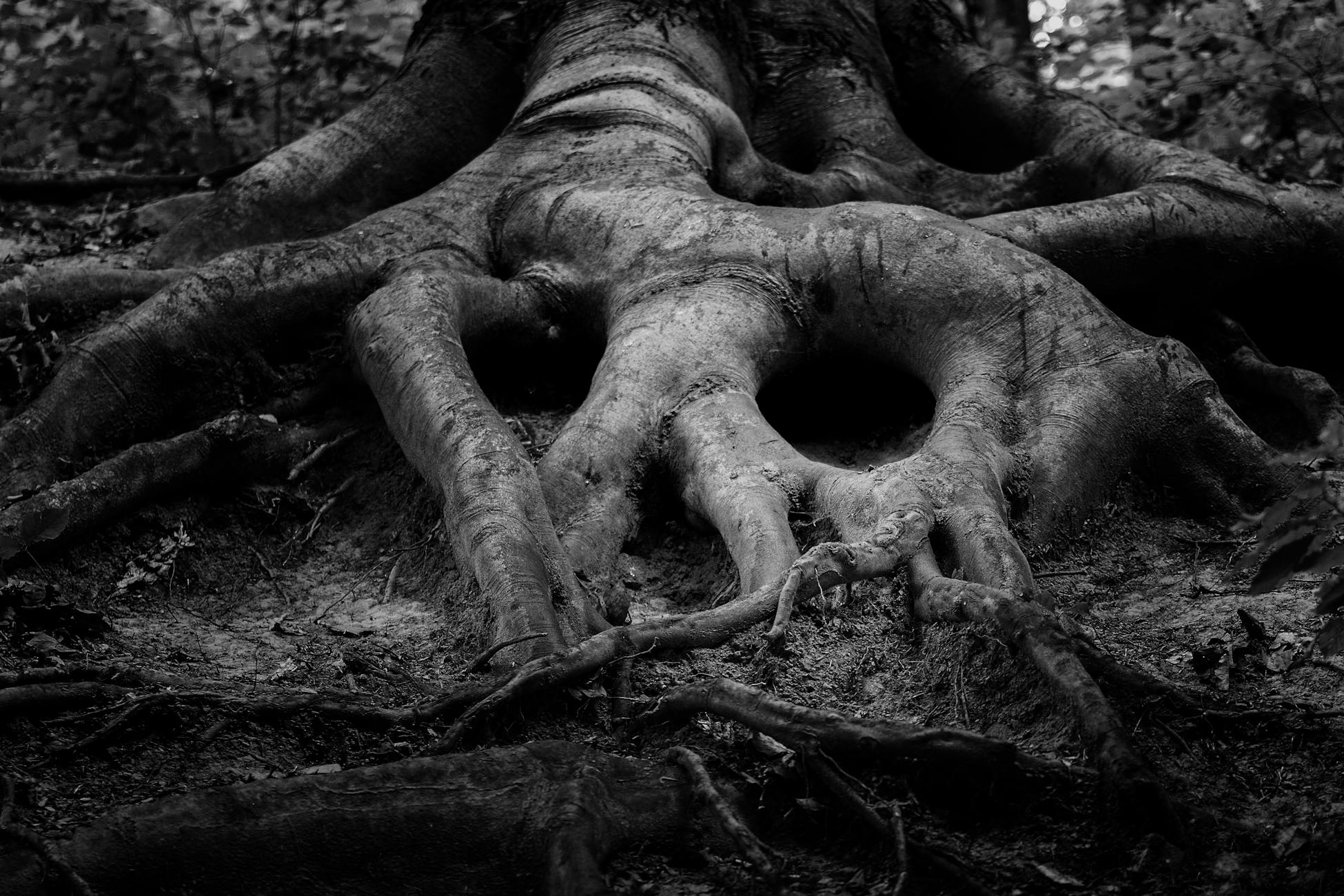
What the convergence might actually mean
Three explanations have circulated in the academic literature. The first is diffusion: that the cosmology spread out of a common Palaeolithic ancestor population before the separations occurred. This would require the structure to have survived essentially unchanged across radically different ecological and linguistic contexts. The deep antiquity is plausible, but the structural conservatism over such a span is not what cultural systems typically do.
The second is what might be called the Eliade artefact — the suggestion that the three-tiered structure is largely imposed by Western observers organising heterogeneous material into a tidy schema. This has merit as a caution but does not survive close reading of the primary ethnographies, many of which were recorded by linguists and anthropologists working in the relevant languages and describing categories that the speakers themselves articulated. The Shipibo did not need Eliade to tell them their cosmos has three layers.
The third explanation is the structurally interesting one: that the three-tiered vertical cosmos with a central axis is a near-universal product of how the human nervous system, in altered states, organises spatial experience. There is a partial evidence base for this. The neuropsychological model developed by archaeologist David Lewis-Williams and Thomas Dowson in the 1980s, building on laboratory work by Heinrich Klüver on mescaline-induced phenomena, identified a consistent staged progression in altered-state experience across induction methods — beginning with geometric form constants and culminating in sensations of passage through a vortex or tunnel toward a transformed realm. fMRI work on psilocybin by Robin Carhart-Harris and colleagues at Imperial College London has since documented disruption of the default-mode network during the experiences subjects describe in vertical and centred terms, and Michael Winkelman’s cross-cultural surveys argue that the phenomenology of trance — whether induced by drumming, fasting, sensory deprivation, or plant compounds — reliably produces sensations of vertical movement, of ascending toward light or descending into darkness, anchored to a felt centre. If the experience itself has a consistent geometry, the cosmologies built to describe and ritualise it would converge on similar architectures without any cultural contact being necessary. The map is not borrowed; it is produced by the territory of the human brain under specific conditions.
This is not a settled claim. It is the hypothesis with the fewest moving parts that does not require either implausible diffusion or dismissive deconstruction of the ethnographic record. It also has the analytical virtue of explaining why the social and theological content varies so much while the spatial geometry stays constant: the geometry is constrained by neurobiology, while everything filling the geometry is free to be culturally specific.
What is being lost
The convergence matters because the three regions where the architecture is best preserved are all under acute pressure. Mongabay’s reporting on the Pan-Amazonian Indigenous revival documents a generation working to recover and transmit ritual knowledge that nearly disappeared during the rubber boom and the 20th-century missionary period. The Vatican’s 2019 Amazon synod drew attention to the threat facing isolated Indigenous communities, though the framing was inevitably filtered through Catholic institutional concerns. The Siberian traditions face Russian state pressures and the disruption of reindeer-herding economies by climate change and resource extraction. Aboriginal Australian ritual knowledge has been transmitted under conditions of dispossession and policy interference that have only partially eased.
The structural implication of the convergence is that the three-tiered cosmology with a central axis may be one of the oldest stable cognitive products of the human species — older than agriculture, older than writing, older than the separation of the continents’ populations. If the hypothesis that it reflects a neurological universal is correct, then what is being lost as the traditions erode is not the architecture itself, which the brain will keep producing under the right conditions, but the elaborated cultural systems that knew how to navigate it deliberately, safely, and to specific ends. The distinction matters. A teenager in a sensory-deprivation tank or a clinical-trial subject on psilocybin may stumble into the same vertical geometry that a Shipibo onanya or an Evenki ritualist has been trained from childhood to read, but the experience without the cartography is just weather — strange, sometimes useful, sometimes destabilising, rarely integrated. The traditions encoded thousands of years of practical knowledge about what to do with the geometry once it arrives: how to enter it on purpose, how to retrieve something from it, how to come back. The map is durable. The cartographers are not, and the cartography itself — the accumulated skill of moving along the axis with intent — is what disappears with them.
