
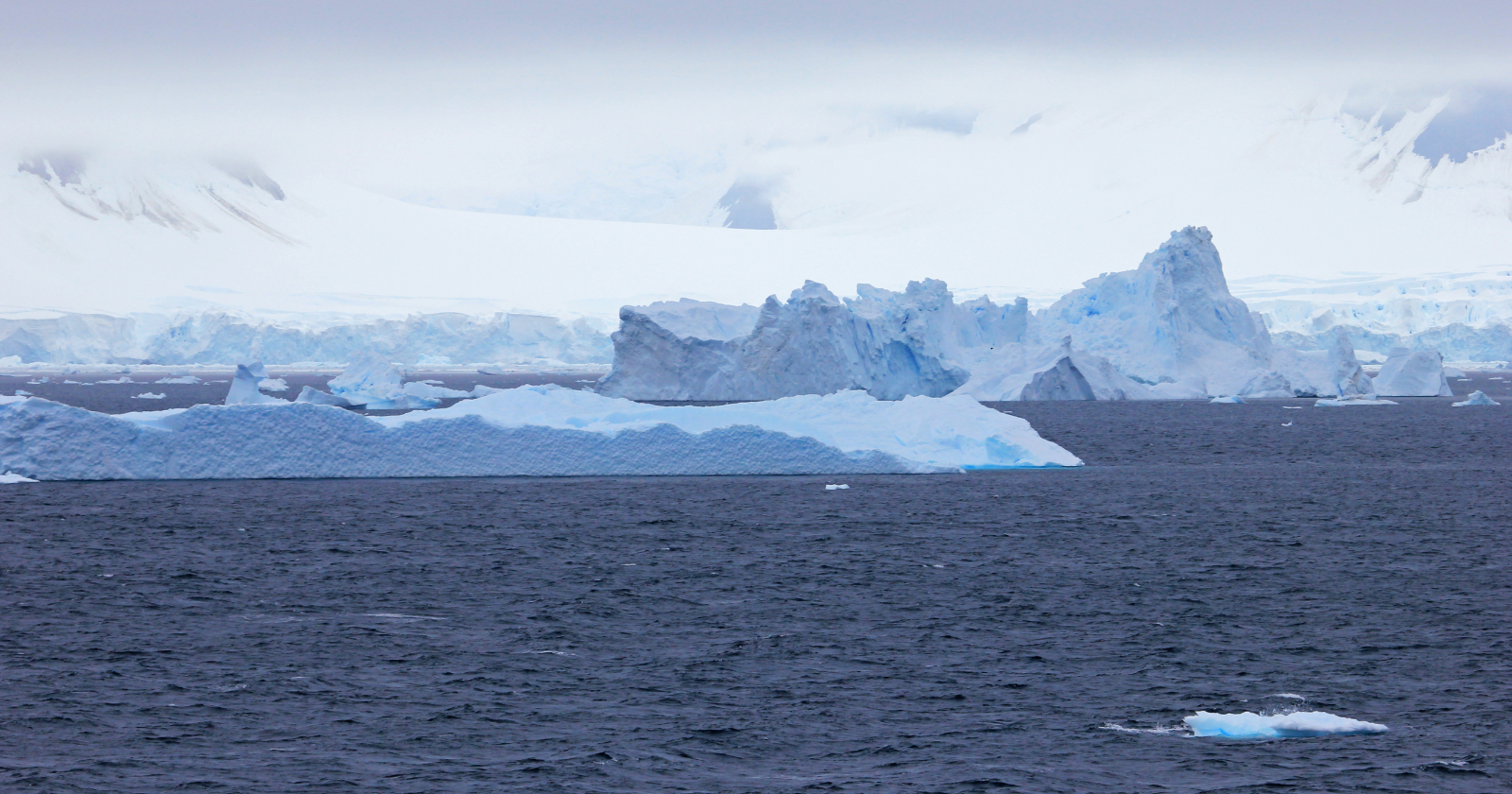
A team led by researchers at the Helmholtz-Zentrum Dresden-Rossendorf (HZDR) has found traces of iron-60 in Antarctic ice cores dating back between 40,000 and 80,000 years, providing the most direct evidence yet that the material filling the Local Interstellar Cloud, the diffuse gas and dust cloud through which our Solar System is currently moving, was seeded by a supernova explosion. The results were published in Physical Review Letters on 13 May 2026, with Dominik Koll of HZDR’s Institute of Ion Beam Physics and Materials Research as lead author.
Iron-60 is a radioactive isotope that does not occur naturally on Earth in any appreciable quantity. It is produced inside massive stars and dispersed when those stars end in supernova explosions. Its presence in geological archives has been used for decades as a tracer of nearby stellar events, and previous measurements had already identified iron-60 concentrations in deep-sea sediments and Antarctic snow samples from recent centuries. What those earlier findings could not resolve was the source: they could have reflected an old, fading supernova signal that had slowly diffused across millions of years, rather than material actively present in the interstellar cloud surrounding us now.
What the ice cores add
The older samples reported in the Physical Review Letters paper change that picture. By analysing ice from the EPICA drilling project, supplied by the Alfred Wegener Institute Helmholtz Centre for Polar and Marine Research (AWI), the team was able to look at the iron-60 signal at a time when the Solar System is believed to have been entering the Local Interstellar Cloud, or still outside it entirely. What they found was that iron-60 levels were lower in the older ice than in more recent samples, suggesting a genuine increase over time, consistent with the Solar System progressively moving deeper into material enriched by a supernova.
The temporal variation matters. The iron-60 signal changes significantly over periods of tens of thousands of years. That rate of change is difficult to explain with an old supernova blast that has been dispersing smoothly for millions of years; such a source would produce a slowly and steadily declining signal, not the pattern observed. According to the paper, this helps rule out competing explanations and supports the hypothesis that the Local Interstellar Cloud itself was shaped by a stellar explosion and still carries that material within it.
“This means that the clouds surrounding the Solar System are linked to a stellar explosion. And for the first time, this gives us the opportunity to investigate the origin of these clouds,” Koll said in the HZDR announcement accompanying publication.
The measurement problem
Detecting iron-60 in ice is not straightforward. The quantities involved are at the outer edge of what current instruments can resolve. The team transported approximately 300 kilograms of Antarctic ice from AWI‘s facility in Bremerhaven to Dresden for chemical processing. After that processing, the usable sample amounted to a few hundred milligrams of dust. The iron-60 content within that dust was measured at the Heavy Ion Accelerator Facility (HIAF) at the Australian National University, which the paper’s authors describe as currently the only facility in the world capable of detecting such small quantities of the isotope.
To confirm that no iron-60 had been lost during preparation, the team cross-checked their samples against beryllium-10 and aluminium-26, two other radioactive isotopes whose expected concentrations in Antarctic ice are independently well established. The logic is straightforward: if the known isotopes were present at expected levels, there was no systematic loss during processing, and the iron-60 measurement could be trusted.
Annabel Rolofs of the University of Bonn, one of the paper’s co-authors, described the detection challenge in the HZDR press release: the accelerator mass spectrometry process separates atoms by mass using electric and magnetic filters, narrowing an original sample of around 10 trillion atoms down to a few iron-60 atoms. The comparison used in the press release was finding a needle in 50,000 stadiums filled with hay.
What the Local Interstellar Cloud is, and where we are in it
The Local Interstellar Cloud is a region of warm, relatively diffuse plasma and gas, roughly 30 light-years across, through which the Solar System has been travelling for some tens of thousands of years. It sits within a larger low-density region known as the Local Bubble, which is itself thought to be the product of multiple supernovae over the past several million years. The precise boundaries of the Local Interstellar Cloud and the Solar System’s exact trajectory through it are subjects of ongoing research.
Current modelling, cited in the HZDR announcement, suggests the Solar System entered the cloud several tens of thousands of years ago and is now near its outer edge. On that basis, the exit from the cloud is estimated to occur within the next few thousand years, though the uncertainty in that estimate is substantial. The Solar System’s transit time through the cloud appears to overlap, at least partially, with the period covered by the ice cores studied in the paper.
This overlap is central to what the new data adds. Earlier iron-60 detections in deep-sea sediments covering the past few million years, and in recent Antarctic snow, were consistent with ongoing exposure to the cloud’s material. But without older ice core data from a period when the Solar System was either at the cloud’s edge or outside it, the comparison was incomplete. The EPICA samples, covering 40,000 to 80,000 years ago, provide that earlier reference point.
What remains unresolved
The paper does not identify which specific supernova produced the iron-60 now present in the Local Interstellar Cloud, or when that explosion occurred. The candidate supernovae most often discussed in the literature in connection with the Local Bubble are thought to have exploded several million years ago in what is now the Scorpius-Centaurus association, a grouping of young, massive stars. Whether the iron-60 in the cloud traces back to one of those specific events, or to a different explosion entirely, is not settled by this paper.
The variability the team observed in iron-60 levels across the time period covered, with lower concentrations in the older ice and higher concentrations in more recent samples, is also not fully explained. One possibility the authors raise is that the cloud itself has significant density variations: patches with more or less of the isotope. Another is that the Solar System’s trajectory through the cloud has taken it through regions of differing concentration. Both possibilities are speculative at this stage, and Koll has said as much in the HZDR materials accompanying publication.
Next steps
The team has stated it plans to extend the study further back in time, to a period before the Solar System entered the Local Interstellar Cloud. AWI is participating in the Beyond EPICA project, which is working to recover ice cores reaching further into Earth’s past than the samples used in the current study. If those older cores contain no iron-60, or contain it at substantially lower levels, that would help draw a clearer boundary around when the Solar System entered the cloud and confirm the source more precisely.
The paper’s broader claim, that ice cores can serve as a geological archive of the Solar System’s position within the interstellar medium, has methodological implications beyond this specific finding.
If iron-60 variations in ice genuinely track changes in the composition of the cloud through which we are passing, the same approach could, in principle, be applied to other isotopic tracers and other time periods, building a more detailed picture of the Solar System’s path through its local galactic neighbourhood.
