
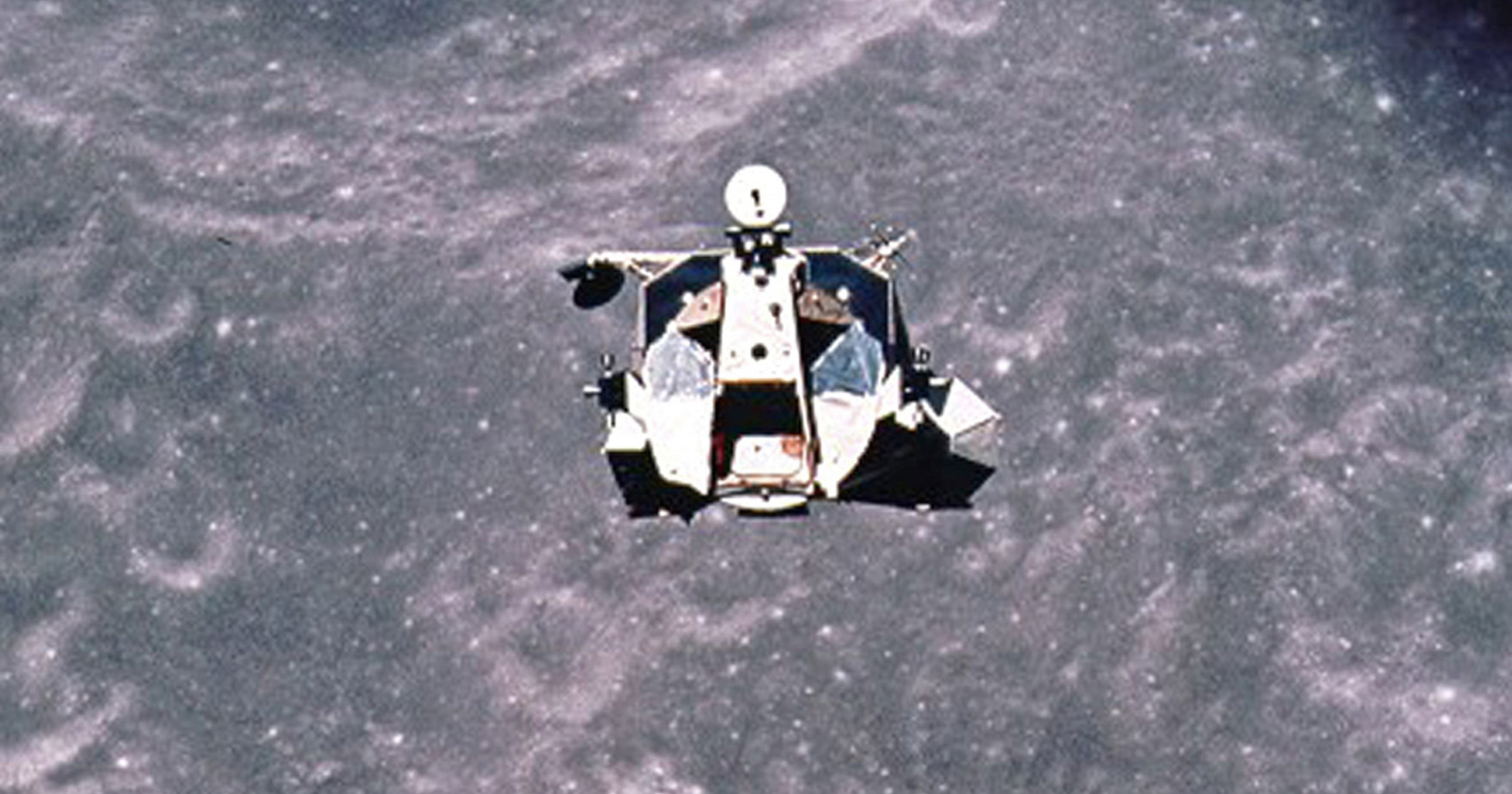
The famous framing was that he was the loneliest human in history. Collins himself, in his own writing, disagreed.
On 20 July 1969, while Neil Armstrong and Buzz Aldrin descended to the lunar surface, Michael Collins orbited above them in the Apollo 11 command module Columbia. For roughly 47 minutes of each orbit, when the body of the Moon sat between Columbia and Earth, no direct radio signal from Earth or Eagle could reach him. Mission Control was blocked. The lunar module Eagle, working on the near side, was blocked. For those 47-minute stretches, he was a single human being with the entire Moon between himself and every other living person.
NASA’s public affairs officer Douglas K. Ward, narrating the moment from Mission Control on 21 July 1969, gave the line that has been quoted ever since: “Not since Adam has any human known such solitude as Mike Collins is experiencing during this 47 minutes of each lunar revolution, when he is behind the Moon with no one to talk to except his tape recorder aboard Columbia.”
It is a memorable line. It also overstates what Collins himself said about the experience.
The 47 minutes, mechanically
Apollo 11 entered lunar orbit on 19 July 1969, with Columbia and the still-attached Eagle settling into a roughly two-hour orbital period around the Moon. NASA’s Apollo 11 mission overview records that the initial elliptical orbit measured 69 by 190 miles, later circularised by a second engine burn. When Eagle separated and descended to the surface on 20 July, Collins continued orbiting solo. Each loop took him over the near side, where he could communicate with both Mission Control in Houston and the landing crew on the surface, and then around the far side, where the Moon itself blocked any direct radio path back to Earth.
The far-side passage on each orbit lasted about 47 minutes. During that period there was no contact at all. The Moon, on the Smithsonian National Air and Space Museum’s account of Collins’ orbit, is 3,473 kilometres across, and the geometry was unforgiving: no relay satellites in lunar orbit, no continuous link, no backup. Once Columbia disappeared over the eastern limb, the radio went silent, and Collins waited until the spacecraft emerged from the western limb roughly three-quarters of an hour later before contact resumed.
Apollo 11 completed thirty lunar orbits over the course of the mission. Collins was alone aboard Columbia for roughly 27 hours, completing 14 solo orbits while Eagle descended to and returned from the surface.
The line about Adam
Ward’s “Not since Adam” line was issued by NASA’s public affairs operation during the mission. It was meant as colour commentary on what was happening. It travelled, and has been reprinted in the half-century since as if it were a settled fact about Collins’ experience.
But the line describes how the situation looked from outside, not how Collins reported it from inside. From outside, the geometry was straightforward and dramatic: one human, alone, with the entire body of the Moon between him and everyone else. From inside, Collins later wrote, the experience was different.
What Collins actually wrote
In Carrying the Fire, the memoir he published in 1974, Collins gave a more careful account of his time alone in Columbia. He acknowledged that solitude was real. He did not call it loneliness.
“I don’t mean to deny a feeling of solitude,” he wrote. “It is there, reinforced by the fact that radio contact with the Earth abruptly cuts off at the instant I disappear behind the Moon.”
He went on to describe his time on the far side as relaxing. He was working: on housekeeping tasks, on monitoring spacecraft systems, on a sequence of operational items that required attention. He had a job. The mission required him to function competently for hours on end, and the framing he chose for the experience was occupational, not existential.
The press conference line he had given two weeks before launch had been in the same register. Asked how it would feel to get so close to the Moon without setting foot on it, Collins had answered: “I’m going 99.9 percent of the way there, and that suits me just fine.”
The fear underneath
What Collins did write about, often and clearly, was a fear that had nothing to do with solitude. He was afraid that something would go wrong with the lunar module ascent engine and his crewmates would not be able to leave the surface.
This was not a small concern. The ascent engine had not been fired on the lunar surface before Apollo 11. If it failed, Collins would have had no way to retrieve Armstrong and Aldrin. He would have had to return to Earth alone. President Nixon’s office, anticipating the possibility, had a contingency speech prepared by speechwriter William Safire. The U.S. National Archives holds the memo, dated 18 July 1969, titled “In Event of Moon Disaster”. It opened: “Fate has ordained that the men who went to the moon to explore in peace will stay on the moon to rest in peace.”
Reflecting on it later, Collins said the fear was specific and operational rather than emotional. He was rehearsing, in his head, the contingencies in which he would have to leave his crewmates behind. That was the weight he carried during the 47-minute blackouts. Not “I am alone in the universe.” Something closer to: if the engine doesn’t light, I leave them there.
External label, internal report
The pattern, on examination, is a familiar one. A situation looks a certain way from the outside. The narrative that gets attached to it, by people watching, by people reporting, by the public affairs office that has to give the country a quotable line, draws the obvious frame. The person inside the situation often experiences something different, and sometimes notices a different thing as the actual difficulty.
This is not unique to astronauts. It shows up in the gap between how grief looks from outside and how it feels from inside. It shows up in the gap between how a public success looks and what the person who pulled it off was actually worried about. It shows up in any story where an external observer has applied a strong frame, and a primary source, written years later, gently disagrees.
Collins’ account does not deny the 47 minutes. The Moon really did block the radio. He really was the only human on the far side of a 3,473-kilometre-wide sphere of rock, with no radio link to Earth or to the lunar surface. The geometry is the geometry.
What he disputed, quietly, in his own book, was the meaning that other people had assigned to it.
The famous “loneliest human” framing has had a long second life because it is dramatic, and because most people writing about Apollo 11 have not gone back to Collins’ own account. The line gets quoted. The qualifier doesn’t. Collins lived to 90, kept flying, kept writing carefully about the mission, and never seemed to think of his time alone in Columbia as the defining event of his life. He preferred, by his own report, the work itself.
The Moon really was between him and everyone. He really did spend 47 minutes per orbit out of contact with the rest of humanity. He just didn’t think those minutes were the story.
