
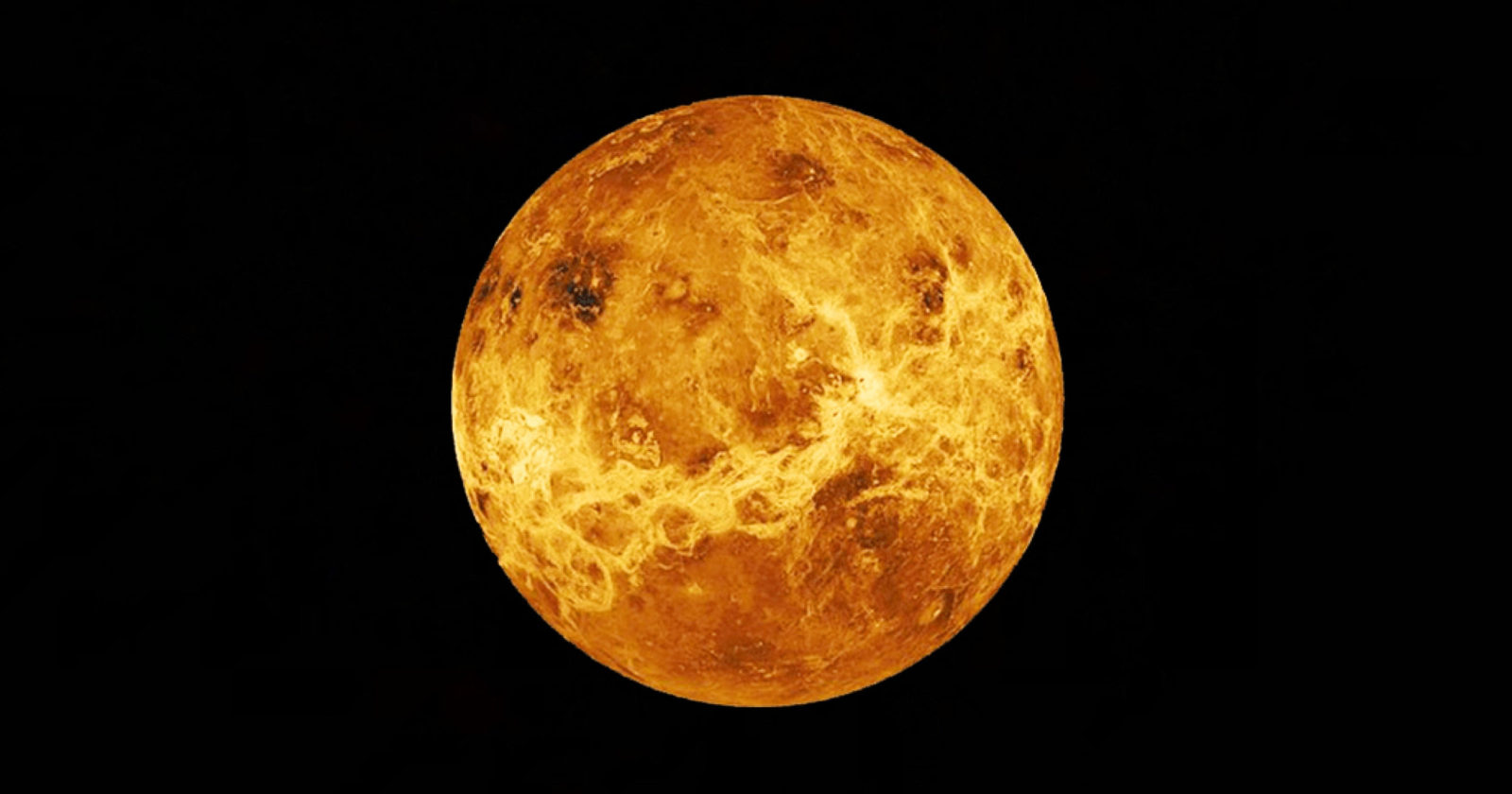
In March 1982, a Soviet lander survived nearly four times its design life on the surface of Venus, returning panoramic imagery from a place that should have destroyed it within half an hour.
On 1 March 1982, the Soviet Venera 13 descent craft touched down on the surface of Venus, in a region just east of Phoebe Regio at 7.5 degrees south, 303 degrees east. According to NASA’s archival entry for the mission, the lander then operated for 127 minutes in conditions that destroyed it: an ambient temperature of 457 degrees Celsius and an atmospheric pressure of 89 Earth atmospheres. The vehicle’s planned design life was 32 minutes.
The figures are worth unpacking, because they get cited more than they get explained.
The conditions on the surface
457 degrees Celsius is hot enough to melt lead, which has a melting point of 327 degrees. It is also hot enough to melt zinc, tin, and bismuth, and to run within a few hundred degrees of the melting point of aluminium. There is nothing analogous to it on the surface of Earth. The hottest desert air recorded on this planet is in the mid-50s.
89 Earth atmospheres is the pressure you would feel about 900 metres beneath the ocean’s surface. The Guinness World Records entry for the longest spacecraft survival on Venus describes it as equivalent to the pressure roughly one kilometre below sea level, which is approaching the crush depth of most military submarines. To survive it for two hours, the Venera 13 lander was built more like a deep-sea pressure vessel than like the Mars and Moon landers that preceded and followed it.
The two conditions together, sustained heat plus crushing pressure, are what make the Venusian surface the most actively destructive environment a spacecraft has ever operated on. Mars is cold. Titan is cold. The Moon swings between extremes but is in vacuum. Venus actively cooks and squeezes anything that lands.
What the cameras saw
Venera 13 carried two opposite-facing cameras, mounted on opposite sides of the lander, and was the first Venera mission to include a colour TV system. After touchdown the cameras were uncovered and began scanning their respective fields of view, with the data relayed back through the flyby bus that had carried the lander to the planet.
The frames returned showed flat platy rocks and a fine, dark soil. After landing, a mechanical drilling arm collected a surface sample and deposited it in a sealed onboard chamber held at 30 degrees Celsius and a pressure of roughly 0.05 atmospheres, well below the outside conditions, so the onboard X-ray fluorescence spectrometer could analyse it. The result, published in Surkov et al.’s 1984 summary in the Journal of Geophysical Research, placed the Venera 13 rock in the class of weakly differentiated melanocratic alkaline gabbroids, broadly similar to terrestrial leucitic basalts with a high potassium content. Venera 14’s sample, drilled roughly 950 kilometres away four days later, was closer to oceanic tholeiitic basalts. The two sites returned chemically distinct rocks, which is part of why Venus’s crust is still treated as poorly characterised.
The sky in the panoramas appears orange. The Venusian atmosphere, dense and rich in carbon dioxide and clouds of sulphuric acid, filters out blue light before it reaches the surface, leaving the reddish end of the spectrum to dominate. The exact colour balance in the published images depends on how the raw data is processed, and different researchers have produced slightly different reconstructions over the decades. The general impression of a dim, orange-lit landscape is robust across all of them.
What else the lander did
Imaging was only part of the science return. The lander’s instruments measured surface composition, recorded the chemistry of the lower atmosphere, captured electrical discharge data during the descent, and carried a microphone used to estimate wind speed at the surface. Venera 13 is widely described as the first spacecraft to return acoustic data from the surface of another planet.
By the time transmission ended at 06:04 UTC, the lander had returned two hours and seven minutes of data from a place where its formal design life was only 32 minutes.
Why the endurance matters
The 127-minute figure carries more weight than it might appear to. The design life of 32 minutes was not a conservative number that the engineers expected to massively overshoot. It reflected the thermal limits of the pressure vessel and the rate at which the surrounding atmosphere was expected to conduct heat into the interior. Surviving four times that duration meant the lander’s insulation, the thermal mass of its internal components, and the cooling architecture all performed considerably better than predicted.
For a planet that has only ever been touched, briefly, by a small handful of Soviet landers, every additional minute of in-situ data is disproportionately useful. The Venera series accounts for almost all of the surface data humanity has from Venus. There has been no successful surface mission since the Vega landers in 1985.
For now, Venera 13’s two hours on the surface remain among the clearest records humanity has of what Venus actually looks like from the ground.
