
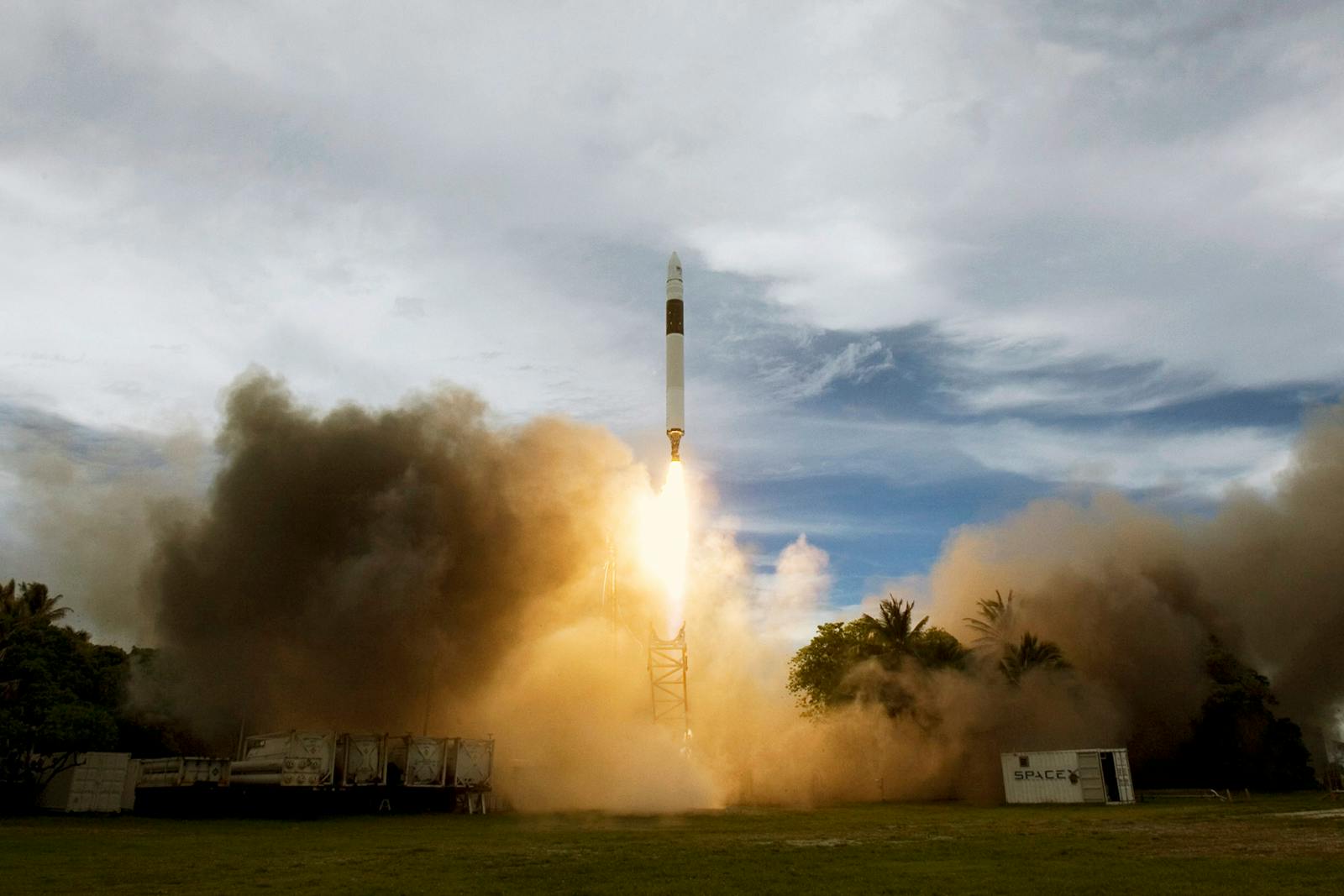
In 2024, a single American company launched 134 orbital rockets. In 2025, that company is on track to launch around 170. The company is SpaceX. The two-year total of approximately 300 launches is, on the available evidence, more orbital launches than the Soviet Union conducted across the entire fifteen-year Space Race from Sputnik to the Apollo-Soyuz mission. This is the cadence the wider public has not, on close examination, quite registered as the structural shift it actually is. The cadence has, quietly and across the last decade, rewritten the economics of every space program on the planet.
The other half of the shift is the cost. A NASA Technical Reports Server analysis placed the cost of putting a kilogram into low Earth orbit on the Space Shuttle at approximately $54,500. The Falcon 9, in current operation, advertises a cost to customers of around $2,720 per kilogram.
SpaceX’s internal cost, depending on whose accounting one trusts, is lower still. The reduction from Shuttle-era launch economics is somewhere between a factor of 20 and a factor of 39, depending on which figures one uses and how one accounts for reuse. The popular shorthand of “95% reduction since 2010” is, on the available numbers, broadly correct, perhaps slightly conservative.
These numbers are large enough that they have, in some real way, changed what the wider space industry is capable of doing. The wider public has, however, mostly continued to think about space in the categories that the pre-2010 economics produced. The categories are out of date. The actual current economics are doing something different.
What the old economics required
The old economics of getting to space were, by every available measure, the dominant constraint on what space programs could do. A satellite that cost a hundred million dollars to build was, in the old economics, going to cost a hundred million dollars to launch. The doubling of the project cost at the launch step had a particular effect on how satellites were designed. Every satellite had to be exquisitely engineered, redundantly tested, and built to last as long as possible, because the cost of replacing it was structurally prohibitive. The satellite was, in some real way, a one-off custom artifact, produced under conditions calibrated to the assumption that launch was the most expensive part of getting it operational.
This economics shaped everything downstream of it. The kinds of missions that could be flown. The kinds of organizations that could afford to fly them. The kinds of risks that could be taken with novel technology. The kinds of constellations that could be deployed. Most of these answers were, in the old economics, conservative ones. The conservative answers were the rational responses to the constraint that launch was so expensive that anything one launched had to be a sure thing.
The new economics has changed all of these answers, and the changing has happened largely outside the public conversation about what the space industry currently is.
What the new economics enables
The most visible consequence of the cost reduction is the constellation. Starlink, SpaceX’s own satellite internet network, has grown to over 7,000 satellites in orbit as of 2025, serving 5.4 million subscribers across more than 100 countries. The constellation is only possible because the launch cost has dropped to the point where deploying and replenishing thousands of satellites is economically feasible. In the old economics, the constellation would have required tens of billions of dollars in launch costs alone. In the new economics, the constellation is the operational core of a company generating $7.7 billion in revenue from the satellite-broadband side of its business in 2024.
The constellation model is the obvious case. The less obvious cases are more interesting. The new economics allows satellites to be smaller, more numerous, and more disposable, because the cost of replacing them is no longer prohibitive. The new economics allows experimental missions to be flown that would not have been justifiable in the old economics. The new economics allows new categories of customer to access space who could not, in the old economics, have afforded to. National space programs that previously had to make do with one or two flagship missions per decade are, in some real way, now able to fly multiple smaller missions per year, because the launch cost has stopped being the dominant component of mission cost.
The Pentagon has noticed. SpaceX received contracts worth $5.9 billion from the Pentagon for 28 National Security Space Launch missions by 2025, alongside a $1.4 billion agreement with the U.S. Space Force in 2024. The strategic logic is not just about cost. The strategic logic is about cadence. A military that can replace damaged or compromised space assets within weeks rather than years is operating in a different strategic environment than a military that has to wait two years for a replacement launch.
What the other space programs are doing in response
The structural pressure on the rest of the global launch industry has been considerable. SpaceX currently handles approximately 60% of global commercial satellite launches and 95% of U.S. launches. The figures are large enough that the other launch providers have been, in some real way, forced to either match the new economics or accept a structural reduction in their addressable market.
The European launch industry has been particularly affected. The Ariane 6, Europe’s primary launch vehicle, is not currently competitive with the Falcon 9 on cost per kilogram. The European Space Agency has, accordingly, been in a multi-year process of restructuring its launch capability around the recognition that the previous economics no longer apply. The process is not finished. The process is, in some real way, the European space program’s most consequential strategic challenge of the current decade.
The Russian space program has been in a more dramatic version of the same crisis. Russia, which dominated the commercial launch market for a significant portion of the 2000s and early 2010s, has seen its launch revenue more or less collapse over the last decade. The collapse was partly geopolitical, related to the 2022 invasion of Ukraine and the resulting Western sanctions. The collapse was also, in significant part, the structural consequence of having a launch capability calibrated to economics that no longer apply.
The Chinese space program is the one major exception, and the exception is worth taking seriously. China has been investing heavily in commercial launch capability over the last decade, with the explicit strategic goal of matching the new economics. The Long March family of rockets, the various commercial Chinese launchers, and the planned heavy-lift Long March 9 are all calibrated to a vision of Chinese launch capability that competes with the new economics rather than the old. Whether China will, in fact, achieve cost-per-kilogram parity with SpaceX is one of the more consequential open questions in the current global space industry. The answer is not yet clear.
What the public has not quite registered
The strange feature of all this, on close examination, is that the wider public conversation about space has mostly continued to operate in the categories the old economics produced. The categories are: space is enormously expensive, only the largest national programs can afford to do anything serious in it, and the cost is the dominant constraint on what is possible.
None of these categories is, in 2026, currently accurate. Space has stopped being enormously expensive in the way that the categories assume. The largest national programs are no longer the dominant actors in the launch industry. The cost is no longer the dominant constraint on what is possible. The constraints have shifted to other variables, including political will, regulatory capacity, the availability of trained workforce, and the strategic decisions about which capabilities to prioritize.
The shift has not, on the available evidence, been adequately absorbed into the wider public conversation. The conversation is still, in most cases, operating on the assumption that the economics of 2005 still apply. The economics of 2005 do not apply. The economics have, in the last fifteen years, been quietly rewritten, and the rewriting has produced a launch environment that the categories the public is still using cannot describe.
The acknowledgment this article wants to leave
The cadence of about 170 launches per year from a single company is, by every available historical measure, unprecedented. The cost per kilogram has dropped by a factor that, depending on the accounting, lies somewhere between 20 and 40. The combined effect has been to take a category of activity that, twenty years ago, was the exclusive preserve of national space agencies operating on multi-billion-dollar budgets, and to convert it into a category of activity that commercial operators conduct routinely and that the wider economy is increasingly built on top of.
This is, on close examination, one of the more consequential industrial shifts of the current century. The shift has not been celebrated in the way that the older space-race milestones were celebrated, partly because it has been the product of incremental engineering rather than dramatic single events, and partly because the wider public has not yet developed the categories necessary to register what has changed. The change is, however, real. The change has, in some real way, already rewritten what space programs are and what they can do. The implications, on the available evidence, are still working their way through the global industrial system. The change itself, in any honest accounting, is largely already done.
