
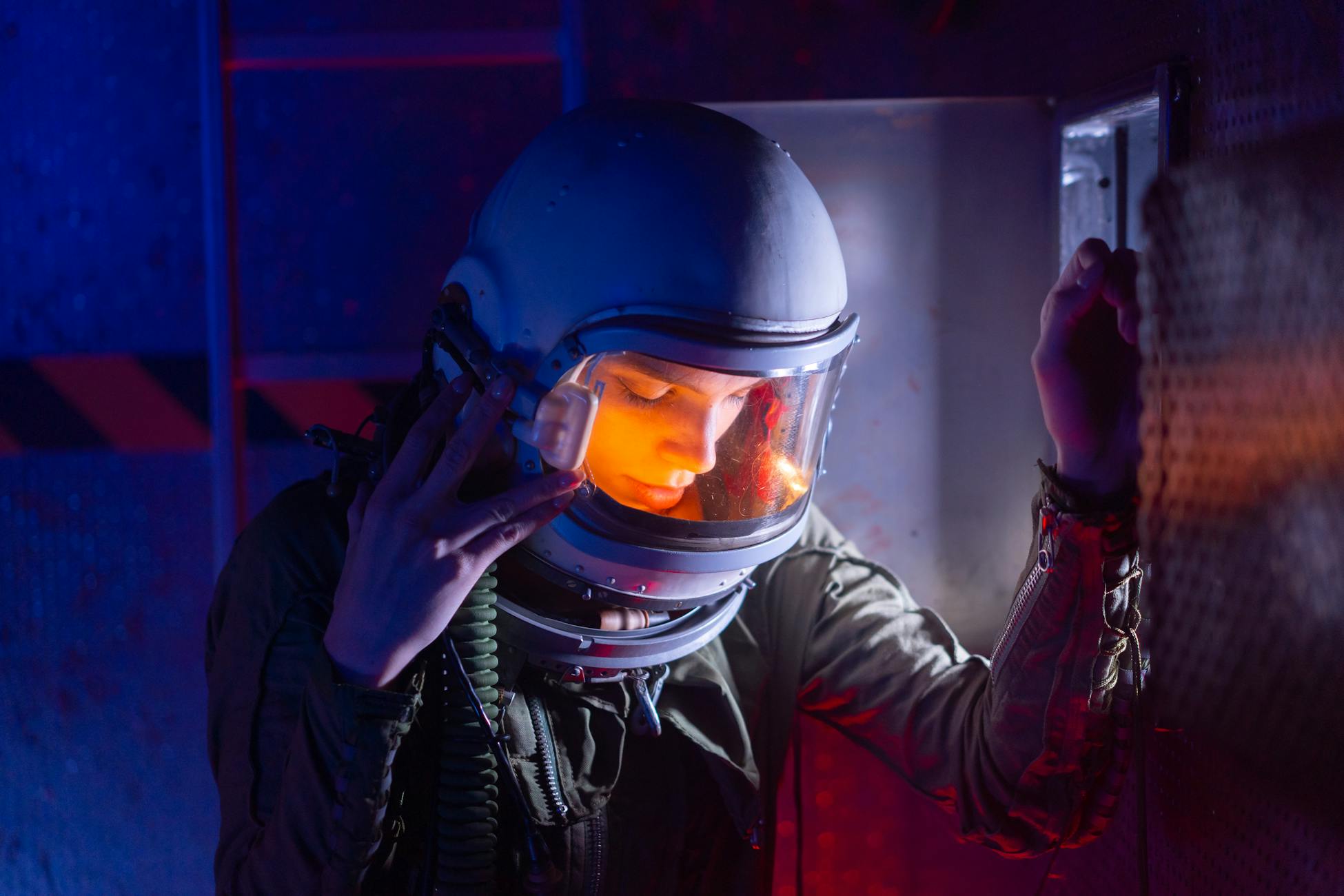
Astronauts have described watching a sunrise from the cupola of the International Space Station, and then, before finishing their coffee, watching another one. This is not poetic exaggeration. The ISS completes an orbit of Earth roughly every ninety-two minutes, which means the crew inside it sees, on average, sixteen sunrises and sixteen sunsets every twenty-four hours. The sun does not set in the way it sets over a kitchen window. It guillotines behind the curve of the planet in about ten seconds, throws the cabin into a sharp, theatrical darkness, and then comes back forty-five minutes later as if nothing had happened.
The popular framing goes like this: astronauts on the ISS live in a kind of zero-gravity wonderland where the rules of ordinary life are gently suspended. That framing is approximately right in its emotional effect and badly incomplete in its procedural reality. The rules are not suspended. They have been painstakingly engineered, debated by committees, written into operations manuals, and renegotiated every time a new crew member arrives carrying a different religion, a different chronotype, or a birthday that falls during a spacewalk.
The clock that nobody on Earth uses
The ISS does not run on local time, because there is no local. It runs on Coordinated Universal Time — the same timezone used by air traffic controllers and the Royal Observatory in Greenwich — and every crew member, regardless of whether they launched from Kazakhstan, Florida, or Tanegashima, synchronizes their day to that single reference. The crew follows a structured daily schedule with designated wake times, work periods, and sleep periods. Between those bookends, the crew works a roughly twelve-hour day broken into blocks: exercise, science, maintenance, meals, a daily planning conference, and a small window of personal time.
That sentence sounds like ordinary office scheduling. It is, in fact, the only thing standing between the crew and physiological collapse. Human beings did not evolve for a ninety-minute light-dark cycle. The human body evolved for one cycle in twenty-four hours, governed by a master clock in the suprachiasmatic nucleus of the hypothalamus that takes its cues from sunlight hitting the retina. Drop that system into sixteen sunrises a day and it does not adapt — it fragments. Melatonin secretion becomes erratic, core body temperature drifts, cortisol patterns flatten, and the cognitive effects show up within days. Researchers at Washington State University have spent years developing rapid melatonin tests for astronauts precisely because the standard clinical assays take too long to be useful in orbit, and the crew needs near-real-time data on whether their circadian system is still tracking the artificial day the station is imposing on them.
To compensate, the station’s lighting system is not lighting in the ordinary sense. It is pharmacology delivered through LEDs. Advanced lighting systems installed across the US segment can adjust their output across the day — bluer, more alerting wavelengths in the morning, warmer and dimmer light in the evening — to simulate the dawn-to-dusk gradient the human body expects. The crew is, in effect, taking a daily prescription of photons. The principle is the same one Harvard Business Review has been describing for terrestrial workplaces, where managers are now being told to design schedules around the team’s circadian rhythms rather than against them. On the ISS the stakes are not productivity. They are whether the person operating the robotic arm has had enough deep sleep to dock a cargo vehicle without making an error.
Sleep in a closet, strapped to a wall
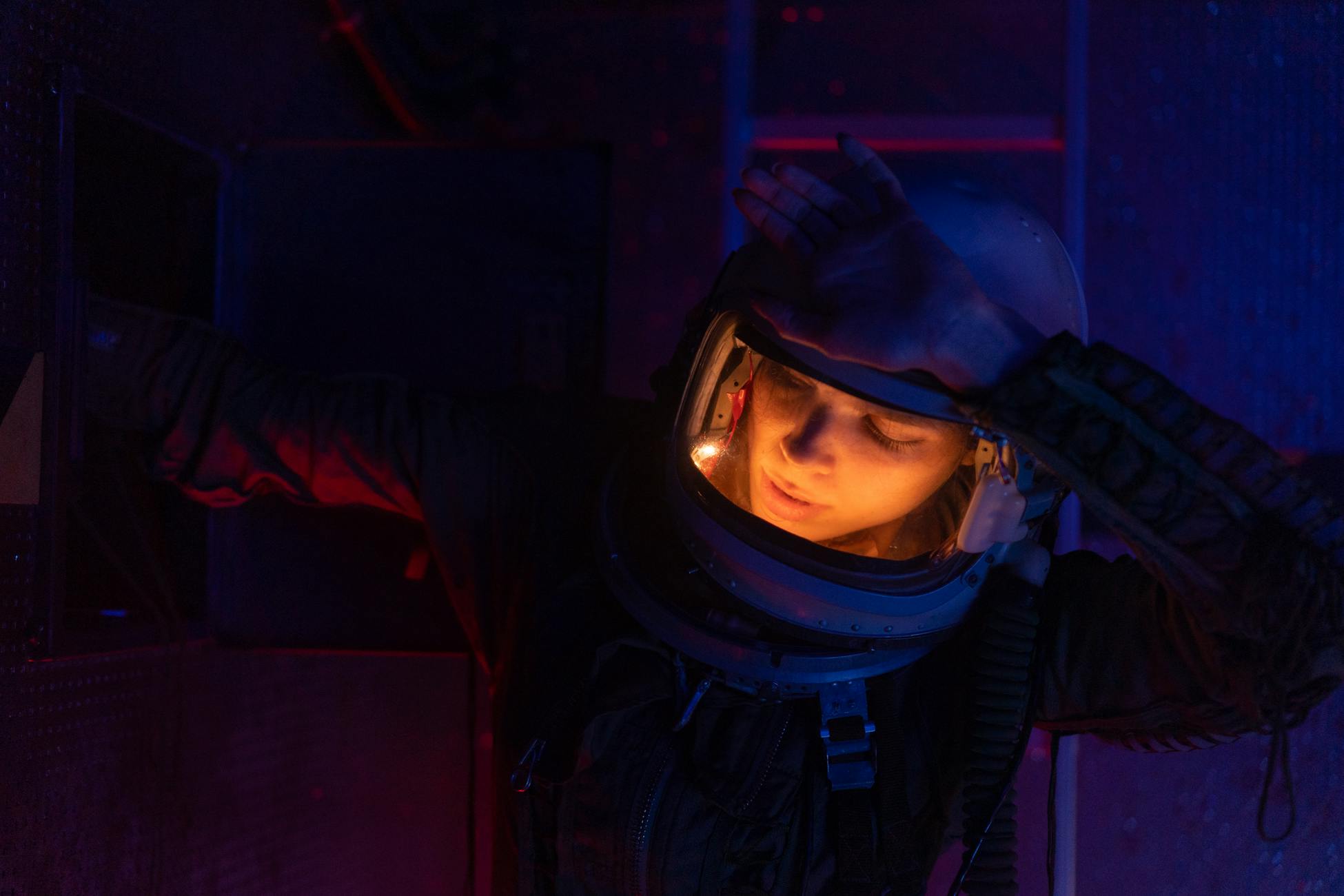
Sleep itself is its own engineering problem. Each ISS crew member has a private sleep station roughly the size of a phone booth, fitted with a sleeping bag tethered to the wall, a laptop, ventilation, and a door that closes. The tethering is not decorative. In microgravity, an unrestrained sleeping body will drift into equipment, into other crew members, or into the path of the CO2 the body itself is exhaling — a pocket of stale air that pools around the sleeper’s face because there is no convection to carry it away. The ventilation fan inside each crew quarters exists primarily to prevent the sleeper from slowly suffocating in their own breath.
Even with all this, astronauts typically get less sleep in orbit than the seven to nine hours most adults need. The deficit compounds. Psychology Today has documented at length how sleep loss degrades cognitive performance in ways that test subjects consistently underestimate in themselves — and astronauts are, on this measure, ordinary humans. Crew members frequently report that they thought they were performing fine, only to look at ground-team data showing reaction times slipping by the second week of a mission. Writers on this site have explored the sleep protocols NASA has developed in response, which include strict light-discipline rules, caffeine timing windows, and sometimes prescribed melatonin at calibrated doses.
The Mecca problem
Prayer is where the philosophical problems get sharper. In 2007, Malaysian astronaut Sheikh Muszaphar Shukor flew to the ISS during Ramadan. He was a practicing Muslim. The five daily prayers are tied to the position of the sun. Fasting begins at dawn and ends at sunset. The qibla — the direction of prayer — points toward the Kaaba in Mecca. None of these instructions translate cleanly to a vehicle moving at 17,500 miles per hour through sixteen sunrises a day, in which “down” is whichever direction the astronaut’s feet happen to be pointing.
Malaysia’s National Fatwa Council convened Islamic scholars and scientists and produced a guidance document with guidelines for performing Islamic rites at the International Space Station. The ruling was elegant and practical. Times of prayer would follow the timezone of the launch site, not the orbital cycle. The qibla would be determined by best effort, in descending order of priority: toward the Kaaba, then toward Earth, then anywhere — the intention mattered more than the geometry. Fasting could be observed according to the launch-site clock or deferred until return. The crew member could pray sitting or even tethered, with motions adapted to microgravity.
The Russian Orthodox Church has produced quieter, less codified guidance for cosmonauts who want to observe feast days. Jewish astronauts have wrestled with the Sabbath: if it begins at sunset, which of the sixteen sunsets counts? The accepted approach, used by Ilan Ramon on STS-107 in 2003, is again to follow the launch-site timezone — in his case, Cape Canaveral local time — as a kind of legal fiction that lets ordinary religious practice continue without recalibrating ancient law for orbital mechanics.

Birthdays, holidays, and the small rebellions of cake
Birthdays are the easiest problem and also the most revealing one. The crew can simply pick a moment in the UTC day and call it the birthday. Cargo vehicles have been known to carry small wrapped gifts, occasionally a rehydratable cake-like item, and the crew gathers in the Unity node for a brief, weightless rendition of the song. Christmas, Hanukkah, Diwali, Lunar New Year, and Cosmonautics Day are all observed on roughly the right calendar date, with decorations that have to be approved for flammability and Velcroed to the walls because they would otherwise drift into air filters.
What is interesting is not that the crew celebrates. It is that they insist on it. Mission planners initially treated festivities as a nice-to-have, a morale extra. What flight surgeons noticed over twenty-five years of continuous habitation is that the rituals are load-bearing. They are how the crew maintains the felt sense that one’s life is moving through meaningful intervals rather than dissolving into undifferentiated duration. Without the markers, six months in orbit becomes a single long Tuesday. With them, it becomes a life.
The body that refuses to forget the planet
The deeper problem is that the body keeps a clock the mind cannot override. Even with engineered lighting, scheduled meals, and a UTC calendar, the crew’s physiology drifts. New research funded by the Fred Hutchinson Cancer Center is now looking at whether chronic circadian disruption may have downstream health consequences including elevated cancer risk, which raises uncomfortable questions for any agency planning multi-year missions to Mars, where the day is twenty-four hours and thirty-seven minutes — close enough to Earth’s to feel familiar, different enough to slowly desynchronize a crew over the course of a two-year stay.
Returning crew members describe a strange aftermath. When astronauts come home from months in orbit, recovery teams put them in chairs before they walk, but the disorientation is not only vestibular. It is temporal. They describe sunsets that feel impossibly slow, days that seem to extend past any reasonable length, a strange grief at how few sunrises a person on Earth gets to see. There is also the relativistic footnote that Scott Kelly returned five milliseconds younger than his twin, which is the technically correct way of saying that even the seconds themselves were a slightly different length up there.
What the station has actually proved
Twenty-five years of continuous human habitation aboard the ISS has demonstrated, among many other things, a quieter point that rarely gets covered. Human beings cannot live in raw orbital time. The species can survive in microgravity and adapt to recycled air, freeze-dried food, and a workplace where the bathroom is a vacuum tube. What humans cannot do is dispense with the structures — the day, the week, the prayer, the birthday — that humanity built to make time feel like a place rather than a current.
Every space agency that has sent humans to orbit has discovered the same thing in roughly the same order. First they tried to ignore the problem. Then they engineered the lighting. Then they negotiated with theologians. Then they remembered the cake. The station that travels at 17,500 miles per hour through sixteen sunrises a day is held together, in the end, by a Greenwich clock, a few LED panels tuned to a wavelength the body recognizes as morning, and a small group of people who agreed in advance that today, regardless of what the windows say, is Wednesday.
