
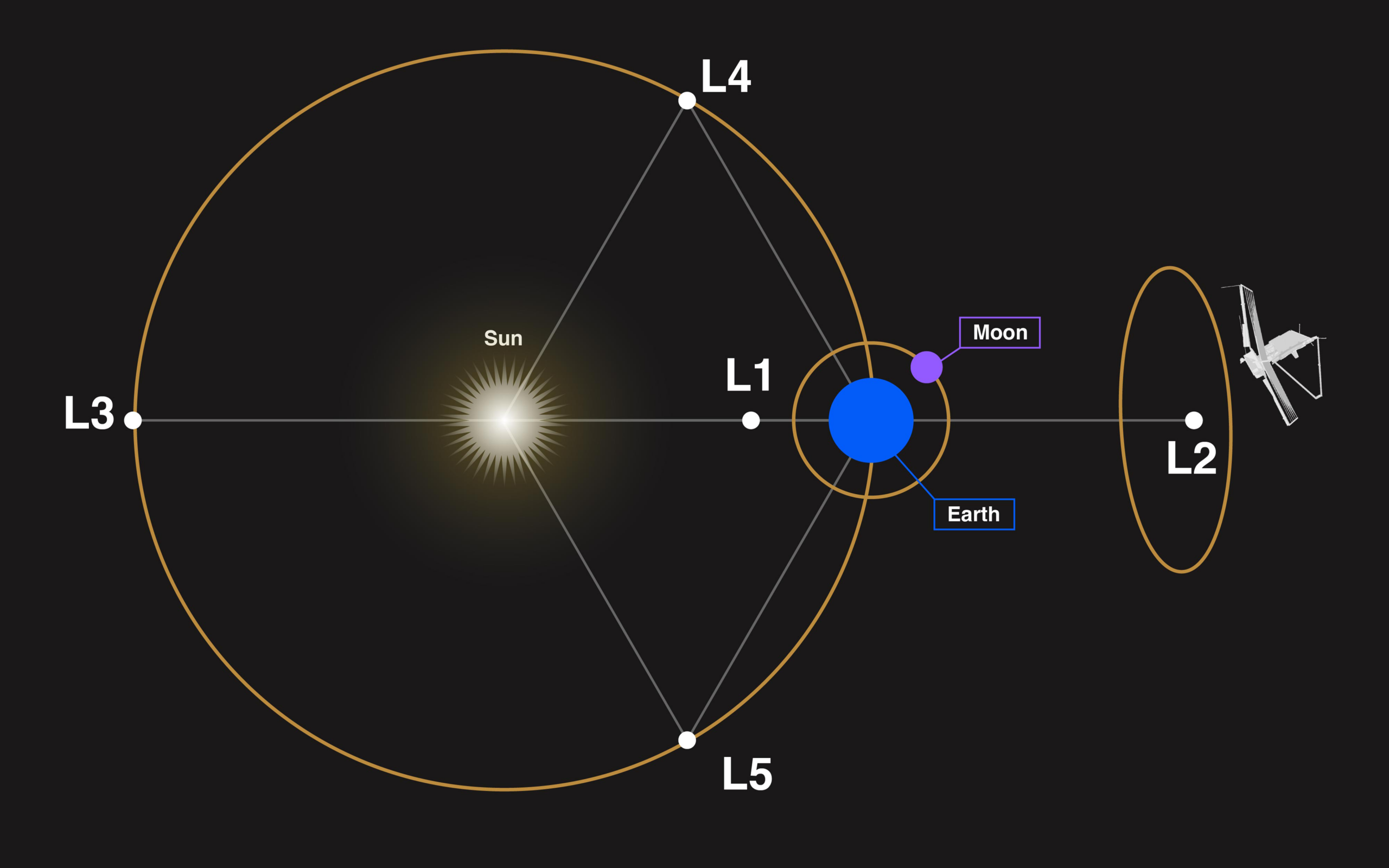
The James Webb Space Telescope operates from a halo orbit around the Sun-Earth L2 point, roughly 1.5 million kilometres from Earth, and runs on about one kilowatt of power. Many household electric kettles draw more than that.
The kilowatt figure comes from NASA’s own descriptions of the observatory’s electrical power subsystem. The solar array is sized at close to two kilowatts to allow for degradation over the life of the mission, but the spacecraft itself, including the four science instruments, communications, propulsion, and thermal management, runs on roughly one. The largest space telescope ever flown does its work on less electricity than it takes to boil water for breakfast.
None of this would have mattered if the deployment had not worked. According to Mike Menzel, Webb’s lead mission systems engineer at NASA’s Goddard Space Flight Center, the observatory launched with 344 single-point failures on its books. A single-point failure is engineering shorthand for a component or step where one mistake compromises the mission. Approximately 80 per cent of those 344 items were tied to the post-launch deployment sequence.
What the 344 actually counted
The number was not a rough estimate. NASA and Northrop Grumman, Webb’s prime contractor, maintained a working list of every mechanism, release, hinge, motor, cable, and pulley whose failure would compromise the mission. According to contemporary reporting from Spaceflight Now, the deployment sequence relied on roughly 140 release mechanisms, 70 hinge assemblies, eight deployment motors, 400 pulleys, and around a quarter of a mile of cable. The primary mirror alone had 178 release devices. The five-layer sunshield required 107 membrane release devices, each a non-explosive actuator that pinned the kapton layers in place for launch.
According to Scott Willoughby, Northrop Grumman’s Webb programme manager, the sunshield’s release count had been higher in earlier designs. The team brought it down from 109 to 107 over years of iteration. Every device on that final list had to work in deep space, with no realistic servicing option if the deployment failed.
The sunshield was the unforgiving part
The sunshield is the part of Webb most often described as the hardest to engineer. It is roughly 21 metres by 14 metres, about the footprint of a tennis court, and is made of five separated layers of kapton with aluminium and silicon coatings. The first layer is 50 microns thick. The other four are 25 microns. The whole structure folds origami-style for launch and unfolds, separates, and tensions over roughly a week in space.
Tensioning is the step that introduces real interaction risk between cables, pulleys, motors, and membrane. James Cooper, NASA’s Webb sunshield manager at Goddard, described tensioning at the time as the hardest part of the deployment to test on the ground, because the complex interactions between structures, mechanisms, cables, and membranes do not behave the same way in 1 g as they do in deep space.
All 107 release devices fired. All five layers tensioned. The sunshield reached its final configuration on 4 January 2022, ten days after launch. Bill Ochs, then JWST project manager, told reporters that completion of the sunshield retired between 70 and 75 per cent of the 344 single-point failures on the original list.
Power and distance forced the design choices
The reason the deployment had to work the first time is geography. L2 sits roughly 1.5 million kilometres from Earth, about four times the Earth-Moon distance. No servicing mission was available for Webb at L2, unlike Hubble in low Earth orbit, which the Space Shuttle visited five times before being retired in 2011.
The kilowatt power budget is a function of the same constraint. Webb’s instruments run cold, with the coldest detector temperatures around 7 kelvin on MIRI and roughly 40 kelvin across the rest of the optical assembly. Most of that cooling is achieved passively, through the sunshield, rather than through power-hungry mechanical cryocoolers. Passive cooling does not draw electricity. The result is a spacecraft that can observe, store, and downlink science data on roughly the same draw as a domestic appliance.
What was retired, what remains
According to NASA briefings and STScI status reporting, deployment completion retired 295 of the original 344 single-point failures. The remaining 49 are items common to most spacecraft, such as the propulsion system, and will sit on the list for the rest of the mission. The 155 motors on the backs of the 18 hexagonal primary mirror segments, which align the optics, were each tested individually after deployment.
Every one worked.
The sunshield, the size of a tennis court, was folded for launch and unfurled in deep space. Eighteen hexagonal mirror segments are now aligned by 155 small motors operating in the cold. The whole observatory runs on about a kilowatt of power, 1.5 million kilometres from Earth, returning infrared images no other telescope has been able to produce.
