

The brain is supposed to go quiet when it dies. That is the assumption baked into a century of clinical practice, the framework that lets hospitals declare neurological death, and the intuition that makes flatline the universal cinematic shorthand for the end. The brain is also, in some measurable percentage of dying patients, doing the opposite — generating a coordinated surge of gamma wave activity at frequencies and amplitudes that exceed anything those same instruments record in healthy, conscious adults.
That sentence sounds like folklore. It is, in fact, supported by EEG recordings made on patients in the minutes after cardiac arrest, as well as corroborated rodent work. The signal is real. The instrumentation is standard. The interpretation is where the science genuinely runs out of road.
The popular framing goes like this: the dying brain produces a final blaze of consciousness, possibly the neural correlate of the “life review” reported in near-death testimony, possibly evidence that something escapes the body at the moment of death. That framing is approximately right in its emotional effect and almost entirely unsupported in its mechanistic claims. What the recordings show is electrical. What the person experienced, if anything, is a question no instrument has yet been built to answer.
What the recordings actually captured
Rodent studies have used anesthetized rats and recorded continuously through cardiac arrest. Within the first minute of the heart stopping, the animals’ EEG traces showed a transient but powerful increase in gamma-band oscillations, the 25 to 140 hertz frequencies associated in waking brains with conscious perception, attention, and the binding of disparate sensory information into a unified experience. Cross-frequency coupling, a marker of organized cortical communication, rose above waking baseline. So did feedback connectivity from front to back of the cortex, one of the signatures neuroscientists treat as a fingerprint of conscious processing.
Human studies have examined comatose patients removed from life support after the families consented to continued EEG monitoring. Some patients showed gamma surges in the seconds and minutes after cardiopulmonary collapse while others did not. Those who did showed patterns that matched the rodent data closely enough to suggest a reproducible phenomenon rather than an artifact.
The part of the story worth slowing down on is the magnitude. Gamma activity in a healthy, attentive adult sits at amplitudes the EEG technician has learned to identify as a faint, fast ripple on top of slower waves. In the dying brains that produce the surge, gamma can briefly rise to levels several times that baseline, with coordination across cortical regions that would be unusual at any point in a normal waking day. The brain, in the act of losing its oxygen supply, is for a window of seconds doing something it does not do when fully alive.
Why oxygen starvation might produce its opposite
The leading mechanistic guess, and it is a guess, is that the gamma surge is a consequence of the brain’s chemistry collapsing all at once. When oxygen stops arriving, neurons lose the ability to maintain the ion gradients that keep them at rest. Potassium leaks out. Glutamate, the primary excitatory neurotransmitter, floods the synapses. The inhibitory networks that normally damp cortical activity fail first, because they are the most metabolically expensive to run. What remains, for a brief interval before complete cellular failure, is a brain that has lost its brakes.
That is one model. It accounts for the timing, the high frequencies, and the synchrony. It does not explain why some patients show it and others do not, why the rodent data is more consistent than the human data, or whether the activity represents anything the dying person perceives. The working assumption that organized gamma activity reflects consciousness is itself contested in neuroscience. Questions about whether neural correlates of consciousness can be identified at all remain central to the field, and the question of whether the brain even generates subjective experience in the way the standard model assumes remains genuinely open.
So the inferential chain runs: gamma activity is associated with consciousness in waking brains, the dying brain produces intense gamma activity, therefore the dying brain may be conscious. Each link in that chain is defensible. Stacked together, they are an argument, not a finding.
The near-death experience problem
Patients who survive cardiac arrest sometimes report experiences during the period when their hearts and brains were, by clinical measures, not functioning. The reports are remarkably consistent across cultures: a sense of detachment from the body, movement through a tunnel or toward light, encounters with deceased relatives, a review of life events, an absence of pain. The phenomenon has been studied for fifty years and remains a contested area of consciousness research, with serious scientists on multiple sides of the question.
The temptation, once the gamma surge was documented, was immediate: here, finally, is the neural signature of the near-death experience. The brain produces a final burst of organized activity, the dying person perceives the canonical sequence of imagery and emotion, and the mystery resolves into physiology.
The temptation is also where careful researchers have urged the most caution. The patients whose dying brains have been recorded did not survive to report anything. The rats did not report anything. The correlation between gamma activity and the subjective content of near-death testimony is, at present, entirely inferential. The literature on near-death experiences is also genuinely uneven in its methodological rigor, with strong empirical work sitting alongside material driven more by commercial or ideological pressure than by data.
What can be said honestly is this: there is a documented electrical event in some dying brains, and there is a documented body of subjective testimony from some survivors. Whether the first explains the second is a hypothesis. Treating it as an established connection is where popular science writing routinely overshoots what the evidence supports.
What the instruments can and cannot see
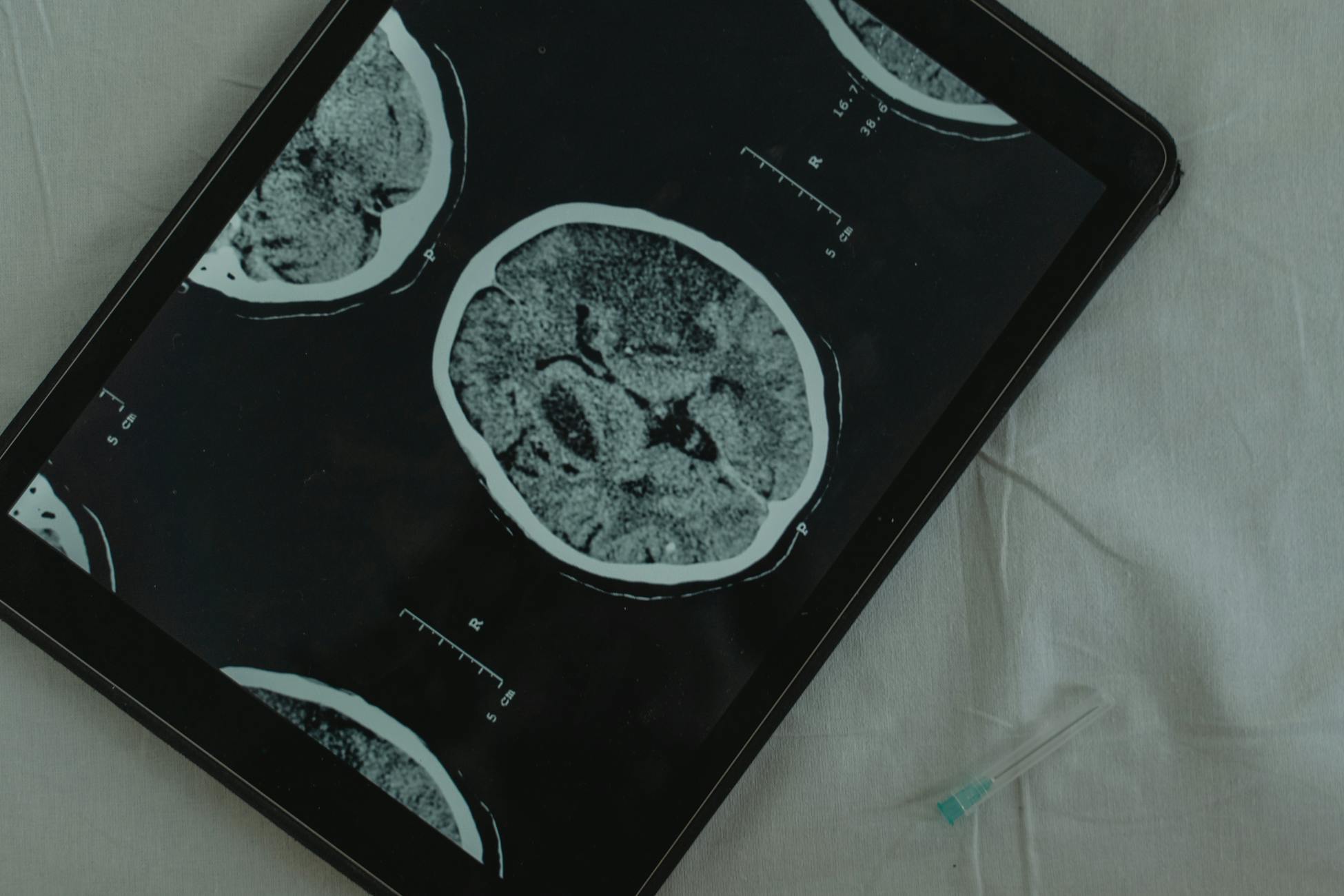
EEG measures the summed electrical activity of large populations of cortical neurons firing in rough synchrony. It is excellent at detecting oscillations and timing. It is poor at localizing activity to specific structures, and it sees almost nothing of what happens in deeper brain regions, including the thalamus, brainstem, and hippocampus. The dying brain is doing many things at once. Most of those things are invisible to the scalp electrodes that produced the recordings.
Scalp EEG captures activity from roughly the outer few millimeters of cortex, and only when populations of neurons are large enough and synchronized enough to produce a signal that survives the dampening effect of the skull. A great deal of organized neural activity could be happening during the gamma surge that the recording would not register. A great deal of disorganized activity could also be happening that the recording would not register. The instrument is showing one slice of what the dying brain is doing, and the slice is biased toward exactly the kind of large-scale synchronized oscillation that the gamma surge represents.
This matters because the “the brain lights up at death” framing implies a more complete picture than the data supports. What the data shows is that a particular kind of activity, measured by a particular kind of instrument, in a particular subset of dying patients, exceeds the levels seen in those same patients while alive. Whether that activity represents heightened consciousness, terminal seizure-like discharge, the mechanical consequence of metabolic collapse, or something else entirely is the question the research has not answered.
Why this remains unsettled
The methodological obstacles are severe. Recording EEG during natural death requires the patient to already be instrumented, which essentially restricts the data to ICU patients on continuous monitoring whose families have consented to the recording continuing through withdrawal of life support. The sample sizes are tiny. The patients are by definition atypical — gravely ill, often with neurological injury, frequently on medications that affect cortical activity. Generalizing from the small number of documented cases to any claim about what happens in human dying generally requires more humility than most coverage of the work has shown.
Adjacent neuroscience is moving fast on related questions. Recent work using brain organoids grown from human cells has begun to give researchers access to neural tissue under conditions that no in vivo experiment could ethically permit, and laboratory-grown mini brains have already produced electrical signatures distinctive enough to distinguish psychiatric conditions. None of that work has yet been turned on the question of what happens to coordinated cortical activity when oxygen is withdrawn, but the technical tools to ask the question in controlled settings are arriving.
The cultural conversation around death is also shifting in ways that may make this research easier to fund and conduct, reflecting a broader willingness in mainstream journalism and medicine to treat dying as a process worth studying empirically rather than as a moment to be managed and then turned away from.
The honest summary
A coordinated gamma burst has been recorded in the dying brains of some humans and some rats, at amplitudes and frequencies that exceed the waking baseline of those same brains. The activity is reproducible enough to count as a phenomenon, not an artifact. Its function, if it has one, is unknown. Its relationship to subjective experience, if any, is unknown. Its relationship to the testimony of near-death survivors is hypothesized but not demonstrated.
This is the kind of finding that resists the closing paragraph science journalism usually wants to provide. The neurons are doing something. The instruments are detecting it. The person inside the brain, if there is anyone there at all in that final window, has not yet found a way to communicate what they saw. The version of the body that was alive seven seconds earlier is, in a literal physical sense, already on its way to becoming something else. What rides that wave of gamma activity, or whether anything rides it at all, is a question the recordings open and do not close.
